



Stock Introduction & Thesis
Taiwan Semiconductor Manufacturing Company (NYSE: TSM) has delivered another powerful earnings report, but the investment question is changing. Investors must judge whether today’s exceptional profits can fund tomorrow’s factories without weakening returns. Its October 15 results show substantial demand for advanced chips, alongside the initial margin pressure from a major technology transition.
TSMC operates a dedicated foundry: customers design semiconductors, while TSMC manufactures them and supplies related technology and packaging services. That business model gives shareholders exposure to multiple chip designers rather than requiring a prediction about which artificial-intelligence product will win. Its manufacturing expertise, customer relationships and enormous investment requirements create meaningful barriers to entry. TSMC’s company profile describes the breadth of this customer ecosystem.
The latest numbers reinforce that positioning. High-performance computing represented 68% of third-quarter revenue, versus 57% a year earlier. However, this category includes more than AI accelerators, so it should not be treated as a pure AI revenue measure. Smartphones still contributed 21%, preserving exposure to a more cyclical consumer market.
The thesis is therefore conditional: advanced-node demand can support durable earnings growth, but the stock’s attractiveness depends on valuation, cash conversion and successful capacity expansion. This analysis uses disclosures available by October 20, 2026, not a guarantee that current growth will persist.
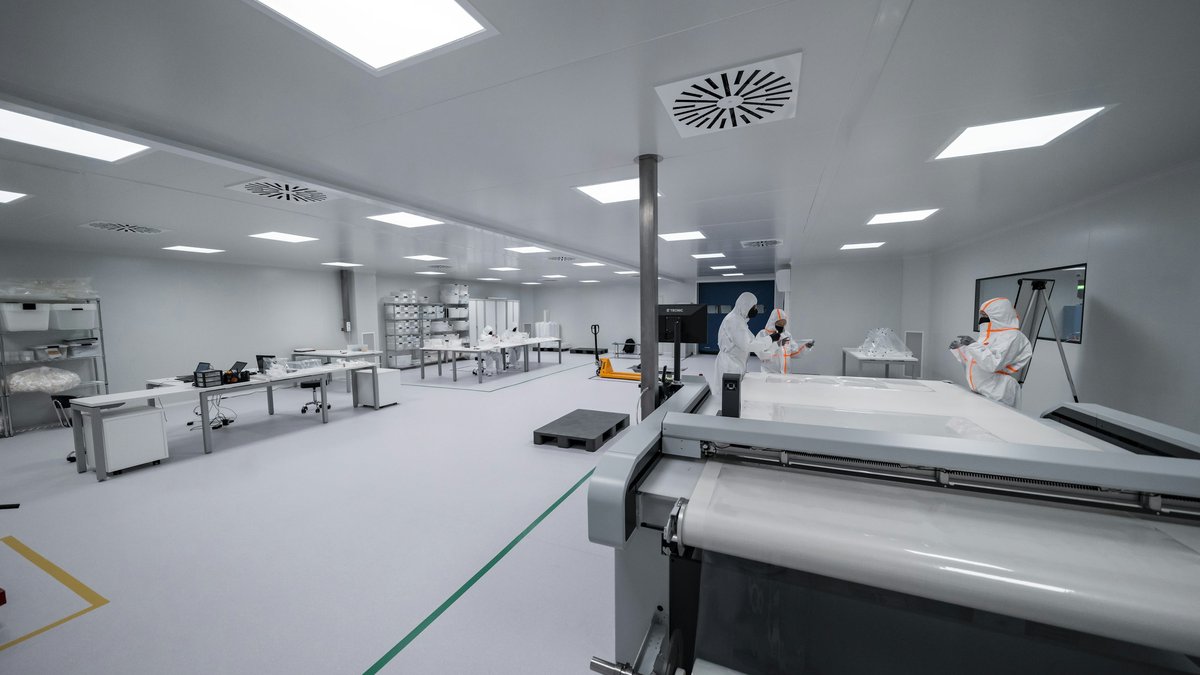
Photo: TECNIC Bioprocess Solutions / Unsplash. Contextual cleanroom imagery; not a TSMC facility.
Recent Developments & Catalysts
Third-quarter revenue reached $46.72 billion, above management’s previous $44.6 billion–$45.8 billion forecast. The result exceeded the upper boundary by approximately 2.0%. Revenue rose 41.2% year over year in U.S. dollars and 50.9% in Taiwan dollars. Those growth rates differ because of currency translation; mixing them would overstate or understate underlying comparisons. The official earnings release provides both bases.
The next catalyst is fourth-quarter execution. Management guided revenue to $52.3 billion–$54.3 billion. The $53.3 billion midpoint implies approximately 14.1% sequential growth. It also expects full-year dollar revenue growth around 44%, according to the October earnings call. These are forward-looking company expectations, not reported results.
The 2-nanometer transition is especially important. This technology generated 8% of wafer revenue, up from 3% in the second quarter. Management expects annual capacity for its N2 technology family to more than double in 2027. Smaller process generations can improve customers’ computing efficiency, but manufacturing ramps initially carry additional costs.
Expansion also extends beyond Taiwan. Management expects Arizona’s second fab to begin volume production in the third quarter of 2027 and Japan’s second fab in 2028. Meanwhile, it retained a $60 billion–$64 billion capital budget for 2026. These projects increase supply and geographic diversification, but introduce execution and cost risks.
Investment implications: Strong guidance supports the growth thesis, yet investors should distinguish new demand from capacity that has not entered production. The decisive evidence will be quarterly shipments, N2 adoption and margins, rather than expansion announcements alone. Customer commitments must ultimately translate into profitable production and cash receipts.
Financial Analysis
Third-quarter net income attributable to shareholders reached NT$763.06 billion, rising 68.7% year over year. Diluted earnings were NT$29.43 per ordinary share, or $4.60 per American depositary receipt. Each ADR represents five ordinary shares; confusing the two share units would materially distort valuation. The figures follow Taiwan’s financial reporting standards and are not adjusted earnings.
Profitability remained exceptional but softened sequentially. Gross margin declined from 67.7% to 66.4%, while operating margin fell from 60.3% to 58.7%. TSMC attributed the gross-margin decline primarily to the initial N2 ramp. Net income grew only 8.0% sequentially despite 17.6% Taiwan-dollar revenue growth, partly because the second quarter included investment-related gains that did not recur. The quarterly management report explains this comparison.
Cash generation offers a useful second test. Operating cash flow was NT$919.77 billion against NT$443.21 billion of capital expenditure. Their difference, TSMC’s company-defined free cash flow, was NT$476.56 billion: approximately 31.9% of revenue and 62.5% of shareholder net income. The measure excludes interest classified outside operating cash flow and should not be confused with fully post-interest cash available to equity holders.
Balance-sheet capacity is substantial. Cash and marketable securities totaled NT$4.02 trillion against NT$1.03 trillion of interest-bearing debt. This liquidity provides flexibility during expansion, although securities are not identical to cash and future construction commitments still matter.
Investment implications: Earnings quality looks strong, but the margin decline deserves monitoring. Persistent cash generation after capital spending would support the thesis more convincingly than headline profit growth alone. Comparing successive quarters helps separate temporary ramp costs from structural pressure.
Photo: Kevin Ache / Unsplash. Contextual computing infrastructure; not a TSMC facility.
Valuation & Competitive Position
At Yahoo Finance’s October 19 closing price of $420.22, TSM trades at approximately 27.0 times trailing reported ADR earnings. The $15.54 denominator combines fourth-quarter 2025 earnings with nine-month 2026 earnings; differing period exchange rates make this an approximation.
A StockAnalysis/S&P Global forecast implies a 0.38 PEG proxy: 24.89 times fiscal-2026 adjusted earnings divided by 66.24% expected adjusted EPS growth. That estimate already includes nine months of actuals. It is not a fiscal-2027 PEG or evidence that exceptional growth is sustainable.
The primary valuation approach is an illustrative earnings-multiple model. Annualizing third-quarter ADR earnings gives $18.40, not a forecast. Twelve-month bear, base and bull scenarios assume respectively flat, 15% and 30% growth from that anchor, valued at 18, 22 and 26 times earnings. Resulting price scenarios are approximately $331, $466 and $622. These assumptions discount today’s trailing multiple for execution risk; they are not analyst consensus targets. Sensitivity: $21.16 EPS at 18–26 times yields $381–$550; $18.40–$23.92 EPS at 22 times yields $405–$526.
As a cash-generation cross-check, trailing company-defined free cash flow implies approximately a 2.1% yield at this ADR price, translating Taiwan-dollar cash flow at September’s closing exchange rate. That relatively low yield cautions against calling the stock an obvious bargain.
Investment implications: Manufacturing scale and customer trust support a premium, but Samsung and Intel remain competitors. Both earnings delivery and the multiple investors pay determine returns; faster growth alone does not remove valuation risk.
Risks & Outlook
The largest unquantifiable risk remains Taiwan-related geopolitical disruption. Overseas factories diversify production but do not eliminate exposure to Taiwan’s infrastructure, technical ecosystem or cross-strait tensions. Export restrictions and changing trade policies can also alter customer demand and manufacturing economics.
The financial risks are more measurable. Management expects overseas expansion to dilute gross margin by roughly two percentage points in 2026 and three to four points over the next few years. N2 ramp costs add pressure. At the same time, AI customers may delay spending if data-center power, financing or project construction becomes constrained.
Reuters’ earnings coverage highlighted management’s cautious planning for 2027 despite robust advanced-chip demand. Consumer weakness should not be ignored simply because AI orders remain strong.
The outlook is constructive, not unconditional. Watch fourth-quarter delivery against guidance, N2 capacity utilization and cash flow after investment. A sustained margin deterioration, weaker customer commitments or shrinking post-investment cash generation would undermine the thesis even if reported revenue continued growing.
Disclaimer: This analysis is for informational and educational purposes only and should not be considered financial advice. Individual stock investments carry significant risks including company-specific and market risks. Always conduct your own research and consult with a qualified financial advisor before making investment decisions.