



Market Overview
U.S. stocks enter Friday, November 13, after a volatile Thursday session that exposed two competing risks: disruption at the center of the artificial intelligence trade and renewed inflation pressure from energy. This report uses the November 12 U.S. close and overseas reporting available around 4:05 a.m. Eastern; Friday’s American cash session has not begun.
The S&P 500 fell 0.35% to 7,592.40, losing 26.98 points. The Dow Jones Industrial Average declined 0.36% to 52,297.09, down 189.40 points, while the Nasdaq Composite slipped 0.39% to 25,366.09, shedding 100.10 points. Small companies faced greater pressure: Yahoo Finance’s dated closing record put the Russell 2000 at 2,799.06, down 1.66%, or 47.20 points. These are completed-session figures, not premarket quotes.
The major benchmarks traded on both sides of unchanged before finishing lower. Semiconductor shares were divided rather than uniformly weak: Nvidia’s decline contrasted with substantial gains at AMD and Broadcom, while the Philadelphia semiconductor index lost 0.5%. Energy benefited from rising crude prices, but that same move complicated the outlook for consumer spending and interest rates.
Sentiment remains cautious. Smaller stocks’ underperformance and higher Treasury yields suggest that buying selected technology alternatives is not the same as a broad return to risk-taking. The central question is whether resilient AI demand can offset leadership uncertainty and a more restrictive financing environment.
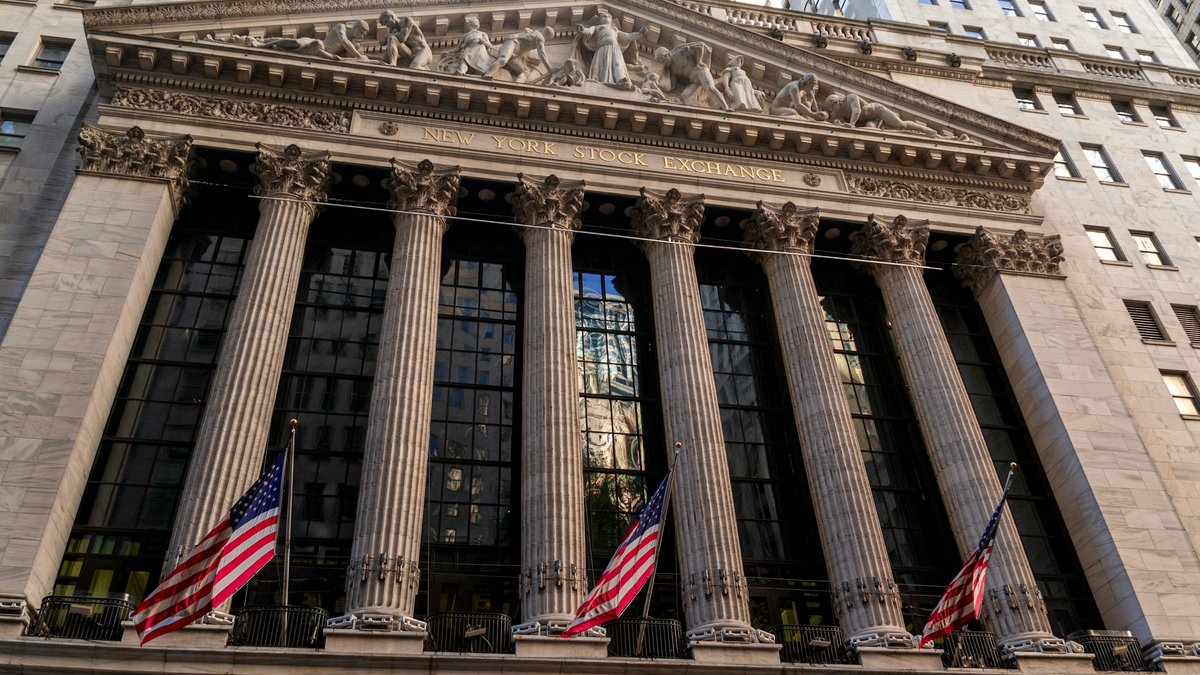
Photo: David Vives / Unsplash. Stock photograph.
Top Market Movers
Nvidia’s leadership change raises execution risk
Nvidia closed at $166.19, down 4.34%, a $7.54 decline from Wednesday’s $173.73 close. The company confirmed Jensen Huang’s immediate resignation and appointed finance chief Colette Kress interim CEO while searching for a permanent successor. Shares recovered considerably from their session low. The board said customer commitments and the product roadmap should continue without interruption; that remains management’s stated expectation, not a guarantee.
Investment implications: Leadership continuity now matters alongside earnings. Investors should distinguish the company’s operating performance from the additional uncertainty surrounding strategy, retention and succession, rather than treating a lower share price alone as proof of value.
AMD gains as investors reassess AI suppliers
AMD rose 5.86% to $585.30, up $32.40 from $552.90. Reuters reported that rival Broadcom also advanced 5.5%, as investors considered whether Nvidia’s upheaval might benefit competing chip suppliers. The divergence suggests that concern about one industry leader has not erased expectations for AI computing demand. It does not establish that competitors have already won additional contracts.
Investment implications: Diversifying supplier exposure may reduce company-specific risk, but anticipated market-share gains still need confirmation through orders, margins and customer adoption. A strong daily rally can price in benefits before they appear in financial results.
Oil’s rebound revives the inflation trade
Brent settled at $95.82 a barrel, up 3.3%, or $3.06. WTI finished at $88.74, up 2.55%, according to CNBC. Deteriorating prospects for an Iran agreement and renewed threats to regional energy infrastructure supported prices.
Investment implications: Producers may benefit, while fuel-intensive businesses and consumers face higher costs. Oil’s direction also matters for inflation expectations, making energy exposure an imperfect hedge against broader equity-market weakness.
Economic Data & Fed Watch
U.S. data showed resilient employment alongside weak housing and persistent inflation. Initial jobless claims rose 9,000 to a seasonally adjusted 200,000 in the week ended November 7. Continuing claims fell 20,000 to 1.697 million for the week ended October 31. October existing-home sales dropped 5.5% to a 3.75 million annualized pace, the lowest since August 2010.
October consumer prices, released Tuesday, increased 0.4% month on month after September’s 0.6%; core prices rose 0.3%. BLS could not publish headline or core annual inflation because October 2025 comparison data were unavailable following the government shutdown. Monthly changes should not be mistaken for annual inflation rates.
The Fed’s target range remains 3.75%–4.00%. New York Fed President John Williams said further action was needed to return inflation sustainably to 2%, without specifying timing or size. Cleveland Fed President Beth Hammack favored smaller, more frequent increases. These are policymakers’ views, not a newly announced committee decision.
Reuters’ Thursday market snapshot put the two-year Treasury yield at 4.867%, up 13.96 basis points, and the ten-year at 5.105%, up 11.58 basis points. The dollar index gained 0.3% to 103.18 as tightening expectations supported the currency.
Investment implications: Higher discount rates challenge long-duration equities and refinancing-sensitive borrowers. Resilient employment does not remove inflation risk; portfolios exposed to both growth stocks and long bonds may remain vulnerable to another rates repricing.
International Markets
Europe showed relative resilience on Thursday before weakening early Friday. The STOXX 600 closed November 12 at 664.01, up 0.14%, after touching a record 666.58. Reuters put it at 662.64, down 0.2%, at 8:08 a.m. UTC Friday. Technology shares lost 0.6% as Nvidia-related uncertainty traveled across markets, while slower sales growth weighed on luxury group Richemont.
CNBC’s Friday report recorded mixed Asian closes: Japan’s Nikkei 225 rose 0.53% to 61,142.35, but South Korea’s Kospi fell 0.98% to 5,290.53. China’s CSI 300 lost 0.68% to 4,016.29, and Australia’s ASX 200 declined 0.71% to 9,082.2. These are reported local-session closes, not synchronized live readings.
Currency markets remained sensitive to U.S. interest rates. Reuters quoted the dollar index at 103.18, up 0.9% for the week, with the euro around $1.1059 and the dollar near 159.89 yen. Yen levels close to 160 keep intervention risk in focus. For emerging economies, dollar strength and expensive imported energy can tighten financial conditions even without a domestic policy change.

Photo: Alev Takil / Unsplash. Stock photograph.
Looking Ahead
Friday’s immediate test is October producer prices at 8:30 a.m. Eastern. The release had not occurred at this report’s cutoff. Investors should watch whether wholesale-price pressure reinforces Tuesday’s consumer-price evidence, while avoiding conclusions drawn from the headline alone. Components relevant to subsequent inflation measures may matter as much as the overall monthly change.
Next week brings Empire State manufacturing on Monday, followed by Tuesday’s retail sales at 8:30 a.m. and industrial production at 9:15 a.m. Wednesday’s October FOMC minutes arrive at 2 p.m.; Thursday brings weekly jobless claims and the Philadelphia Fed manufacturing survey. All times are Eastern, and schedules remain subject to change.
Nvidia reports fiscal third-quarter 2027 earnings Tuesday, November 17, at approximately 4:20 p.m. Eastern, followed by its 5 p.m. call. Results, customer-demand commentary and the interim leadership team’s outlook will provide a concrete test of the AI investment narrative. Meanwhile, developments affecting Iranian negotiations or regional energy infrastructure could shift oil, bond yields and sector performance before the next scheduled release.
Sources
- Reuters: November 12 global closing wrap; CNBC: U.S. closing report.
- Yahoo Finance dated records: Russell 2000, Nvidia, AMD.
- Nvidia: leadership transition and earnings timing.
- DOL: weekly claims; NAR: October existing-home sales; BLS: October CPI.
- Fed: October policy statement; Reuters: Williams, Hammack.
- Reuters: European morning; CNBC: Asian sessions and U.S. futures; Reuters: currencies.
- Official calendars: BLS, New York Fed, Federal Reserve, Census retail.
Disclaimer: This analysis is for informational and educational purposes only and should not be considered financial advice. Market conditions can change rapidly, and past performance does not guarantee future results. Always conduct your own research and consult with a qualified financial advisor before making investment decisions.