




The U.S. economy closed out 2025 with a display of unexpected vigor, as a significant upward revision to third-quarter GDP painted a picture of robust growth. However, this economic strength was met with a dose of caution from the Federal Reserve, whose recently released December meeting minutes revealed deep divisions among policymakers regarding the future path of interest rates. This created a complex backdrop for investors, with resilient economic data seemingly at odds with a central bank that is growing more hesitant to continue its rate-cutting cycle. The past week's data also highlighted a persistent paradox in the labor market, where layoffs remain low but hiring has slowed considerably, and a disconnect between weak consumer sentiment and strong consumer spending. As we enter 2026, these conflicting signals suggest a period of heightened uncertainty and potential market volatility.
Deep Dive: Key Data Points
A closer examination of the past week's key economic releases reveals the crosscurrents shaping the current market environment. The data underscore a narrative of surprising economic resilience clashing with a more hawkish-than-expected Federal Reserve.
| Data Release | Period | Actual | Consensus | Previous |
| :— | :— | :— | :— | :— |
| **GDP (Q3 Final)** | Q3 2025 | 4.3% | 3.2% | 3.8% |
| **Initial Jobless Claims** | Dec 20 | 214,000 | 224,000 | 224,000 |
| **Pending Home Sales** | Nov 2025 | 3.3% | 1.0% | 2.4% |
| **Consumer Confidence** | Dec 2025 | 89.1 | 92.9 | 88.7 |
The most significant surprise was the final revision of third-quarter **Gross Domestic Product (GDP)**, which was revised up to a stellar 4.3% annualized growth rate. This marked the strongest pace of economic expansion in two years and was driven by robust consumer spending and a notable increase in business investment. The report suggests the economy carried significant momentum into the final quarter of 2025.
> **Investment Implications:** A stronger economy is generally positive for corporate earnings and equity valuations. However, this robust growth reduces the urgency for the Federal Reserve to cut interest rates, potentially creating a headwind for rate-sensitive sectors and growth stocks that have benefited from the prospect of lower borrowing costs.
Minutes from the **Federal Reserve's December 9-10 meeting** provided a critical, and somewhat unsettling, look into the central bank's thinking. The committee voted 9-3 to cut its benchmark rate by a quarter-point, but the minutes revealed the decision was “finely balanced.” A significant portion of the committee expressed concern that progress on inflation had stalled and indicated a preference to hold rates steady for some time. The median forecast from the accompanying Summary of Economic Projections pointed to just one more rate cut in all of 2026.
> **Investment Implications:** The hawkish tone of the minutes suggests that the bar for further rate cuts is high. Bond investors should prepare for a “higher for longer” interest rate environment, which favors locking in current yields. For equity investors, this signals a potential shift away from speculative growth toward quality companies with strong balance sheets and pricing power.
The **labor market** continued to present a paradoxical picture. Initial jobless claims fell to 214,000, better than the 224,000 expected, indicating that large-scale layoffs are not occurring. However, this stands in stark contrast to the very weak November jobs report, which showed only 64,000 new jobs were created. This divergence points to a labor market that is cooling through a slowdown in hiring rather than an increase in firings.
> **Investment Implications:** In this environment, investors should focus on companies with proven operational efficiency and the ability to grow revenue without relying on a booming labor market. A focus on quality over quantity in employment-related stocks is warranted.
Finally, the **housing market** showed surprising resilience. Pending home sales, a forward-looking indicator, jumped 3.3% in November, easily beating the 1.0% forecast. This, combined with a stronger-than-expected S&P Case-Shiller Home Price Index, suggests that the housing sector is holding up better than anticipated despite elevated mortgage rates.
> **Investment Implications:** The strength in housing could provide a tailwind for homebuilders, construction material suppliers, and related industries. However, with the Fed signaling a pause, mortgage rates are likely to remain elevated, which could cap the upside for the sector.
Fed Policy & Interest Rate Outlook
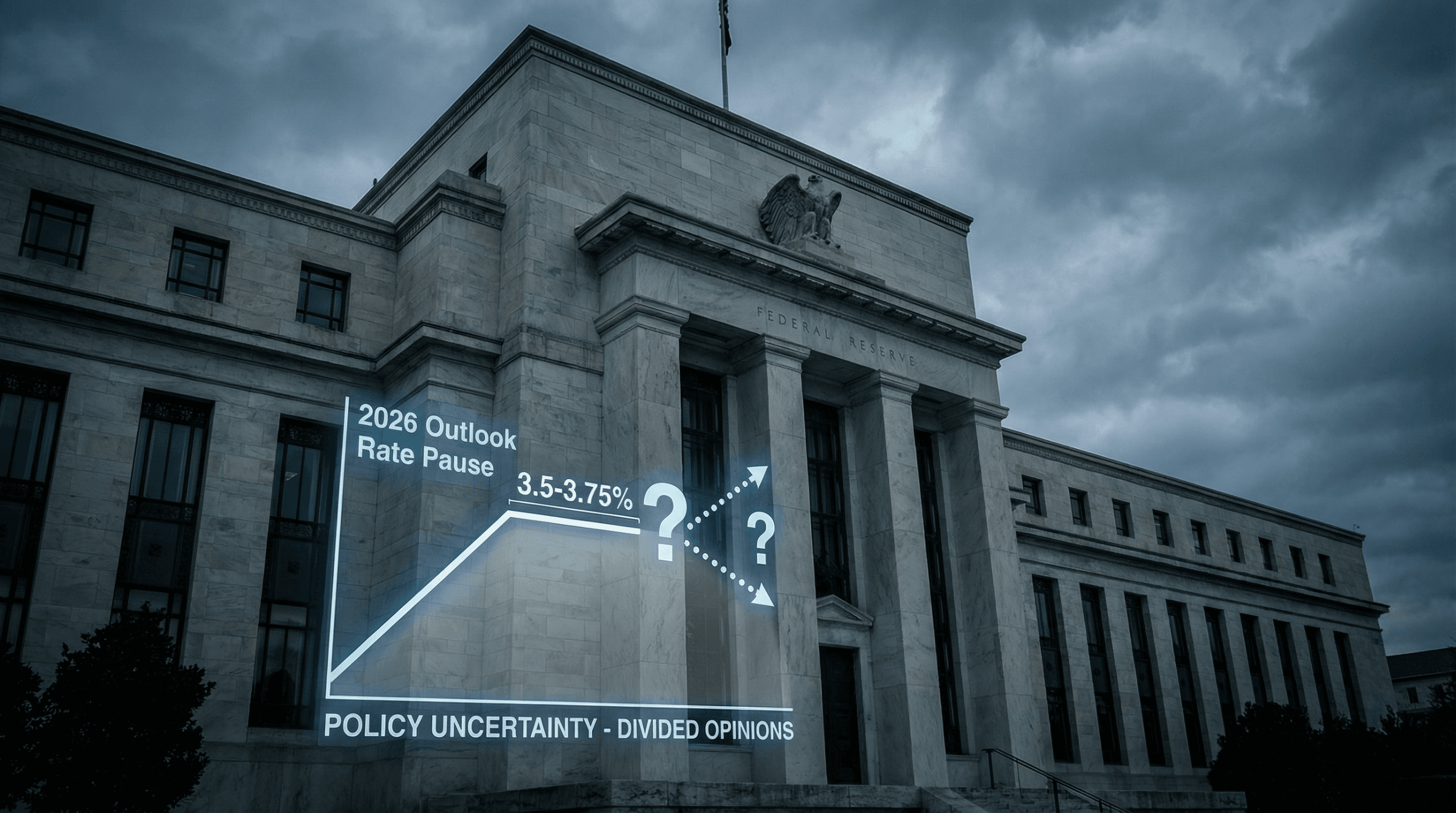
The Federal Reserve's policy outlook has become the market's primary obsession, and the December minutes have injected a significant dose of uncertainty. The deep divisions among policymakers, with a growing faction concerned about stalled progress on inflation, signal a shift from the more dovish stance seen earlier in 2025. The minutes explicitly noted upside risks to inflation and downside risks to employment, a classic central bank conundrum.
The CME FedWatch Tool reflects this shift, with the probability of a rate hold at the upcoming January meeting surging to 84.5%. Looking further out, the market is now pricing in just under two full rate cuts for the entirety of 2026, a significant recalibration from previous expectations. The Treasury market has responded in a relatively orderly fashion, with the 10-year yield hovering around 4.13% and the 2-year yield at 3.45%. The yield curve remains positively sloped, which typically signals economic expansion, but the overall level of yields remains restrictive.
Adding another layer of complexity is the annual rotation of voting members on the FOMC, which appears to be tilting the committee in a more hawkish direction for 2026. This combination of a divided committee, persistent inflation concerns, and a resilient economy suggests a prolonged pause in the Fed's rate-cutting cycle is the most likely path forward.
> **Investment Implications:** For income investors, the current environment offers an opportunity to lock in attractive yields on high-quality bonds. For equity investors, the focus should be on companies that are not heavily reliant on cheap debt to fuel their growth. The U.S. dollar is also likely to remain supported in a higher-for-longer rate environment, which could be a headwind for U.S. companies with significant international revenue.
Cross-Asset Impact Analysis
The crosscurrents of strong economic data and a cautious Fed have led to mixed performance across asset classes. After a stellar year, with the S&P 500 and Nasdaq Composite up 17.4% and 21% respectively, equity markets stumbled into the year's end with three consecutive days of losses amid thin holiday trading. This risk-off sentiment was particularly evident in the underperformance of technology and other momentum-driven sectors.
In the bond market, Treasury yields have remained relatively stable, digesting the Fed's more hawkish tone without a significant sell-off. This suggests that while the prospect of imminent rate cuts has diminished, the market does not see a renewed risk of rate hikes. The dollar has maintained its strength, with the DXY index trading in a narrow range around 98.30.
The standout performer has been gold, which has rallied significantly in 2025, climbing over 60% year-to-date to trade above $2,600 per ounce. The metal has benefited from its safe-haven status amid geopolitical uncertainty and as a hedge against persistent inflation. In contrast, oil prices have been sluggish, reflecting concerns about a potential global economic slowdown.
From a sector perspective, the recent environment has favored value over growth. Financials have benefited from the prospect of higher-for-longer rates, while defensive sectors like consumer staples and healthcare have also held up relatively well. Conversely, rate-sensitive sectors like utilities and REITs, along with high-growth technology stocks, have faced headwinds.
> **Investment Implications:** The current market requires a balanced and diversified approach. A portfolio that includes an allocation to value stocks, quality bonds, and real assets like gold can help navigate the uncertainty. Investors should be wary of chasing last year's winners and instead focus on companies with strong fundamentals and reasonable valuations.
Week Ahead: Economic Calendar
All eyes will be on the upcoming week's economic calendar, which culminates in the critical December jobs report on Friday, January 9th. This report will be crucial in either confirming the narrative of a cooling labor market or reigniting fears of economic overheating.
| Date | Report | Period | Forecast | Previous |
| :— | :— | :— | :— | :— |
| Jan 5 | **ISM Manufacturing PMI** | Dec | 48.0 | 48.2 |
| Jan 7 | **ADP Employment** | Dec | TBD | -32,000 |
| Jan 7 | **ISM Services PMI** | Dec | 50.0 | 50.0 |
| Jan 9 | **U.S. Employment Report** | Dec | TBD | 64,000 |
| Jan 9 | **Unemployment Rate** | Dec | TBD | 4.6% |
The week kicks off with the **ISM Manufacturing PMI** on Monday, which is expected to remain in contractionary territory for the fourth consecutive month. On Wednesday, the **ADP Employment Report** will provide a key preview of the official jobs data, followed by the **ISM Services PMI**, which is teetering on the 50-point line that separates expansion from contraction.
The main event, however, is Friday's **U.S. Employment Report**. After the shockingly weak 64,000 print in November, another soft number could amplify recession fears and put pressure on the Fed to reconsider its pause. Conversely, a strong rebound in job growth would validate the Fed's cautious stance and likely send Treasury yields higher.
> **Investment Implications:** The week's data, particularly the jobs report, has the potential to significantly move markets. Investors should be prepared for a potential increase in volatility. A weak jobs number could benefit bonds and defensive stocks, while a strong number would likely favor cyclical sectors and value stocks. Given the uncertainty, maintaining a diversified portfolio and having some cash on the sidelines to capitalize on any post-data dislocations could be a prudent strategy.
> **Disclaimer:** This analysis is for informational and educational purposes only and should not be considered financial advice. Always conduct your own research and consult with a qualified financial advisor before making investment decisions. Past performance does not guarantee future results. The author and Market Wealth Pro do not hold positions in the stocks discussed unless otherwise stated.