



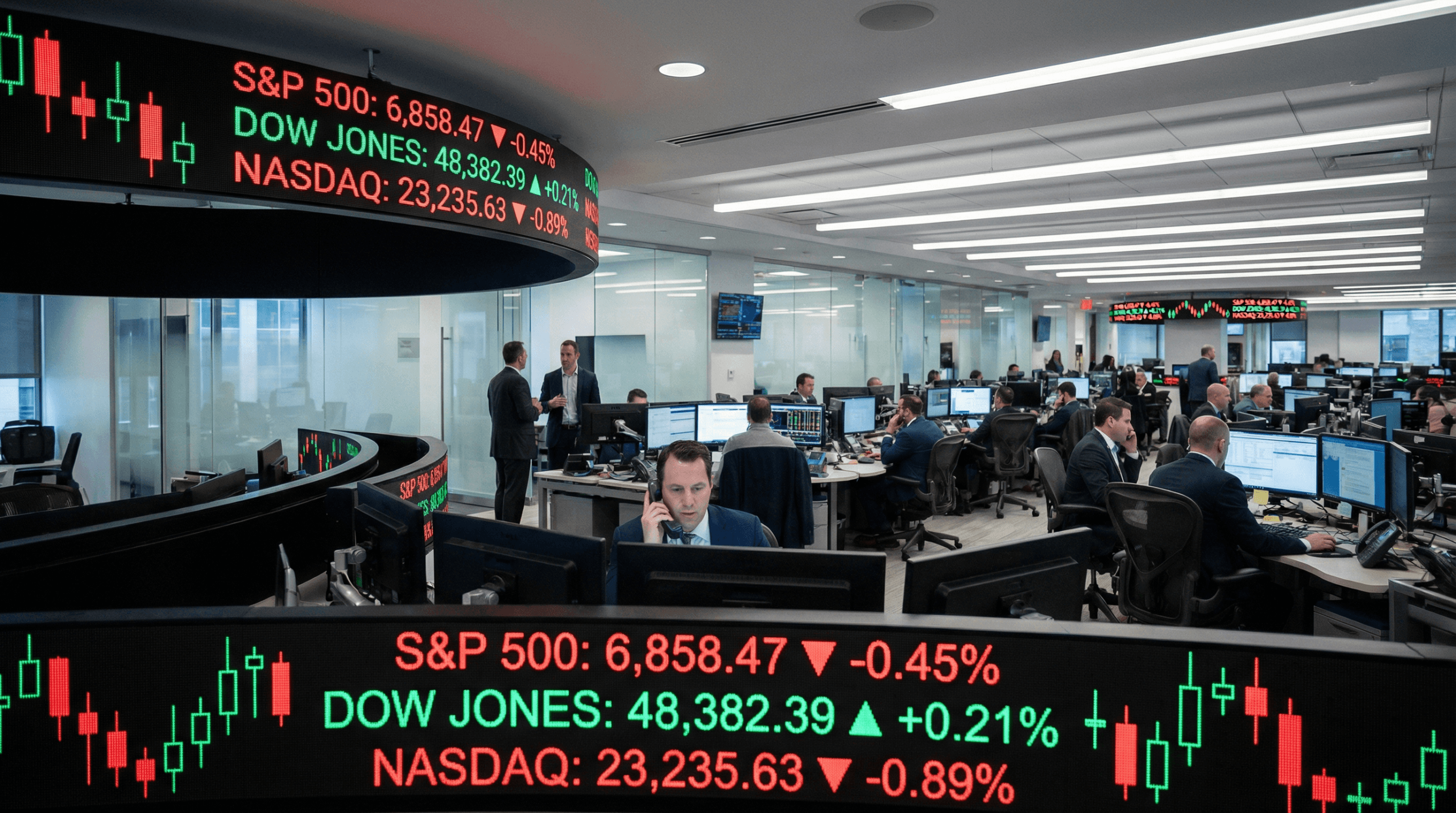
Week in Review: Market Performance
The first trading week of 2026 delivered a mixed but telling performance, as major indices diverged and investors grappled with a sputtering “Santa Claus rally” for the third consecutive year. While the Dow Jones Industrial Average and S&P 500 managed to snap four-session losing streaks to close the week with modest gains, the tech-heavy Nasdaq Composite extended its skid to five sessions. For the holiday-shortened week, the Nasdaq fell 1.5%, the S&P 500 lost 1.0%, and the Dow edged down 0.7%, a notable reversal after four straight weeks of gains for all three indices. The S&P 500 finished Friday up 0.19% at 6,858.47, the Dow gained 0.66% to 48,382.39, while the Nasdaq slipped 0.03% to 23,235.63. This performance comes on the heels of a strong 2025, where the S&P 500 surged over 16%, the Nasdaq jumped more than 20%, and the Russell 2000 climbed 12%, marking the third straight year of double-digit gains for the S&P 500. The market's breadth was a mixed bag, with defensive sectors like Utilities showing strength while high-growth areas like Consumer Discretionary lagged, signaling a cautious tone as the new year gets underway.
Major Market Drivers
Several key narratives drove market action this week, reflecting both continued momentum from 2025 and emerging concerns for the year ahead. The semiconductor sector was a clear bright spot, with the upcoming CES 2026 conference in Las Vegas fueling a rally in chip stocks. Nvidia (NVDA), AMD (AMD), and Micron (MU) all posted strong gains, with investors eagerly awaiting keynotes from the CEOs of Nvidia and AMD. This enthusiasm, however, did not extend to the broader tech sector, as most of the “Magnificent 7” mega-cap stocks underperformed. Tesla (TSLA) was a notable laggard, falling over 2% on Friday after reporting Q4 vehicle deliveries that missed analyst expectations and marked a 15% year-over-year decline. This weakness in big tech, which was a major engine of market gains in 2025, raises questions about the sustainability of the AI-driven rally. In contrast, precious metals continued their impressive run, with gold and silver building on their strongest annual performance since 1979. Gold prices flirted with the $4,342 per ounce level, and aluminum prices surpassed $3,000 per ton for the first time since 2022, signaling a flight to safety and a potential hedge against inflation and geopolitical uncertainty. Finally, the Federal Reserve remained a central focus, with growing divisions within the central bank over the future path of interest rates. With President Trump expected to name a new Fed Chair this month, and the market split on the likelihood of a rate cut in March, policy uncertainty is a significant overhang for investors.
Investment implications: The divergence between the semiconductor rally and the broader underperformance of the “Magnificent 7” suggests a potential rotation within the tech sector. Investors may be becoming more selective, favoring companies with clear near-term catalysts like those in the semiconductor space. The continued strength in precious metals underscores the importance of portfolio diversification and a potential hedge against market volatility. The uncertainty surrounding Fed policy suggests that investors should remain nimble and prepared for a range of potential interest rate scenarios.
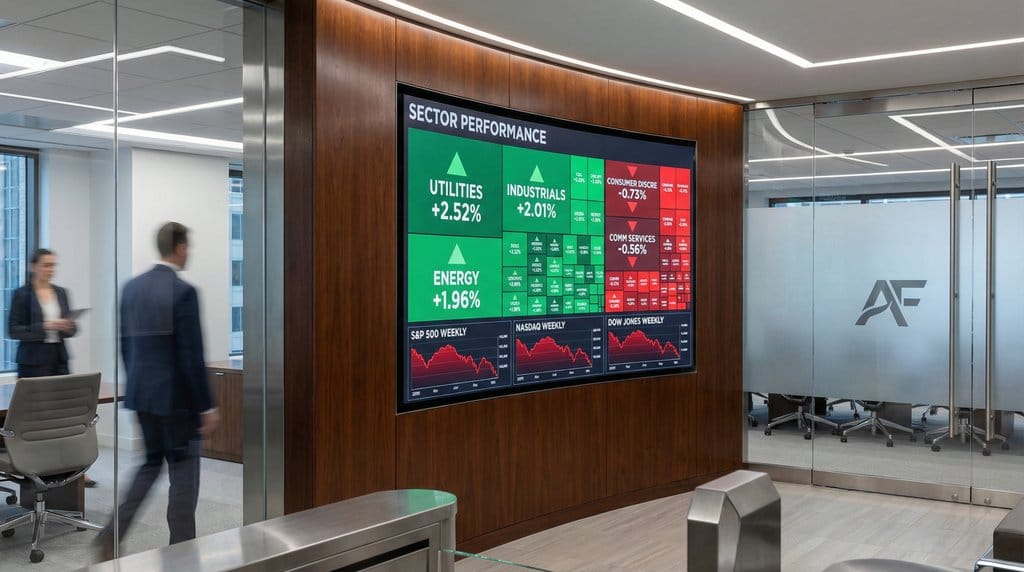
Sector Performance Analysis
A closer look at sector performance this week reveals a clear defensive rotation, as investors favored safety over growth. Utilities was the top-performing sector, surging 2.52% as market participants sought refuge in stable, dividend-paying stocks. Industrials (+2.01%) and Energy (+1.96%) also showed surprising strength, suggesting that some cyclical areas of the economy remain resilient. Basic Materials (+1.21%) and Financial Services (+0.71%) rounded out the top five performers. On the other end of the spectrum, the Consumer Discretionary sector was the worst performer, falling 0.73%, largely dragged down by the significant drop in Tesla's stock. Communication Services (-0.56%) and Consumer Defensive (-0.11%) also finished the week in the red. The Technology sector, despite the rally in semiconductor stocks, was a middle-of-the-pack performer with a modest gain of 0.17%, highlighting the internal divergence within the sector. This rotation away from high-growth consumer and technology names and into more defensive and cyclical value sectors is a key theme to watch as we move further into 2026.
Investment implications: The leadership of Utilities and the weakness in Consumer Discretionary point to a risk-off sentiment in the market. Investors appear to be reducing exposure to high-beta growth stocks and rotating into more defensive areas of the market. The relative strength in Industrials and Energy could signal an opportunity in cyclical sectors that may have been overlooked during the tech-fueled rally of 2025. The mixed performance within the Technology sector suggests that a broad-based approach to tech investing may be less effective in the current environment, and a more granular, stock-specific approach is warranted.
What We Learned This Week
The first week of trading in 2026 provided several valuable lessons for investors. First, the sputtering of the “Santa Claus rally” for the third year in a row serves as a reminder that historical patterns are not always reliable predictors of future performance. This suggests a more cautious and data-driven approach is warranted, rather than relying on seasonal trends. Second, the clear rotation into defensive sectors like Utilities and the underperformance of high-growth areas like Consumer Discretionary indicate a significant shift in market sentiment. The risk-on appetite that characterized much of 2025 appears to be waning, replaced by a more cautious, risk-off posture. Third, the divergence within the technology sector, with semiconductors rallying while mega-cap tech stocks faltered, highlights the importance of a granular, stock-specific analysis. The days of a rising tide lifting all tech boats may be over, and investors will need to be more discerning in their stock selection. Finally, the continued strength in precious metals underscores the value of diversification and the importance of having a hedge against market volatility and uncertainty.
Investment implications: The current market environment calls for a more balanced and defensive portfolio posture. Investors should consider increasing their allocation to defensive sectors like Utilities and Healthcare, while being more selective in their exposure to high-growth technology and consumer stocks. The strength in precious metals suggests that a small allocation to gold or silver could provide a valuable hedge against potential market downturns. The key takeaway is that the market landscape is shifting, and investors who can adapt their strategies to the new environment will be best positioned for success in the year ahead.
Looking Ahead: Next Week's Focus
Looking ahead to the second week of January, investors will be closely watching a packed economic calendar for clues about the health of the economy and the future direction of Fed policy. The week kicks off with the ISM Manufacturing Index on Monday, followed by the ISM Services Index on Wednesday. However, the main event will be the December U.S. Employment Report on Friday, which is expected to show a significant slowdown in job growth. The unemployment rate is forecast to tick up to 4.7%, and hourly wages are expected to show a modest 0.3% increase. Any significant deviation from these forecasts could have a major impact on market sentiment and Fed expectations. In addition to the jobs report, investors will be paying close attention to speeches from several Fed officials, including Richmond Fed President Tom Barkin and Fed Vice Chair Michelle Bowman, for any hints about the central bank's thinking on interest rates. The week will also feature the start of the CES 2026 conference in Las Vegas, which will be a major catalyst for the tech sector, particularly semiconductor stocks. Key technical levels to watch for the S&P 500 include support at the 6,800 level and resistance at the recent highs around 6,900.
Investment implications: The upcoming economic data, particularly the jobs report, will be a major driver of market sentiment in the week ahead. A weaker-than-expected report could increase the odds of a Fed rate cut in March, which could be bullish for stocks. Conversely, a surprisingly strong report could push back rate cut expectations and put pressure on the market. Investors should be prepared for increased volatility around these key data releases. The CES conference will be a key event for the tech sector, and any positive announcements could provide a boost to semiconductor and other tech stocks. Given the current market uncertainty, a cautious and data-driven approach is the most prudent course of action for the week ahead.
Disclaimer: This analysis is for informational and educational purposes only and should not be considered financial advice. Always conduct your own research and consult with a qualified financial advisor before making investment decisions.