



December CPI Report Shows Inflation Holding Steady at 2.7%
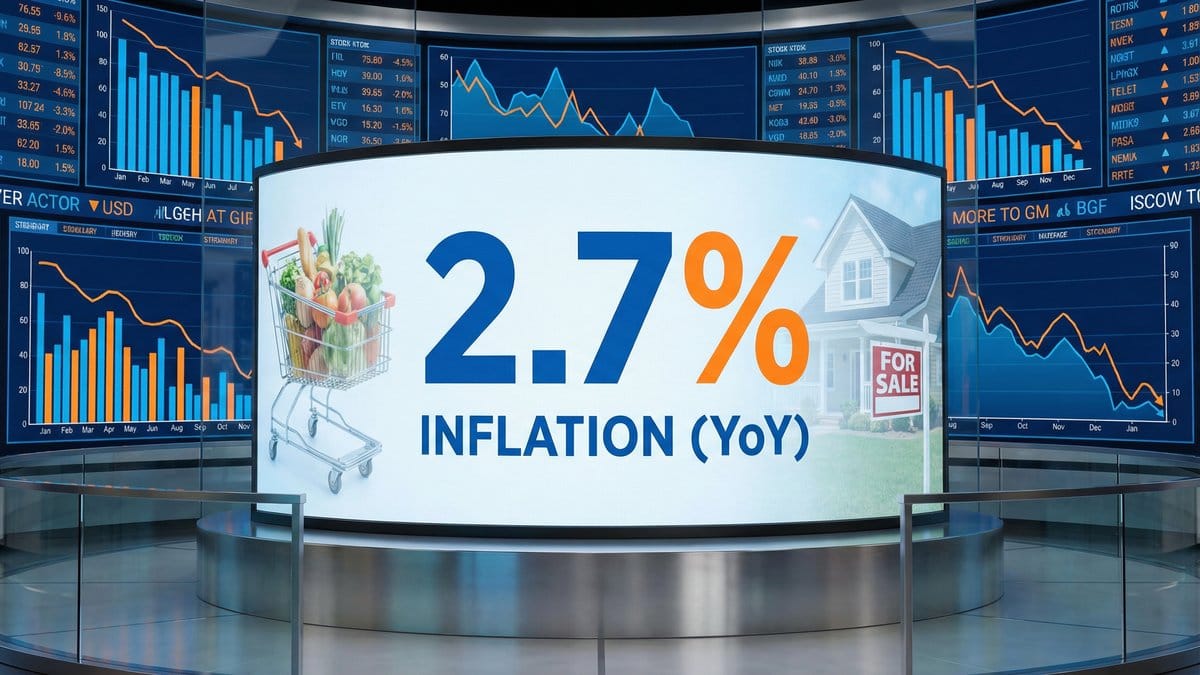
The Bureau of Labor Statistics released its December 2025 Consumer Price Index report on Tuesday, revealing that annual inflation remained unchanged at 2.7 percent from November. While the year-over-year figure held steady, the monthly pace of inflation accelerated to 0.3 percent from November’s 0.1 percent, driven by persistent housing costs, sharply rising food prices, and higher energy costs.
The report marks the conclusion of a year that saw modest progress on inflation, with both overall and core inflation rates cooling from January 2025’s levels of 3.0 percent and 3.3 percent respectively. However, the December data also underscores the challenges that remain in bringing inflation back to the Federal Reserve’s 2 percent target, particularly as various economic and policy factors continue to influence price dynamics.
Core Inflation and Monthly Price Pressures
Core CPI, which excludes volatile food and energy prices and serves as a closely watched indicator of underlying inflation trends, rose 0.2 percent from November. This brought the annual core inflation rate to 2.7 percent in December, slightly above the previous month’s reading. Economists had anticipated that core CPI would rise by 0.3 percent monthly and that the annual rate would tick up to 2.7 percent, according to FactSet estimates.
The December increase was primarily driven by three key categories. Housing-related inflation remained persistent, with the shelter index bouncing back from a deceptively muted reading in November. Food prices surged 0.7 percent from the month before, representing one of the sharpest monthly increases in recent months. Energy prices also contributed to the upward pressure, rising 0.3 percent during the period.
Elizabeth Renter, senior economist at NerdWallet, characterized the current inflation environment as stable but cautious. “I think it’s safe to say that inflation is not reaccelerating at this point, and signs point to it continuing to moderate – albeit slowly,” she told CNN in an interview. “I do think there are still risks out there.”
Data Distortions From Government Shutdown
December’s CPI report provided the clearest picture on the trajectory of inflation in three months, though some data distortions continue to linger from the government shutdown that lasted from October 1 to November 12. The shutdown negatively impacted data collection for both October and November, resulting in the majority of prices not being collected for October and an increased number of estimates being made.
The most significant shutdown-related data issue involves housing-related inflation, captured in the shelter index, which carries the most weight among the basket of goods and services that feed into the CPI. Because of missing data, the BLS carried forward previously reported shelter costs, resulting in an assumption that rental inflation was zero in October. This distortion is still affecting the overall inflation rate, with economists noting that the annual and core rates are running about 0.1 percentage points lower than they should be.
Dean Baker, senior economist at the Center for Economic and Policy Research, indicated that this issue will eventually correct itself but likely won’t happen until April. The BLS uses rotating six-month panels for its rent price data, which means the full impact of the data collection disruption will take several months to work through the system.
Tariff Impact on Consumer Prices
One of the biggest risks to the inflation outlook remains the continued impact from sweeping tariffs implemented throughout 2025. While these tariffs were expected to raise prices and put upward pressure on overall inflation, they weren’t anticipated to cause price hikes to skyrocket like they did in 2022. The expectation was that price increases would be more one-time in nature rather than creating sustained inflationary pressure.
However, since the tariff policy rolled out in fits and starts, the impacts have been delayed and uneven across different product categories. Many goods categories have shown significant price spikes throughout the year, with some of the biggest increases occurring in coffee, home furnishings, major appliances, toys, window coverings, and tableware. Other categories have seen costs largely absorbed by manufacturers, retailers, and importers who have been reluctant to pass the full burden onto consumers.
Gregory Daco, economist at EY-Parthenon, noted that businesses typically revisit their pricing decisions at the start of the year. This suggests there could be a burst of goods inflation in the first quarter of 2026 as firms attempt to pass along the higher costs they’ve been absorbing for months. This potential delayed impact represents a significant wildcard for the inflation outlook in the coming months.
Federal Reserve Policy Implications
Tuesday’s inflation data is not expected to significantly influence the Federal Reserve’s upcoming interest rate decision at the end of January. Sung Won Sohn, chief economist at SS Economics and finance and economics professor at Loyola Marymount University, characterized the report as providing neither a strong case for aggressive action nor for maintaining the status quo.
“This CPI report does not signal an inflation reacceleration, but it also does not provide the Federal Reserve with a strong justification for rapid easing,” Sohn wrote in a note on Tuesday. “The most likely path is a gradual shift toward rate cuts over time, but with policymakers maintaining caution until shelter inflation and services inflation show clearer improvement.”
The Federal Reserve has faced unprecedented criticism from the White House under President Donald Trump’s second term for not lowering interest rates more dramatically. The administration has cited upward risks to inflation from domestic policies such as tariffs and broader geopolitical concerns as reasons why more aggressive rate cuts would be appropriate. However, Fed policymakers have maintained their data-dependent approach, emphasizing the need to ensure inflation is on a sustainable path back to the 2 percent target before making significant policy adjustments.
Economic Outlook for 2026
Looking ahead to 2026, economists expect inflation to remain in a range of 2.2 percent to 2.7 percent, reflecting the push-and-pull effect that various policy changes are having on businesses and American households. Eric Teal, chief investment officer at Comerica Wealth Management, highlighted several competing forces that will shape the inflation trajectory.
“The inflationary pressures from tariffs are being countered by the deflationary impact of tighter immigration in the housing market,” Teal wrote Tuesday. “Net immigration is approaching zero this year and given the supply glut of apartments, vacancy rates are expected to increase and rents to decline.”
At the same time, inflationary pressures are expected to continue in leisure and hospitality industries, which could experience worker shortages because foreign-born workers are more heavily represented in these sectors. The tightening of immigration policy could create upward wage pressure in industries that have traditionally relied on immigrant labor, potentially offsetting some of the disinflationary forces in the housing market.
Teal also noted that significant deflationary pressure from artificial intelligence on wages is still in the making. As AI technologies become more widely adopted across various industries, they could reduce labor demand in certain sectors and put downward pressure on wage growth, which would have broader implications for inflation dynamics.
Consumer Sentiment and Price Levels
While the latest inflation data shows that the rate of price increases has moderated significantly from the peak levels of 2022, many Americans continue to struggle with affordability concerns. NerdWallet’s Renter emphasized that consumers are more sensitive to absolute price levels than they are to the rate of change over time.
“People are still feeling the pain from the high inflation period we had just a few years ago,” she explained. “It’s going to take even longer for that pain to subside.” This observation highlights an important disconnect between economic data and consumer experience. Even as inflation rates approach more normal levels, the cumulative effect of several years of elevated price increases has left many households facing significantly higher costs for essential goods and services compared to pre-pandemic levels.
Investment Implications
The December CPI report reinforces the view that inflation is moderating gradually rather than rapidly returning to the Fed’s 2 percent target. This environment of sticky but slowly declining inflation has important implications for investment strategy. Fixed-income investors should anticipate a measured pace of Federal Reserve rate cuts rather than aggressive easing, which suggests that current yield levels may persist longer than some market participants expect.
For equity investors, the inflation outlook presents a mixed picture. Sectors that benefit from pricing power, such as consumer staples and healthcare, may continue to perform well in an environment where inflation remains above target but is not accelerating. Conversely, rate-sensitive sectors like utilities and real estate may face headwinds if the Fed maintains a cautious approach to rate cuts.
The ongoing impact of tariffs creates uncertainty for companies with complex global supply chains. Investors should pay close attention to how individual companies are managing tariff-related cost pressures and whether they have the pricing power to pass these costs along to consumers without significantly impacting demand. Companies that have successfully absorbed tariff costs may face margin pressure if they attempt to recoup these expenses in early 2026.
The housing market presents particularly interesting dynamics for investors. The combination of elevated shelter inflation in the CPI data and expectations for declining rents due to apartment oversupply creates a complex picture. Real estate investment trusts focused on multifamily housing may face challenges from rising vacancy rates, while single-family housing markets may see continued strength from persistent shelter inflation.
Finally, the potential for AI-driven deflationary pressure on wages could have significant long-term implications for corporate profitability and investment returns. Companies successfully implementing AI technologies to reduce labor costs may see margin expansion, while those in industries vulnerable to AI disruption may face increased competitive pressure.
Disclaimer: This analysis is for informational and educational purposes only and should not be considered financial advice. Economic data is subject to revisions, and the factors influencing inflation are complex and constantly evolving. Investors should conduct their own research, consider their individual financial circumstances and risk tolerance, and consult with qualified financial advisors before making investment decisions. Past economic trends do not guarantee future results, and policy changes can have unexpected impacts on inflation and market conditions.