



The energy sector faces mounting headwinds as major financial institutions release bearish oil price forecasts for 2026, citing an expected supply glut that could push West Texas Intermediate crude to $50 per barrel by year-end. Despite recent geopolitical tensions and strong year-to-date performance in energy stocks, analysts warn that chronic oversupply will dominate market dynamics throughout the year, creating a challenging environment for oil producers while potentially benefiting refiners and consumers.
Goldman Sachs Warns of $50 Oil
Goldman Sachs energy analysts issued a stark warning this week, projecting that West Texas Intermediate crude could decline to $50 per barrel by late 2026 as the global oil market grapples with a substantial supply surplus. The investment bank forecasts a 2.3 million barrels per day supply excess for the year, which would require significantly lower prices to rebalance the market by slowing non-OPEC production growth and supporting demand.
The Goldman forecast represents a significant downward revision from earlier expectations and underscores growing concerns about oversupply in global energy markets. The bank's analysts noted that rebalancing the market will likely require lower oil prices to incentivize production cuts among non-OPEC producers, particularly in the United States shale sector, where breakeven costs have declined but remain sensitive to price fluctuations.
While Goldman's near-term outlook is decidedly bearish, the bank offered a more constructive view for 2027 and beyond. By next year, the global oil market may swing into deficit as non-OPEC production growth reverses in response to lower prices and OPEC maintains production discipline. Even so, Goldman projects Brent crude at $54 to $58 per barrel for 2027, down $5 from previous estimates. Looking further ahead to 2035, the bank predicts Brent could exceed $70 per barrel, supported by robust demand and years of underinvestment in new production capacity.
Investment implications: The bearish near-term price outlook creates a challenging environment for exploration and production companies, particularly those with higher cost structures. Investors should focus on low-cost producers with strong balance sheets that can weather an extended period of depressed prices. Conversely, downstream companies such as refiners may benefit from lower crude input costs, potentially expanding margins if refined product demand remains resilient.
Consensus Builds Around Lower Prices
Goldman Sachs is far from alone in its bearish assessment of 2026 oil markets. The U.S. Energy Information Administration projects that West Texas Intermediate will average $52.21 per barrel in 2026, down sharply from $65.40 in 2025. The EIA's quarterly breakdown shows Brent crude averaging $58.93 per barrel in the first quarter before declining to even lower levels as the year progresses.
BloombergNEF estimates Brent crude will average $55 per barrel in 2026, assuming geopolitical disruptions do not materially impact global supply. However, the research firm noted that prices could spike to $91 per barrel if Iranian oil exports face significant disruption due to ongoing protests and political instability in the country. This wide range of potential outcomes highlights the dual nature of current oil market risks, with structural oversupply pushing prices lower while geopolitical tensions create upside volatility.
The bearish consensus extends beyond price forecasts to fundamental supply-demand analysis. Industry consultancy Enverus characterized 2026 as the largest period of oil oversupply in recent memory, with first-half weakness likely to persist before a potential second-half recovery as inventory builds force production adjustments. ICIS analysts echoed this view, warning that chronic oversupply will push crude prices below $60 per barrel for much of the year.
Investment implications: The convergence of bearish forecasts from multiple credible sources suggests that lower oil prices are not merely a possibility but a likely scenario for 2026. Investors should adjust portfolio allocations accordingly, reducing exposure to high-cost producers and increasing positions in companies with diversified revenue streams or downstream operations that benefit from lower feedstock costs.
Current Market Dynamics
Despite the bearish long-term outlook, oil prices showed modest gains this week as geopolitical concerns provided temporary support. West Texas Intermediate settled at $59.34 per barrel, up 0.44%, while Brent crude finished at $64.13, gaining 0.58%. Natural gas prices declined 0.80% to $3.103 per million British thermal units, reflecting ample supply and moderate winter demand.
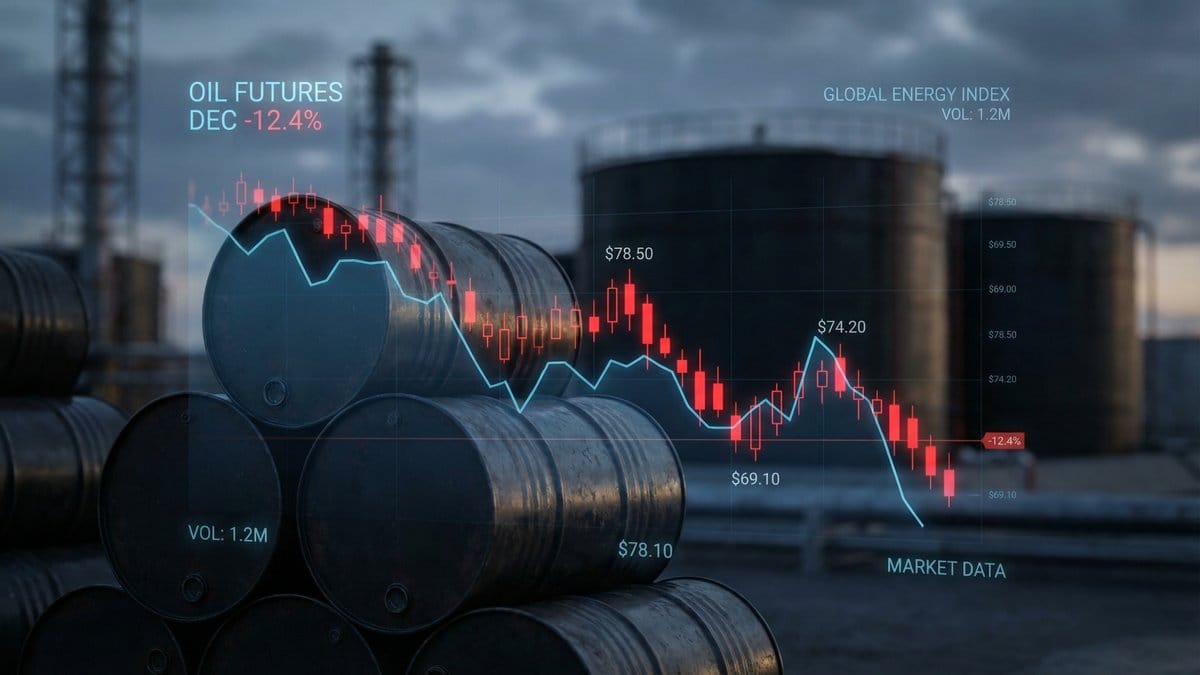
The recent price stability masks significant underlying tensions in global energy markets. Protests in Iran have raised concerns about potential disruptions to the country's 1.9 million barrels per day of oil exports, with ANZ analysts noting that demonstrators have called on oil industry workers to join the movement. However, President Trump downplayed the prospect of military conflict with Iran earlier this week, causing oil prices to fall 3% as war premium dissipated from the market.
Venezuela has emerged as another wild card in global oil supply dynamics. The United States recently sold its first cargo of Venezuelan crude for $500 million, marking a significant shift in bilateral energy relations. Industry forecasts suggest Venezuela could increase oil output by 50% by 2035, potentially adding substantial supply to global markets. However, this optimistic production outlook depends on sustained investment in the country's deteriorating oil infrastructure and continued easing of international sanctions.
Energy Stocks Defy Bearish Fundamentals
In a surprising disconnect from bearish oil price forecasts, energy stocks have posted strong gains in early 2026. The S&P 500 Energy sector has climbed 7.5% year-to-date, significantly outperforming the broader market. Refining companies have led the rally, benefiting from expectations of wider crack spreads as crude prices decline while refined product demand remains relatively stable.
The strong stock performance reflects several factors beyond near-term oil prices. Many energy companies have strengthened their balance sheets over the past several years, reducing debt and improving operational efficiency. Dividend yields in the sector remain attractive compared to other equity sectors, providing income-oriented investors with compelling total return potential even if capital appreciation moderates. Additionally, energy stocks are trading at relatively low valuations compared to historical norms, suggesting that much of the bearish price outlook may already be reflected in current share prices.
However, not all energy producers are thriving in the current environment. Billionaire Harold Hamm announced this week that his company would halt drilling operations in the Bakken shale formation due to low oil prices that make new wells uneconomic. This development illustrates the production discipline that Goldman Sachs and other analysts believe will be necessary to rebalance global oil markets. As more high-cost producers curtail activity, supply growth should moderate, eventually providing support for prices.
Investment implications: The divergence between bearish oil price forecasts and strong energy stock performance suggests that investors are looking beyond near-term commodity price weakness to focus on company-specific fundamentals such as cost structures, balance sheet strength, and capital return policies. Selective stock picking within the energy sector may offer opportunities, particularly among integrated companies and refiners that are less exposed to crude price volatility.
Natural Gas Market Faces Its Own Challenges
While crude oil has captured most of the attention in energy markets, natural gas faces its own set of challenges in 2026. The EIA forecasts that Henry Hub natural gas prices will decline slightly this year before rebounding sharply in 2027. Current prices around $3.10 per million BTU reflect ample supply from continued shale gas production and moderate winter heating demand.
Several major developments are reshaping natural gas markets. Mitsubishi announced a $5.2 billion acquisition in the Haynesville shale formation, one of the most prolific natural gas basins in the United States. This transaction signals continued confidence in long-term gas demand, particularly for liquefied natural gas exports. Chevron greenlighted a major expansion of Israel's Leviathan gas field, which will increase supply to European markets seeking alternatives to Russian gas.
President Trump's executive order mandating an emergency power auction for Big Tech artificial intelligence data centers could significantly boost natural gas demand over the coming years. Data centers require enormous amounts of reliable baseload power, and natural gas is likely to play a key role in meeting this demand alongside renewable energy sources. This policy development may provide fundamental support for natural gas prices in the medium term, even as near-term oversupply weighs on the market.
Geopolitical Factors and Policy Shifts
Geopolitical developments continue to inject volatility into energy markets, even as fundamental supply-demand dynamics point toward lower prices. The situation in Iran remains fluid, with protests threatening oil production and exports. While the immediate risk of military conflict has receded following President Trump's comments, the potential for supply disruptions remains elevated. Any significant reduction in Iranian oil exports could quickly tighten global markets and push prices higher, particularly if OPEC+ does not increase production to offset the lost barrels.
Energy policy shifts are also influencing market dynamics. Germany relaunched a major electric vehicle subsidy program with billions in funding, potentially accelerating the transition away from petroleum-based transportation fuels in Europe's largest economy. China's coal imports fell sharply as domestic production increased and renewable energy capacity expanded, signaling a gradual shift in the world's largest energy consumer's fuel mix. These policy-driven demand changes are contributing to bearish long-term outlooks for fossil fuels, even as near-term consumption remains robust.
The evolving U.S.-Venezuela relationship represents another significant policy development with implications for global oil supply. Beyond the recent crude sale, the easing of sanctions could unlock substantial Venezuelan production capacity over time. However, realizing this potential will require massive investment in the country's oil sector, which has deteriorated significantly over the past decade. The pace of Venezuela's production recovery will be a key variable in determining how quickly global oil markets move from surplus to balance.
Looking Ahead
The energy sector enters a period of significant uncertainty, with bearish price forecasts colliding with geopolitical risks and policy shifts that could alter supply-demand dynamics. For oil producers, the outlook is challenging, with lower prices likely to force production discipline and capital spending cuts. Companies with high-cost production assets or weak balance sheets face particular pressure and may need to consider asset sales or other strategic alternatives.
Refiners and downstream companies appear better positioned to navigate the current environment, benefiting from lower crude costs while maintaining pricing power for refined products. Integrated energy companies with diversified operations across the value chain may offer the most attractive risk-reward profiles, able to offset upstream margin compression with downstream gains.
For investors, the energy sector presents a complex picture. While bearish oil price forecasts suggest caution, attractive valuations and strong dividend yields provide compelling reasons to maintain exposure. Selectivity will be crucial, with a focus on low-cost producers, strong balance sheets, and companies with proven track records of capital discipline. The sector's strong year-to-date performance may moderate as bearish price forecasts begin to materialize, but long-term investors with appropriate risk tolerance may find opportunities in the current dislocation between stock prices and commodity fundamentals.
Natural gas markets bear close watching as well, with the potential for demand growth from data centers and LNG exports providing a more constructive outlook than crude oil. Companies with significant natural gas exposure may outperform pure-play oil producers if these demand drivers materialize as expected. The energy transition continues to reshape long-term demand outlooks, but the pace of change remains uncertain, and fossil fuels will likely remain essential to the global energy mix for decades to come.
Disclaimer: This article is for informational purposes only and should not be considered financial advice. Energy markets are highly volatile and subject to rapid changes based on geopolitical events, policy decisions, and supply-demand dynamics. Always conduct your own research and consult with a qualified financial advisor before making investment decisions in the energy sector.