



Economic Overview
The global economy stands at a pivotal juncture, navigating a complex interplay of moderating inflation, resilient labor markets, and shifting growth dynamics. Recent data reveals an economy that is cooling but not collapsing, defying earlier predictions of a more severe downturn. Headline inflation has shown a clear downward trend, moving closer to the Federal Reserve's target, which has allowed the central bank to pause its aggressive rate-hike cycle. However, the persistence of core inflation in some sectors, particularly services, suggests the path ahead is not without its challenges. The labor market continues to display remarkable strength, with job creation consistently beating expectations, although a closer look reveals a concentration of growth in specific industries. Meanwhile, after a period of robust expansion, GDP growth is expected to normalize to a more sustainable pace. This environment of cautious optimism is tempered by wavering consumer confidence and mixed signals from retail sales, indicating that households are becoming more discerning with their spending. The overall picture is one of a soft landing becoming more plausible, but the balance remains delicate, with policymakers and investors alike closely monitoring incoming data for signs of either renewed inflationary pressure or a sharper-than-expected economic slowdown.
Inflation & Fed Policy
Inflationary pressures have continued to ease, a welcome sign for both consumers and policymakers. The latest Consumer Price Index (CPI) for January 2026 registered a 2.4% year-over-year increase, a notable deceleration from the 2.7% seen in the previous month. On a monthly basis, the index rose a modest 0.2%. Core CPI, which strips out volatile food and energy prices, came in at 2.5% annually, indicating that underlying price pressures are also moderating, albeit at a slower pace. The decline in headline inflation was largely driven by a 1.5% monthly drop in energy prices, with gasoline prices falling 3.2%. However, shelter costs, a significant component of the index, continued to climb, rising 0.2% for the month and 3.0% over the year. In response to this evolving landscape, the Federal Reserve has adopted a wait-and-see approach. At its January 2026 meeting, the Federal Open Market Committee (FOMC) unanimously voted to maintain the federal funds rate at its current target range of 3.5% to 3.75%. Minutes from the meeting revealed a split among officials regarding the future path of monetary policy, with a general consensus to pause further rate cuts for the time being, while leaving the door open for potential adjustments later in the year. The Fed is carefully balancing the risks of cutting rates too soon, which could reignite inflation, against the risk of keeping policy too tight for too long, which could stifle economic growth.
Investment implications: The current environment of moderating inflation and a paused Fed creates a nuanced landscape for investors. A less aggressive central bank is generally positive for equities, as it reduces the discount rate on future earnings. Sectors that are sensitive to interest rates, such as technology and growth stocks, may find some relief. For bond investors, the prospect of stable to lower rates could lead to price appreciation for existing bonds. However, the persistence of core inflation and the Fed's data-dependent stance mean that volatility is likely to remain. Investors should focus on quality companies with strong balance sheets and pricing power that can navigate a period of slower economic growth. Diversification across asset classes remains a prudent strategy to mitigate risks.
Labor Market Analysis
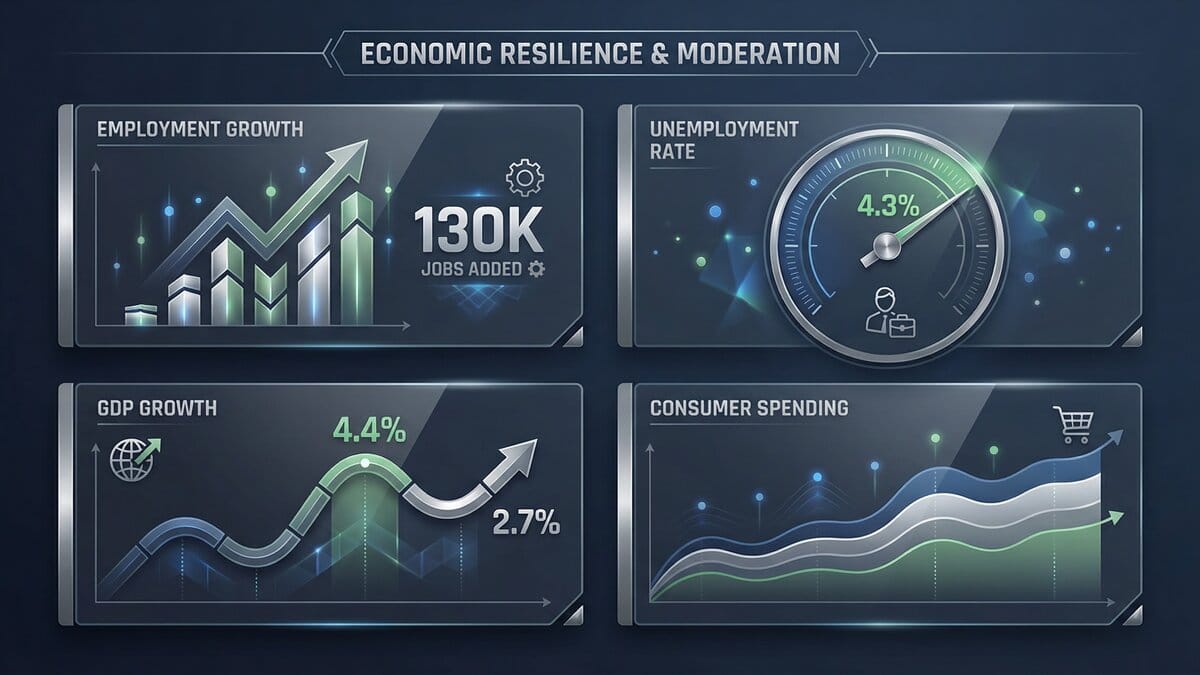
The U.S. labor market continues to defy expectations, demonstrating surprising resilience in the face of tighter monetary policy. The January 2026 jobs report showed the economy added 130,000 nonfarm payrolls, significantly outpacing consensus estimates. The unemployment rate edged down to 4.3%, remaining near historic lows. This sustained job growth is a key pillar supporting the economy, providing households with the income necessary to fuel consumer spending. However, a deeper dive into the data reveals a more complex picture. The bulk of the job gains were concentrated in a few sectors, primarily health care and social assistance. This lack of broad-based growth could be a sign of underlying weakness. Furthermore, data from the ADP employment report, which tracks private payrolls, showed a significant decline in jobs at small establishments, suggesting that smaller businesses may be struggling to cope with the current economic climate. While the headline numbers remain strong, the concentration of job growth and the struggles of small businesses are important trends to monitor. A healthy labor market is crucial for a sustained economic expansion, and any signs of a significant slowdown in hiring could have a ripple effect across the economy.
Investment implications: A strong labor market is generally positive for corporate earnings and stock prices, as it supports consumer demand. Cyclical sectors that are tied to the health of the economy, such as consumer discretionary and industrials, may benefit from continued job growth. However, the concentration of growth in specific sectors suggests that a more targeted approach may be warranted. Companies that provide services to the aging population, for example, may be well-positioned to benefit from the long-term trend of growth in the health care sector. On the other hand, the potential for wage growth to fuel inflation remains a concern. If wage pressures start to build, it could force the Fed to maintain a more hawkish stance, which would be a headwind for the market.
Growth & Consumer Indicators
After a surprisingly strong performance in the third quarter of 2025, when real GDP expanded at a 4.4% annualized rate, economic growth is expected to moderate. Forecasts for the fourth quarter of 2025 point to a more sustainable pace of growth in the range of 2.5% to 2.7%. This slowdown is not necessarily a cause for concern, as it reflects a normalization of growth after a period of rapid expansion. The consumer, who is the primary driver of the U.S. economy, is showing signs of both strength and caution. Consumer spending, as measured by Bank of America card data, rose 2.6% year-over-year in January, the largest increase in nearly two years. However, this strength is not being felt equally across all income levels, with concerns about a K-shaped recovery, where higher-income households fare much better than their lower-income counterparts. This divergence is also reflected in consumer confidence, which fell sharply in January. The Conference Board's Consumer Confidence Index dropped 9.7 points to 84.5, suggesting that while consumers are still spending, they are becoming more pessimistic about the future. This pessimism was also evident in the disappointing retail sales figures for December, which were flat compared to the previous month, missing expectations for a 0.4% increase. The holiday shopping season appears to have been lackluster, a sign that consumers are becoming more price-sensitive and discerning in their purchases.
Investment implications: The moderation in GDP growth and the mixed signals from the consumer have important implications for investors. A slowing economy could be a headwind for corporate earnings, particularly for companies that are sensitive to the business cycle. Investors may want to consider a more defensive posture, focusing on sectors that are less economically sensitive, such as consumer staples and utilities. The divergence in consumer spending patterns also suggests that a one-size-fits-all approach to investing in the consumer sector may not be effective. Companies that cater to higher-income consumers may continue to perform well, while those that target the lower-end consumer may face challenges. Investors should carefully analyze a company's target market and its ability to adapt to changing consumer behavior.
Market Implications & Outlook
The crosscurrents of moderating inflation, a resilient labor market, and slowing but still positive growth have created a complex and challenging environment for financial markets. Asset prices have been volatile as investors attempt to price in the likelihood of a soft landing versus the risk of a recession. The stock market has been buoyed by the prospect of the Federal Reserve ending its rate-hiking cycle, but the rally has been uneven, with technology and growth stocks leading the way. The bond market has also been volatile, with yields fluctuating in response to changing expectations for inflation and Fed policy. Looking ahead, the outlook remains uncertain. The path of inflation will be a key determinant of the Fed's next move, and by extension, the direction of the market. If inflation continues to moderate, it could give the Fed the green light to begin cutting rates later this year, which would be a major catalyst for a sustained market rally. However, if inflation proves to be stickier than expected, it could force the Fed to keep rates higher for longer, which would be a significant headwind for both stocks and bonds. Investors should be prepared for continued volatility and focus on building diversified portfolios that can withstand a range of economic outcomes. In this environment, a focus on quality, a long-term perspective, and a disciplined approach to risk management will be more important than ever.
Disclaimer: This analysis is for informational and educational purposes only and should not be considered financial advice. Economic forecasts are subject to significant uncertainty and actual results may differ materially. Always conduct your own research and consult with a qualified financial advisor before making investment decisions.