



Precious Metals Overview
The precious metals market continues to navigate a complex macroeconomic landscape in mid-April 2026, balancing geopolitical tensions, persistent inflation, and shifting expectations for Federal Reserve monetary policy. As of April 13, 2026, the sector is experiencing a period of consolidation following a robust first quarter. Gold remains the anchor of the complex, trading at $4,726.52 per ounce, reflecting a minor intraday pullback but sustaining an impressive 8.5% year-to-date gain. Silver, often more volatile than its yellow counterpart, is currently priced at $74.96 per ounce, demonstrating resilience above key support levels despite a recent 1.64% dip.
In the platinum group metals (PGMs) sector, both platinum and palladium have faced downward pressure in recent trading sessions. Platinum is currently hovering around $2,055 per ounce, representing a 2.69% decline on the week, though it remains significantly elevated compared to historical averages. Palladium is trading near $1,538 per ounce, down 1.85% over the same period. The divergence in performance between the monetary metals (gold and silver) and the industrial-heavy PGMs highlights the nuanced drivers currently shaping the broader precious metals complex. Investors are closely monitoring the fragile U.S.-Iran ceasefire, the trajectory of the U.S. dollar, and the implications of the latest inflation data on future interest rate decisions.
Gold Market Analysis
Gold's performance in April 2026 has been defined by its role as a premier safe-haven asset amid escalating geopolitical risks and sticky inflation. The metal reached an all-time high of nearly $5,600 earlier in the year and, despite a subsequent correction, remains structurally supported. The recent U.S. Consumer Price Index (CPI) report for March showed annual inflation climbing to 3.3%, the highest level since May 2024. This energy-driven inflation spike has reinforced gold's traditional utility as a hedge against the erosion of purchasing power. However, elevated inflation also complicates the Federal Reserve's path to rate cuts, keeping the opportunity cost of holding non-yielding bullion relatively high.
Despite the headwind of a “higher-for-longer” interest rate environment, gold is finding robust support from unprecedented central bank accumulation. Global central banks have extended their net buying streak to 23 consecutive months, adding 25 tonnes to their reserves year-to-date. The National Bank of Poland led recent acquisitions with a massive 20-tonne purchase, while China marked its 16th consecutive month of buying. This price-inelastic demand provides a formidable floor for the market. Furthermore, major financial institutions maintain bullish outlooks, with J.P. Morgan forecasting an average price of $5,055 per ounce in the fourth quarter of 2026, and Goldman Sachs setting a target of $5,400.
Investment implications: The structural bull market for gold appears firmly intact, driven by central bank diversification and persistent macroeconomic uncertainty. While short-term volatility tied to Middle East developments and shifting Fed rate cut probabilities (currently hovering around 30% for December) is expected, the long-term trajectory remains upward. Investors may view current consolidation phases as strategic entry points, particularly given the metal's proven liquidity and diversification benefits during periods of market stress.
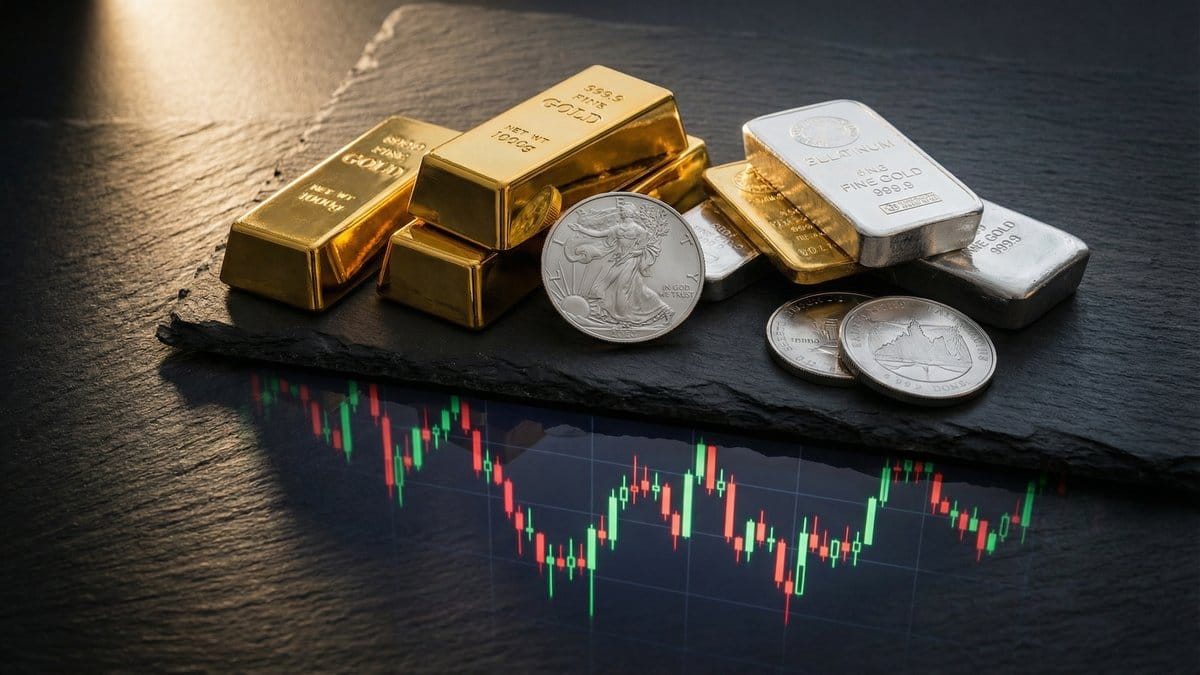
Silver Market Analysis
Silver is currently navigating a dual identity, caught between its historical role as a monetary metal and its increasingly critical function as an industrial commodity. Trading at $74.96 per ounce, silver has posted a nearly 5% year-to-date gain and recently secured its third consecutive weekly advance. The metal's price action is heavily influenced by the same macroeconomic factors driving gold, including the U.S. dollar's recent weakness and the geopolitical premium associated with the fragile Middle East ceasefire. However, silver's fundamental supply-demand dynamics offer a distinct narrative that is capturing investor attention.
The physical silver market has been operating in a structural supply deficit for several consecutive years. Global demand reached approximately 1.2 billion ounces in 2024 and remains elevated, propelled by accelerating adoption in green energy technologies, particularly solar photovoltaics, as well as electric vehicles and advanced electronics. Above-ground stocks are steadily depleting, creating a tight physical market that cushions downside price risk. Adding a modern twist to silver demand is the explosive growth of tokenized silver perpetual contracts on cryptocurrency exchanges, which saw trading volume surge over 65,000% in the first quarter of 2026, introducing a new layer of 24/7 speculative demand.
Investment implications: Silver offers a compelling asymmetric risk-reward profile. Its industrial applications provide a strong fundamental floor, while its monetary characteristics offer significant upside leverage to any potential Federal Reserve pivot or further geopolitical destabilization. The ongoing supply deficit suggests that physical silver and related equities could outperform broader market indices as industrial demand continues to outpace mine production.
Platinum & Palladium Update
The platinum and palladium markets are currently exhibiting divergent long-term setups despite recent parallel price declines. Platinum, trading at $2,055 per ounce, is down nearly 7% over the past month but remains an astonishing 119% higher year-over-year. The metal is supported by a projected 240,000-ounce supply deficit for 2026, following a massive 1.08 million-ounce deficit in 2025. Furthermore, bar and coin investment demand for platinum is expected to jump 35% this year, providing a broader base of support beyond its primary use in automotive catalytic converters.
Palladium, conversely, faces a more challenging fundamental landscape. Priced at $1,538 per ounce, it is heavily reliant on the automotive sector, making it highly sensitive to shifts in vehicle production and the ongoing transition to electric vehicles. The primary catalyst currently supporting palladium prices is trade uncertainty surrounding Russian supply. The U.S. Commerce Department is scheduled to issue a final countervailing duty determination on Russian palladium imports by May 20, 2026. This geopolitical risk premium is keeping prices elevated, but the metal's narrower demand base makes it more vulnerable to negative industrial sentiment compared to platinum.
Mining Stocks & ETFs
Precious metals mining stocks and related Exchange Traded Funds (ETFs) have delivered exceptional performance in 2026, offering investors leveraged exposure to the underlying commodity prices. The SPDR Gold Trust (GLD) and iShares Gold Trust (IAU) have both posted year-to-date gains of nearly 10%, closely tracking the spot price of gold. However, the real outperformance has been found in the equities of the miners themselves, which have benefited from expanding profit margins as gold prices remain well above all-in sustaining costs.
The VanEck Gold Miners ETF (GDX), which tracks major producers like Newmont and Barrick Gold, has surged over 13% year-to-date and an incredible 136% over the past year. The ETF recently traded near $99.39, a massive recovery from its April 2025 low of $40.26. Junior miners have also participated in the rally, with the VanEck Junior Gold Miners ETF (GDXJ) up nearly 12% year-to-date. This strong equity performance indicates that the market is increasingly confident in the sustainability of current precious metals prices and the operational efficiency of the mining sector.
Investment implications: Mining equities currently present an attractive proposition for investors seeking leveraged returns in the precious metals space. While they carry operational and jurisdictional risks not present in physical bullion, the current margin environment is highly favorable. Investors should focus on producers with strong balance sheets, consistent production profiles, and disciplined capital allocation strategies, as these companies are best positioned to translate high metal prices into robust free cash flow and shareholder returns.
Disclaimer: This analysis is for informational and educational purposes only and should not be considered financial advice. Precious metals investments carry significant price volatility and market risks. Always conduct your own research and consult with a qualified financial advisor before making investment decisions.
