


Wall Street extended its record-setting run on Tuesday, June 2, 2026, as the artificial intelligence trade continued to dominate market sentiment. The S&P 500 rose 0.13% to close at 7,609.78 — its latest all-time high — while the Dow Jones Industrial Average added 0.45% to finish at 51,307.79. The Nasdaq Composite edged up 0.03% to 27,093.90. All three major indexes have now posted fresh record closes in back-to-back sessions, driven almost entirely by a concentrated surge in AI-related stocks.
The day's single most explosive catalyst was a statement by Nvidia CEO Jensen Huang at Computex week in Taipei, Taiwan. Taking the stage alongside Marvell Technology CEO Matt Murphy, Huang declared, “Ladies and gentlemen, the next trillion-dollar company,” in direct reference to Marvell. The endorsement sent Marvell Technology (MRVL) shares surging as much as 26% on the day, adding over $47 billion in market capitalization in a single session — the stock's largest single-day gain on record.
The AI Chip Race Accelerates
Marvell Technology designs optical networking chips and custom AI accelerators — commonly called XPUs — for the world's largest cloud computing companies, including Microsoft and Amazon. Earlier this year, Nvidia announced a strategic partnership with Marvell and a $2 billion investment, cementing the relationship between the two chipmakers. Last week, Marvell projected its custom chip business would cross $10 billion in annual revenue by fiscal 2029, fueled by the relentless expansion of AI data center infrastructure.
Huang's trillion-dollar prediction is not without context. Marvell's market cap stood at approximately $192 billion at Monday's close — meaning the stock would need to rise roughly fivefold to reach the $1 trillion threshold. Yet the market's reaction underscores how seriously investors are taking the AI infrastructure buildout. Memory chipmaker Micron Technology (MU) crossed $1 trillion in market capitalization just last month, joining Samsung Electronics and SK Hynix in that elite club, driven by insatiable AI demand for high-bandwidth memory chips.
The Broader AI Rally: A Concentration Story
Today's market action reinforces a striking structural reality: the S&P 500's 2026 rally is not broad-based — it is being carried almost entirely by AI-related names. According to analysis from Goldman Sachs cited by Yahoo Finance, a version of the S&P 500 that strips out AI enablers is essentially flat since late February, while the headline index is up approximately 10% and AI winners have surged over 45% in the same period.
Research firm Bianco Research has gone further, arguing that the market has not been this concentrated around a single theme in 150 years. Using a JPMorgan list of 41 AI-related stocks, Bianco found those names now account for nearly half of the S&P 500's total market value — a level of concentration that draws comparisons to the railroad boom of the late 19th century. The cautionary parallel is the dot-com bubble: investors who exited in 1996 on Alan Greenspan's “irrational exuberance” warning missed a nearly 300% Nasdaq rally before the eventual peak.
| Index / Asset | June 2 Close | Daily Change | YTD Change |
|---|---|---|---|
| S&P 500 | 7,609.78 | +0.13% | +11.2% |
| Dow Jones Industrial Average | 51,307.79 | +0.45% | +6.8% |
| Nasdaq Composite | 27,093.90 | +0.03% | +16.6% |
| Russell 2000 | 2,931.96 | +0.90% | +18.1% |
| Marvell Technology (MRVL) | ~$273.70 | +26% | Record high |
| Gold (Spot) | $4,519.20/oz | -0.02% | +38% (1-yr) |
| Brent Crude Oil | ~$96/barrel | +1.0% | Elevated |
HPE Earnings: AI Infrastructure Demand Is Real
Hewlett Packard Enterprise (HPE) provided further confirmation that enterprise AI spending is accelerating, not slowing. The company reported record second-quarter earnings on Monday evening, with revenue reaching $10.7 billion — up 40% year over year — and adjusted earnings per share of $0.79, up 108%, blowing past its own guidance. HPE shares jumped nearly 25% over two sessions to hit all-time highs.
CEO Antonio Neri noted that “traditional server orders increased triple digits as customers continue to modernize their compute infrastructure and invest in AI inferencing.” Unlike the GPU-heavy training phase of AI development, inference — the process of running AI models to perform tasks — can be accomplished on conventional CPU-based servers, which HPE specializes in. This distinction is important: it means AI demand is now spreading beyond the small universe of GPU chipmakers into a much wider ecosystem of enterprise hardware companies.
Geopolitical Wildcard: Iran and Oil Prices
Beneath the AI euphoria, a significant geopolitical risk continues to simmer. The ongoing U.S.-Iran conflict has disrupted global oil supply chains, with Brent crude trading near $96 per barrel on Tuesday. A top executive at commodity trading giant Vitol warned at a London conference that U.S. and European leaders are “asleep at the wheel” regarding the severity of the oil supply crisis. Global oil inventories are approaching critical operational minimums, and refined products such as diesel and jet fuel are already seeing sharper price increases.
President Trump intervened on Monday to stabilize sentiment, announcing that Israel and Hezbollah had agreed to stop attacks and that U.S.-Iran negotiations were continuing “at a rapid pace.” The news helped lift oil prices modestly and improved broader market sentiment on Tuesday morning. With U.S. gasoline prices averaging $4.29 per gallon heading into the summer driving season, energy costs remain a meaningful headwind for consumers and corporate margins alike.
Labor Market Sends a Bullish Signal
Tuesday's economic data added another positive layer to the market narrative. The April Job Openings and Labor Turnover Survey (JOLTS) showed 7.62 million job openings — a nearly two-year high and a significant beat versus the 6.89 million economists had expected. Layoffs fell in the same period, suggesting the labor market remains resilient despite elevated interest rates and geopolitical uncertainty. This is the first in a series of employment reports this week, culminating in the May nonfarm payrolls report on Friday.
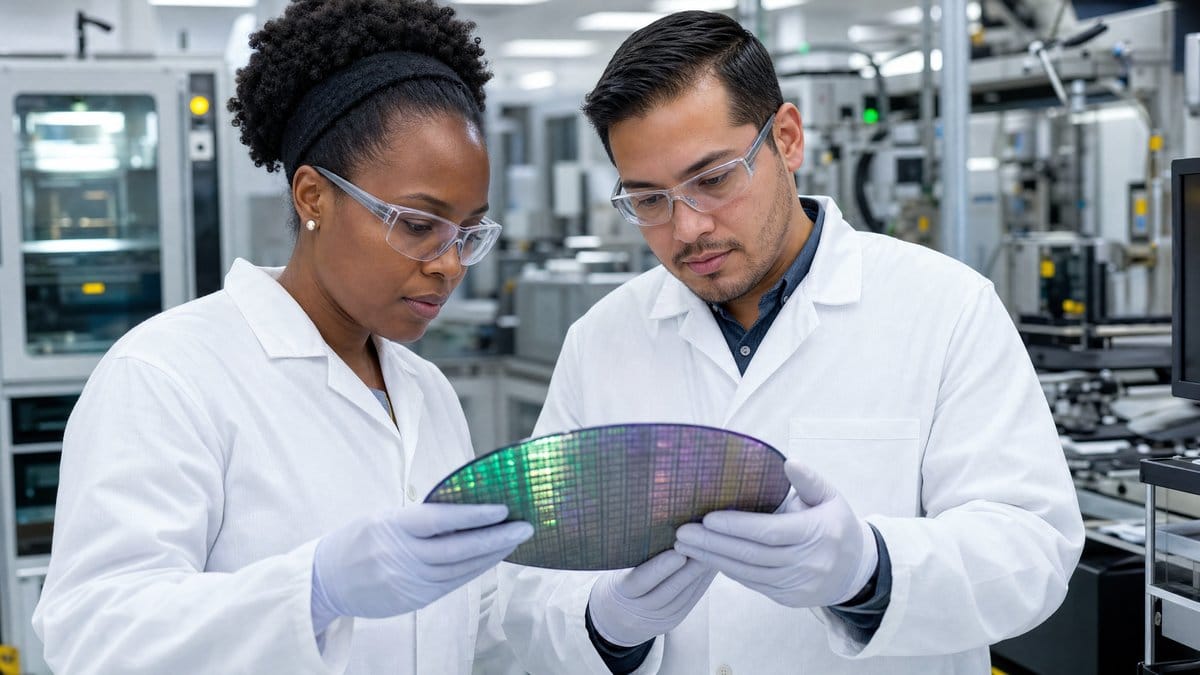
Semiconductor engineers examine a silicon wafer at an advanced chip fabrication facility. The AI infrastructure boom is driving unprecedented demand for custom chips and memory. (AI-generated editorial image)
What This Means for Retirement Investors
For investors aged 45 and older who are focused on building and protecting retirement wealth, today's market action carries several important implications. The AI trade is real, it is generating genuine earnings growth, and it is not going away — but its extreme concentration creates meaningful portfolio risk. If you hold broad index funds such as an S&P 500 ETF, you already have substantial AI exposure, whether you realize it or not. Nearly half the index's value is now tied to a single theme.
Diversification remains critical. The Russell 2000's 0.9% gain today — outpacing the S&P 500 — is a reminder that smaller-cap stocks, which have far less AI concentration, are also participating in the rally. Investors approaching or in retirement may want to review whether their equity exposure is appropriately balanced between AI-heavy large caps and the broader market.
On the energy side, elevated oil prices and geopolitical uncertainty in the Middle East argue for maintaining some allocation to energy sector equities or commodities as a hedge. Gold, trading at $4,519 per ounce, has risen 38% over the past year and continues to serve its traditional role as a store of value during periods of geopolitical stress.
Finally, the strong JOLTS data and Friday's upcoming jobs report will be closely watched by the Federal Reserve. A resilient labor market reduces the urgency for rate cuts, which means bond yields may remain elevated for longer — a consideration for retirees who rely on fixed-income portfolios for income generation.
Looking Ahead
The week's key catalysts include Palo Alto Networks (PANW) earnings after Tuesday's close, CrowdStrike (CRWD) results on Wednesday, and the May nonfarm payrolls report on Friday. Any disappointment from the cybersecurity sector — which has been riding the AI security wave — could test the market's resilience. Meanwhile, further developments in U.S.-Iran negotiations will continue to drive oil price volatility and broader risk sentiment.
The AI trade has now been the dominant market narrative for over two years. Whether Jensen Huang's trillion-dollar prediction for Marvell proves prescient or premature, the infrastructure buildout underpinning it — data centers, custom chips, networking hardware, and power infrastructure — represents a multi-year capital expenditure cycle that is reshaping the investment landscape for a generation.
Disclaimer: This article is for informational purposes only and should not be considered financial advice. Market conditions can change rapidly, and past performance does not guarantee future results. Always conduct your own research and consider consulting with a qualified financial advisor before making investment decisions.