



Market Overview
Wall Street delivered its strongest session in more than a year on Wednesday, as investors celebrated a decisive Democratic sweep of the U.S. midterm elections, piled into economically sensitive shares and dumped crude oil on hopes the war with Iran may be winding down.
The Dow Jones Industrial Average surged 1,569.40 points, or 3.03%, to close at 53,356.12 — its best day since April 9, 2025 and its first finish above 53,000 since September 8. The S&P 500 added 1.58% to 7,688.62, the Nasdaq Composite gained 1.44% to 25,736.51 and the Russell 2000 rose 1.58% to 2,856.95, evidence the advance reached well beyond mega-cap technology.
Sentiment shifted violently. The Cboe Volatility Index fell 20.3% to 16.61 as the removal of election uncertainty unlocked sidelined cash. President Donald Trump accepted the results and said he would work with the new Congress, a tone strategists credited for part of the rebound. “Markets like gridlock,” said Andrew Slimmon of Morgan Stanley Investment Management.
Oil supplied the second engine. Brent crude fell 8.6% to $94.70 a barrel, its first close below $100 in nearly a month, after Vice President JD Vance blamed the Iran conflict for Republican losses; West Texas Intermediate dropped more than 7.7% to below $90. Leadership rotated accordingly, with health care, financials, staples and solar leading while energy, defense and data-center technology lagged. Breadth was unusually healthy, with Walmart up 3% and Bank of America up 4% — participation missing during the narrow, AI-led advance.
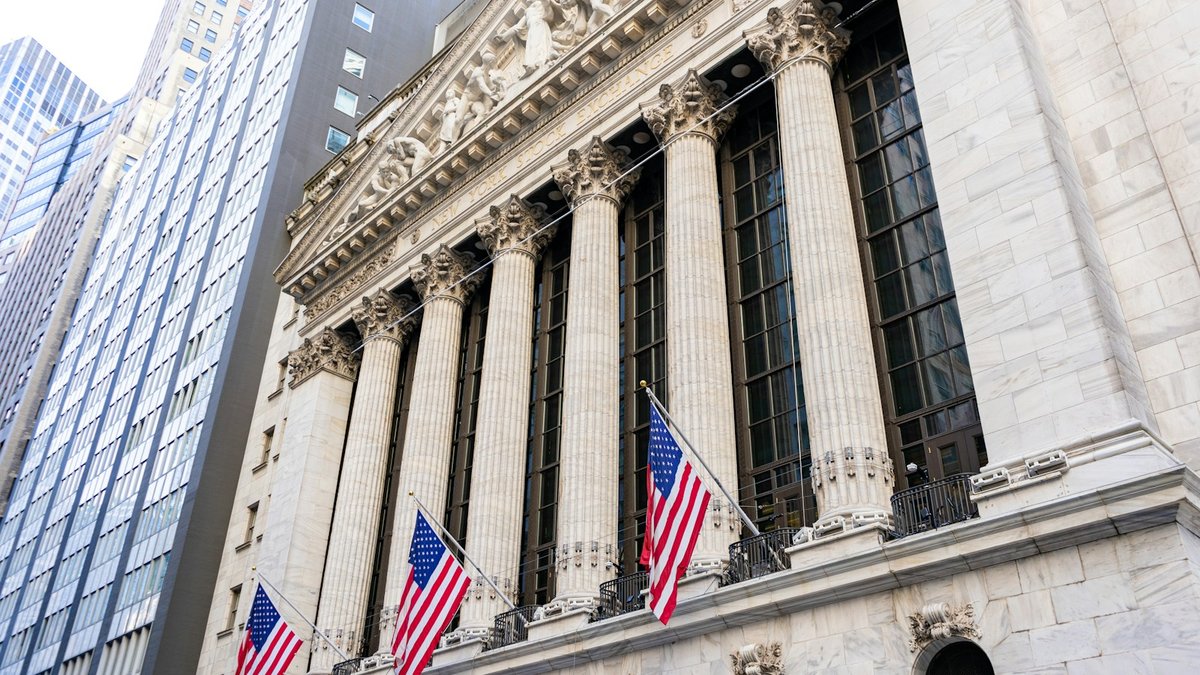
Photo: Unsplash
Top Market Movers
Apple rides the anti-AI trade to a record
Apple (AAPL) jumped 6% to an all-time high of $354.33, lifting its market capitalization above $5.12 trillion. The company had just reported a disappointing margin forecast on memory costs, but investors recast the stock as a defensive shelter: a Democratic Congress may slow data-center construction and ease that squeeze.
Investment implications: Apple’s move is a rotation signal, not an operating upgrade; buyers are paying for safety and balance-sheet quality, so position sizes should reflect that.
Chips and AI infrastructure crack
Nvidia (NVDA) fell 3% and CoreWeave (CRWV) tumbled 10.2% after Gina Hinojosa, the newly elected Democratic governor of Texas, promised a moratorium on new data centers in the country’s key AI construction hub. Alphabet (GOOGL) rose 4% and AMD (AMD) added 0.1%.
Investment implications: Regulatory risk has turned local and tangible for AI infrastructure; holders of data-center, power and networking exposure should stress-test for permitting delays, not just chip demand.
Energy shares surrender the war premium
ExxonMobil (XOM) fell 4.6% and ConocoPhillips (COP) dropped 5.2% as Brent settled 8.7% lower at $94.62. Both had rallied much of 2026 on the war. Defense contractors fell in sympathy, with Lockheed Martin (LMT) down 6.9% and Northrop Grumman (NOC) off 4.5%.
Investment implications: Energy and defense are now binary bets on Middle East de-escalation, which argues for trimming momentum positions and favoring low-cost integrated majors.
Health care and discount retail catch a bid
HCA Healthcare (HCA) climbed 9.6% and Dollar Tree (DLTR) rose 8.9% on bets a Democratic Congress will resist cuts to federal health programs and food assistance, while First Solar (FSLR) gained 4.6% on friendlier clean-energy expectations.
Investment implications: Policy-sensitive value stocks carry a visible catalyst into 2027, though divided government rarely legislates quickly.
Economic Data & Fed Watch
The macro backdrop did not cooperate with the bullish mood. The ISM services index slipped to 54.5 in October from 54.9, with new orders down 3.9 points to 55.9, while the prices-paid gauge held at an elevated 73.0 — a reminder that services inflation remains sticky. ADP reported private employers added 86,000 jobs in October, and Tuesday’s JOLTS data showed broad improvement in hiring and quits.
The Federal Reserve has shifted decisively hawkish. Policymakers held the benchmark rate at 3.75%-4.00% on October 28 by a 10-2 vote, with Governors Lisa Cook and Beth Hammack dissenting in favor of an immediate quarter-point increase, following September’s hike. Chair Kevin Warsh argued the economy is not “too hot,” but the statement promised the committee “will deliver price stability.” Futures price roughly a 79% chance of another quarter-point hike on December 9.
Treasury yields fell as oil tumbled and investors bet divided government constrains deficit expansion. The 10-year note ended at 4.888%, down from 4.95%, and eased to about 4.84% on Thursday, an eight-week low. The two-year touched 4.546% before settling near 4.604%, and the 30-year slipped to roughly 5.28%. The dollar weakened, the ICE U.S. Dollar Index down 0.38% to 101.48 after a one-month low near 101.21.
Investment implications: A hiking Fed with sticky services inflation favors short-duration bonds, cash-like instruments and pricing-power equities over long-duration growth. Thursday’s yield decline looks more like a growth scare than relief.

Photo: Unsplash
International Markets
Europe rallied hard on the U.S. result. The pan-European STOXX 600 jumped 1.82% to 657.40 on Wednesday, its best session since June 12, led by banks, luxury and renewable energy shares; the Euro Stoxx 50 gained 2.3%. Momentum continued into Thursday, with the STOXX 600 up 0.6% to a record high as LVMH added 3.3%, while Shell and TotalEnergies slipped 1.9% and 2.8%. Rheinmetall plunged more than 16% after cutting guidance, a warning for Europe’s defense complex.
Asia was split. Selling in artificial-intelligence hardware hammered Korea’s Kospi, down 3.5% at 5,484.38, with Samsung Electronics off 5.7% and SK Hynix down 7.4%. Tokyo’s Nikkei 225 fell 0.5% to 61,914.53 as Tokyo Electron shed 7.7% and Advantest tumbled 9.4%, while Taiwan’s Taiex lost 1.6%. Markets less exposed to AI supply chains gained: Hong Kong’s Hang Seng rose 2.8% to 24,597.59, Shanghai added 0.1% and Australia’s ASX 200 climbed 1.9% to 9,003.40.
In currencies, the dollar slipped to 157.96 yen from 158.41, and the euro firmed to $1.1256 from $1.1228. The Bank of England is expected to lift its benchmark rate a quarter point to 4% on Thursday, its first increase in three years.
Looking Ahead
Thursday’s U.S. calendar brings the Challenger job-cut report at 5:30 a.m. ET, weekly jobless claims at 8:30 a.m. ET — consensus near 197,000 versus 194,000 previously — and third-quarter productivity and unit labor costs. Friday’s October employment report is the week’s main event: economists expect payrolls of about 65,000, unemployment steady at 4.2% and average hourly earnings up 0.3%. October CPI follows on November 10.
Earnings remain a swing factor. Airbnb and Cloudflare report after Thursday’s close, and Qualcomm’s soft guidance — phone chip sales down 26% — already sent its shares 6.9% lower in extended trading, a caution flag for handset-exposed suppliers.
Politically, every signal on Iran will be parsed: Trump has paused planned strikes to pursue talks, but no agreement is in place and the Strait of Hormuz remains the largest swing factor for crude. Domestically, the new Congress’s agenda on health care, tariffs and data-center permitting will shape sector leadership into year-end, while the December 8-9 FOMC meeting caps the calendar.
Pre-market futures pointed to a pause: S&P 500 futures down about 0.1%, Nasdaq futures off 0.8%, Dow futures up 0.4% and Russell 2000 futures up 0.3%, with gold near $4,137 an ounce.
Sources
- CNBC: Dow soars 1,500 points for best day since April 2025
- AP via PBS: Stocks surge as Brent drops below $95
- Reuters: Fed leaves rates unchanged
- Morningstar: October jobs report preview
- AP via Asahi Shimbun: Asian shares mostly advance
- Trading Economics: European stocks extend gains
- BLS: November 2026 release schedule
- WSJ: Treasury yields fall to eight-week lows
Disclaimer: This analysis is for informational and educational purposes only and should not be considered financial advice. Market conditions can change rapidly, and past performance does not guarantee future results. Always conduct your own research and consult with a qualified financial advisor before making investment decisions.