



Week Ahead Overview
As 2025 draws to a close, investors are turning their attention to a holiday-shortened week that promises to offer crucial insights into the year ahead. While trading activity may be lighter due to the New Year's holiday, the economic calendar is punctuated by several key releases that could set the tone for January and beyond. The main event will be the release of the Federal Reserve's December FOMC meeting minutes on Tuesday, which will be scrutinized for clues about the central bank's 2026 policy trajectory. Alongside the Fed minutes, a slate of housing data will provide a fresh reading on the health of the real estate market, while weekly jobless claims will offer a timely update on the labor market. With major indices trading near record highs after a stellar 2025, this week's data will be critical in determining whether the market's bullish momentum can be sustained as a new year begins.
Economic Calendar Highlights
The upcoming week features a condensed but significant economic calendar. On Monday, December 30th, at 10:00 AM ET, the Pending Home Sales report for November will be released. After a 1.9% increase in October, the consensus forecast is for a more modest 1.0% rise, which would still indicate resilience in a housing market grappling with affordability challenges. Later that morning, at 10:30 AM ET, the Dallas Fed Manufacturing Business Index for December will offer a regional snapshot of manufacturing activity.
Tuesday, December 31st, is the most pivotal day of the week. The morning brings the S&P Case-Shiller Home Price Index for October at 9:00 AM ET, followed by the Chicago PMI for December at 9:45 AM ET. However, all eyes will be on the FOMC Meeting Minutes from the December meeting, scheduled for release at 2:00 PM ET. At that meeting, the Fed signaled a more cautious approach to rate cuts than many investors had anticipated. The minutes will provide a detailed look at the internal debate among policymakers and could significantly shift market expectations for the timing and pace of rate cuts in 2026.
On Wednesday, January 1st, before the New Year's holiday, the weekly Initial Jobless Claims report will be released at 8:30 AM ET. After coming in at a low 214,000 in the prior week, another strong reading would underscore the continued tightness of the labor market, a key factor in the Fed's policy calculus. Bond markets will have an early close at 2:00 PM ET on Wednesday, and all U.S. markets will be closed on Thursday, January 2nd, for New Year's Day.
Investment Implications: The Fed minutes are the week's biggest potential market mover. A more hawkish tone than expected could temper the market's recent rally, while a dovish surprise could add further fuel to the fire. The housing data will be important for the real estate and construction sectors, and continued strength in the labor market could push back expectations for Fed rate cuts, potentially creating headwinds for equities.
Earnings Season Focus
With the holiday season in full swing, the earnings calendar is quiet this week, with no major companies scheduled to report. However, this lull provides an opportunity for investors to look ahead to the fourth-quarter 2025 earnings season, which will kick off in mid-January with reports from the major banks. The outlook for 2026 earnings is a key pillar supporting the market's current valuation. Wall Street analysts are forecasting impressive S&P 500 earnings per share (EPS) growth of around 12.5% in 2026, a significant acceleration from the estimated 8.6% growth in 2025.
The technology sector is expected to be a primary driver of this growth. The seven largest tech companies—Nvidia, Apple, Microsoft, Google, Amazon, Broadcom, and Meta—now account for roughly a quarter of the S&P 500's total earnings and are projected to deliver outsized profit gains as the artificial intelligence (AI) investment cycle continues to ramp up. Analysts project that these tech giants could see sales growth of around 20% in 2026, fueled by the ongoing buildout of AI infrastructure.
Investment Implications: As the fourth-quarter earnings season approaches, investors should focus on companies with strong earnings visibility and pricing power. The technology sector, particularly companies exposed to the AI theme, remains a key area of focus. Beyond tech, financials could benefit from a stable rate environment, while consumer discretionary stocks will be watched closely for signs of a post-holiday slowdown. The expected 12.5% earnings growth for the S&P 500 in 2026 provides a fundamental underpinning for the market, but any signs of a significant slowdown in that growth could pose a risk to valuations.

Technical Market Outlook
The S&P 500 enters the final week of 2025 in a position of technical strength, trading just shy of its all-time highs. As of the close on December 26th, the index stood at 6,929.94, boasting a year-to-date gain of over 17%. The technical picture is overwhelmingly bullish, with the index trading above all its key moving averages. The 50-day moving average at 6,853 and the 200-day moving average at 6,798 now represent significant levels of underlying support.
The market's momentum is also strong. The 14-day Relative Strength Index (RSI) is at a healthy 69.8, and while this is approaching overbought territory (a reading above 70), it is not yet at a level that would signal an imminent reversal. The MACD (Moving Average Convergence Divergence) indicator is also in positive territory, confirming the bullish trend. The immediate resistance level to watch is the recent high around 6,950. A decisive breakout above this level could open the door to a test of the psychologically important 7,000 mark.
Investment Implications: The technical setup for the S&P 500 is constructive heading into 2026. The strong uptrend is well-supported, and any pullbacks are likely to be viewed as buying opportunities. A dip to the 50-day moving average would represent a healthy consolidation. However, with the RSI near overbought levels, some caution is warranted, and investors should consider using stop-losses to protect profits. The Dow Jones Industrial Average and the Nasdaq Composite are also showing similar technical strength, confirming the broad-based nature of the current rally.
What to Watch
As investors position their portfolios for 2026, three key themes will dominate the narrative in the week ahead. First and foremost is the Federal Reserve's policy path. The December FOMC minutes will be the most important data point of the week, offering clarity on the central bank's thinking regarding the timing of future rate cuts. The market is currently pricing in two to three cuts in 2026, and any deviation from this expectation could lead to significant market volatility.
The second theme to watch is year-end market dynamics and the January Effect. The “Santa Claus Rally” has been in full swing, and historical data suggests that strong performance in the last five trading days of the year and the first two of the new year can bode well for the rest of January. With tax-loss harvesting now complete, fresh capital may be deployed in the new year, providing further momentum.
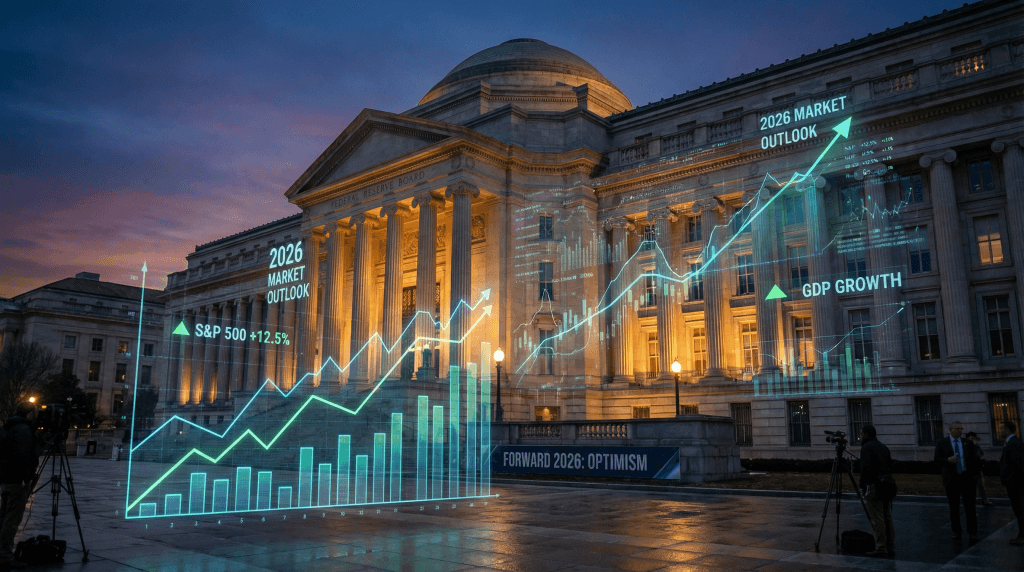
The third key theme is the 2026 market outlook that is beginning to take shape. The Wall Street consensus is for the S&P 500 to reach 7,555 in 2026, implying a further 9% upside from current levels. This outlook is predicated on continued earnings growth, particularly from the AI-driven technology sector. However, risks remain, including the potential for a rise in bond yields, elevated valuations, and ongoing policy uncertainty.
Investment Implications: This holiday-shortened week offers a good opportunity for investors to review their portfolios and prepare for the year ahead. After the strong gains of 2025, rebalancing may be a prudent strategy. A focus on quality companies with strong earnings visibility and exposure to durable themes like AI is recommended. While the outlook for 2026 is generally positive, investors should remain vigilant and be prepared for potential volatility in the first half of the year. Diversification remains a key principle for navigating the opportunities and risks that lie ahead.