



Week Ahead Overview
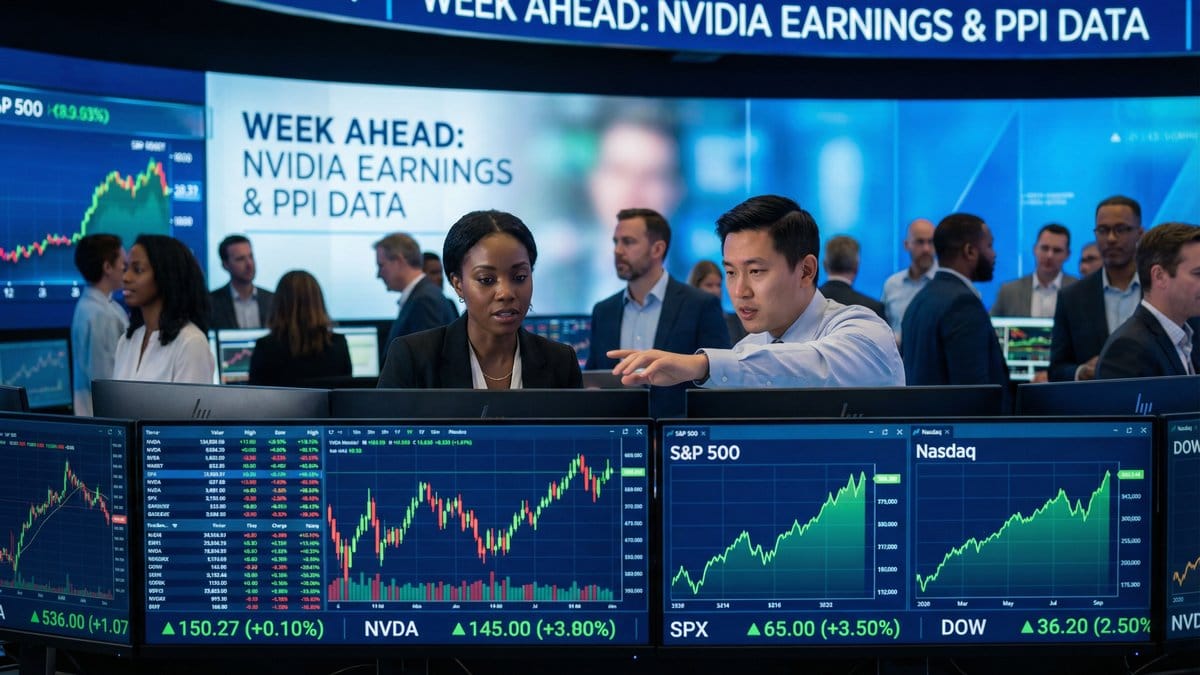
The stock market enters the final full week of February navigating a complex landscape of critical earnings reports, pivotal inflation data, and simmering geopolitical tensions. After a week that saw major indices post modest gains despite a mixed bag of economic signals, investors are bracing for a period of heightened volatility. The S&P 500 closed up 1.07%, the Nasdaq Composite gained 1.51%, and the Dow Jones Industrial Average edged higher by 0.25%. Market sentiment remains cautious, as reflected by a Fear & Greed Index reading of 43, indicating “Fear” among investors. The primary catalysts for the upcoming week will be Nvidia's highly anticipated earnings report, which will serve as a crucial test for the AI-driven market rally, and the Producer Price Index (PPI) data, which will provide a key update on the inflation front. Adding to the uncertainty is the ongoing trade policy saga, with the Trump administration pivoting to new tariff strategies following a Supreme Court setback, and escalating tensions between the United States and Iran, which have already pushed oil prices higher.
Economic Calendar
The economic calendar is packed with market-moving events, headlined by the Producer Price Index (PPI) report on Friday, February 27. Economists expect headline PPI to have risen 0.3% month-over-month in January, a deceleration from the 0.5% increase in December. The core PPI, which excludes food and energy, is also forecast to rise 0.3%, down sharply from 0.7% previously. Any deviation from these expectations could significantly impact the Federal Reserve's policy outlook and reshape expectations for the timing of rate cuts. Earlier in the week, the Conference Board's Consumer Confidence Index on Tuesday is projected to show a modest improvement to 87.6 from 84.5, a reading that will test whether high interest rates and inflation are beginning to erode the resilience of the American consumer. Weekly unemployment claims on Thursday are forecast at 216,000, up slightly from 206,000 the prior week, providing a real-time snapshot of labor market health.
Adding to the complexity of the week is an unusually heavy schedule of Federal Reserve speakers. Governors Waller, Goolsbee, Cook, Barkin, Schmid, Musalem, and Bowman are all scheduled to make public remarks across the week. Their comments will be dissected for any signals about the future path of monetary policy, particularly after recent FOMC minutes revealed that several participants remain open to rate hikes if inflation fails to moderate. The volume of Fed commentary this week significantly increases the probability of market-moving headlines.
Investment implications: A hotter-than-expected PPI report could reignite inflation fears and lead to a repricing of Fed rate cut expectations, potentially pressuring growth and technology stocks while benefiting value-oriented and defensive sectors. Conversely, a softer reading could bolster the case for a more accommodative Fed, providing a tailwind for equities broadly. Investors should also monitor the Consumer Confidence data closely, as a continued decline could signal a weakening consumer spending outlook with implications for retail and consumer discretionary stocks.
Earnings Season Focus
Earnings season continues with another slate of high-profile reports, but all eyes will be on Nvidia, which is set to release its fourth-quarter fiscal year 2026 results on Wednesday, February 25, after the market close. The chipmaker has been the undisputed leader of the AI revolution, and its performance is widely seen as a barometer for the entire technology sector and the broader AI investment thesis. Analysts are forecasting earnings per share of $1.53 on revenue of approximately $65 billion. Beyond the headline numbers, investors will be laser-focused on the company's guidance and commentary on demand for its AI chips, particularly the new Blackwell architecture. Alongside Nvidia, Salesforce reports Wednesday after the close, with analysts expecting EPS of $3.05, offering a window into enterprise AI software spending trends.
Earlier in the week, home improvement giant Home Depot reports Tuesday before the open, with consensus estimates calling for EPS of $2.53. Its results will serve as a key barometer for consumer spending on big-ticket items and the state of the housing market. Lowe's Companies reports Wednesday before the open, providing a complementary read on the same sector. Cloud software leader Workday also reports Tuesday after the close, while Dell Technologies and Intuit round out the week's major reports on Thursday after the close, with estimates of $3.52 and $3.68 per share, respectively. Dell's results will be particularly watched for evidence of AI-driven demand for its server and infrastructure products.
Investment implications: Nvidia's report is a potential make-or-break event for the market's near-term direction. A strong beat and positive guidance could propel the entire technology sector higher and reaffirm the AI investment narrative, potentially pushing the S&P 500 through the critical 7,000 resistance level. A disappointment, however, could trigger a significant sell-off in AI-related stocks. The reports from Home Depot and Lowe's will be crucial for gauging consumer resilience, while results from Salesforce and Workday will indicate the health of enterprise IT budgets.

Geopolitical & Policy Watch
The geopolitical and policy landscape remains a significant source of uncertainty for markets this week. On the trade front, the Supreme Court's landmark ruling on February 20 striking down the Trump administration's use of the International Emergency Economic Powers Act (IEEPA) to impose broad tariffs created a brief sense of relief. However, the administration quickly pivoted, imposing a new 10% global tariff under Section 122 of the Trade Act and subsequently announcing plans to raise it to 15%. This renewed protectionism creates a challenging environment for multinational corporations, could disrupt global supply chains, and adds an inflationary dimension to an already complex economic picture. The European Union has stated that the U.S. must honor its existing trade commitments, setting the stage for potential transatlantic trade friction.
Simultaneously, tensions between the United States and Iran are escalating sharply. Reports indicate that the Trump administration is actively considering a limited military strike to pressure Tehran into a nuclear deal. Iran and Russia have responded by announcing joint naval exercises in the Sea of Oman, raising the risk of a confrontation near the strategically vital Strait of Hormuz, through which approximately 20% of global oil supply flows. This geopolitical risk premium has already contributed to a 5% surge in oil prices over the past week, with further gains possible if tensions escalate. Higher energy prices would complicate the Federal Reserve's inflation fight and could weigh on consumer spending.
Technical & Sentiment Indicators
From a technical perspective, the S&P 500 is currently trading in a well-defined range, with key support established at approximately 6,775 and major psychological resistance at the 7,000 level. A decisive break above 7,000 could open the door to a test of the all-time highs, while a breach of support at 6,775 could trigger a more significant pullback toward the next support zone near 6,522. The Nasdaq Composite, which has shown relative strength recently, finds its next major support at its 52-week moving average around 21,000, with resistance near 24,000. The Dow Jones Industrial Average is approaching its own key resistance at 50,512, with support at 48,428. Critically, all three major indices remain above their rising 52-week simple moving averages, confirming that the primary long-term uptrend remains intact.
Despite the recent resilience, market sentiment indicators paint a picture of underlying anxiety. The CBOE Volatility Index (VIX) is hovering around 19, an elevated level suggesting that options markets are pricing in a meaningful degree of uncertainty. The CNN Fear & Greed Index, which aggregates seven market sentiment indicators, currently reads 43, firmly in “Fear” territory. This combination of elevated volatility and fearful sentiment suggests that the market is vulnerable to sharp swings in either direction, depending on the outcome of the week's key catalysts. Nvidia's earnings and the PPI report are the two events most likely to determine whether the market breaks out of its current range or retreats to test support.
Disclaimer: This analysis is for informational and educational purposes only and should not be considered financial advice. Market forecasts are inherently uncertain, and actual events may differ materially from expectations. Always conduct your own research and consult with a qualified financial advisor before making investment decisions.