



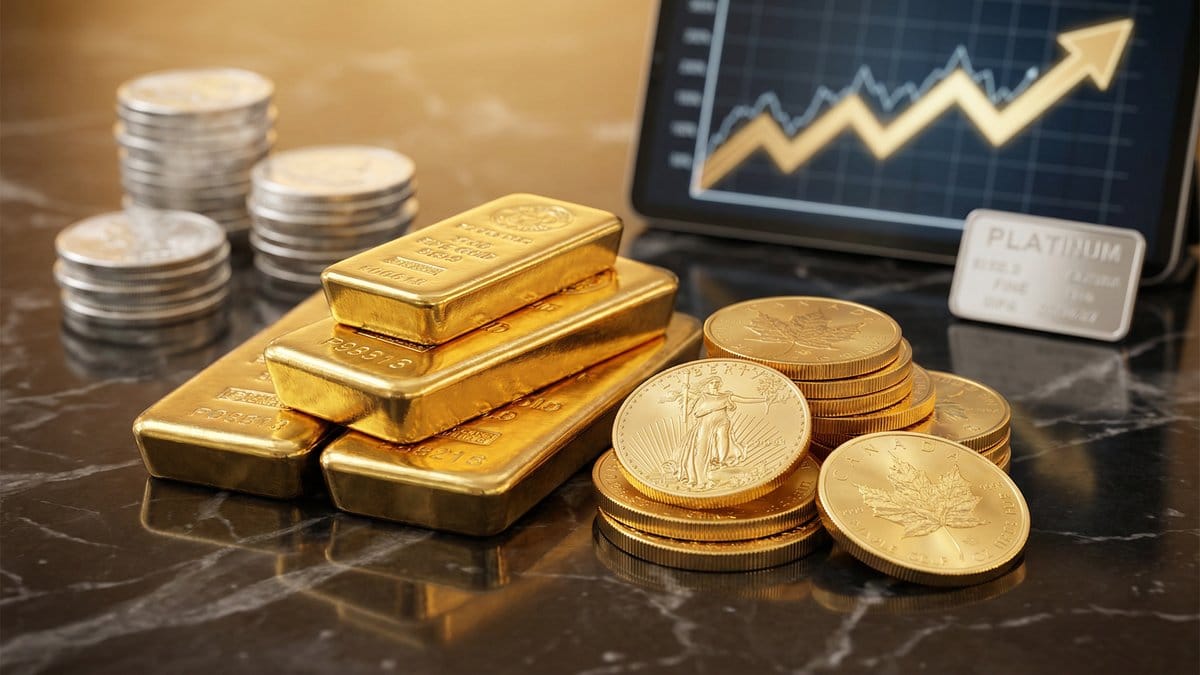
Precious Metals Overview
The precious metals sector has experienced a period of intense volatility and significant price action as we move through early April 2026. Investors are navigating a complex landscape defined by geopolitical tensions, shifting monetary policy expectations, and distinct supply-demand fundamentals across the complex. After a powerful multi-session rally that pushed prices to near-record levels, the market has seen a wave of profit-taking, leading to a sharp but potentially healthy correction.
As of the latest market data, gold is trading near $4,688 per ounce, having retreated slightly from its recent highs above $4,769. Silver has experienced a more pronounced pullback, currently trading around $73.75 per ounce after touching the $75.80 mark. In contrast to the monetary metals, the platinum group metals (PGMs) have shown resilience driven by supply concerns. Platinum has advanced to approximately $2,014 per ounce, while palladium has climbed to $1,531 per ounce. This divergence highlights the unique drivers currently influencing each metal, from safe-haven demand to industrial applications and trade policies.
Gold Market Analysis
The gold market has been the focal point of intense investor interest, driven by a confluence of macroeconomic and geopolitical factors. The recent price action, which saw gold surge past $4,769 before retreating to the $4,688 level, reflects a market balancing safe-haven demand against the realities of profit-taking and shifting interest rate expectations. A primary catalyst for the recent volatility has been the escalating geopolitical tensions in the Middle East, particularly the ongoing conflict involving Iran. President Trump’s recent prime-time address, which outlined an extended timeline for military objectives and threatened further strikes on Iranian infrastructure, initially drove a surge in safe-haven buying.
However, the market’s reaction has been tempered by robust U.S. economic data. The recent ADP National Employment Report showed stronger-than-expected private sector job gains, and initial jobless claims came in below consensus estimates. This resilient labor market data has complicated the outlook for Federal Reserve rate cuts, as strong employment figures give the central bank less urgency to ease monetary policy. The resulting strength in the U.S. dollar and elevated Treasury yields have provided headwinds for gold, prompting the recent wave of profit-taking. Despite this pullback, the underlying structural support for gold remains strong, driven by persistent inflation concerns, highlighted by the recent surge in the ISM prices-paid index, and ongoing central bank purchases.
Investment implications: The current correction in gold prices may present a strategic entry point for long-term investors. While short-term volatility is likely to persist due to geopolitical headlines and economic data releases, the macroeconomic backdrop of sticky inflation and global uncertainty continues to support a bullish long-term thesis for the yellow metal. Investors should monitor key support levels around the $4,600 mark and consider utilizing dollar-cost averaging strategies to build positions during periods of market weakness.
Silver Market Analysis
Silver has exhibited its characteristic high volatility, amplifying the moves seen in the gold market. After a strong rally that pushed prices above $75.80 per ounce, silver experienced a sharp pullback, dropping to the $73.75 level. This price action reflects the dual nature of silver as both a monetary asset and a critical industrial commodity. On the monetary side, silver has been caught in the same safe-haven and interest rate dynamics as gold, benefiting from geopolitical fears but suffering when strong economic data boosts the dollar and yields.
However, the long-term story for silver is increasingly dominated by its industrial applications, particularly in the green energy sector. The demand for silver in photovoltaic (PV) solar panels continues to surge, with the solar sector now accounting for nearly 29% of total industrial silver demand, up from just 11% a decade ago. Despite efforts by manufacturers to reduce the silver loadings in individual panels due to rising costs, the sheer volume of solar capacity being installed globally is driving aggregate demand higher. Furthermore, the growing electric vehicle (EV) market and the expansion of AI data centers are adding new layers of structural demand. This robust industrial consumption is occurring against a backdrop of constrained mine supply, leading analysts to project a significant market deficit for the eighth consecutive year in 2026.
Investment implications: Silver’s compelling fundamental story, characterized by surging industrial demand and chronic supply deficits, makes it an attractive asset for investors seeking leverage to the green energy transition. The current price pullback offers a potential buying opportunity, as the structural supply-demand imbalance is likely to provide a strong floor for prices over the medium to long term. Investors should be prepared for continued volatility but recognize the potential for significant upside as industrial consumption continues to outpace mine production.
Platinum & Palladium Update
The platinum group metals (PGMs) have charted a different course than gold and silver, driven primarily by supply-side dynamics and specific industrial use cases. Platinum has shown notable strength, advancing to $2,014 per ounce. This positive momentum is underpinned by a projected market deficit of 240,000 ounces for 2026, as forecasted by the World Platinum Investment Council (WPIC). This deficit follows an even deeper shortfall in 2025, leading to a significant drawdown in above-ground stocks. Platinum’s demand profile is also benefiting from strong investment interest, with bar-and-coin demand expected to jump 35% this year, alongside steady consumption in the automotive sector for catalytic converters and growing applications in the hydrogen economy.
Palladium, trading around $1,531 per ounce, remains heavily influenced by geopolitical and trade-related factors. The metal has seen support from preliminary U.S. antidumping and countervailing duties on Russian palladium imports, which have maintained a risk premium in the market due to potential supply disruptions. However, palladium faces a more challenging long-term demand outlook compared to platinum. Its primary use is in catalytic converters for gasoline-powered vehicles, a sector facing headwinds from the transition to electric vehicles. While supply concerns provide short-term support, the structural demand picture for palladium is less robust than that of its sister metal.

Mining Stocks & ETFs
The performance of precious metals mining stocks has been a focal point for investors seeking leveraged exposure to the underlying commodities. The sector has experienced extreme volatility, mirroring the price action of gold and silver. The VanEck Gold Miners ETF (GDX), a benchmark for the industry, hit an all-time high earlier in the year before suffering a significant plunge of over 30% in a matter of weeks. This sharp correction was driven by a combination of profit-taking, technical overextension, and the broader market sell-off.
Despite this volatility, the fundamental picture for major mining companies remains exceptionally strong. Top-tier producers like Newmont and Barrick Gold have reported record unit profits, benefiting from the high average gold prices and relatively stable all-in sustaining costs (AISC). In the fourth quarter of 2025, unit profits for the top GDX components soared over 100% year-over-year, and early estimates suggest another blowout quarter for Q1 2026. This explosive earnings growth is making the sector increasingly attractive from a valuation perspective, especially as broader equity markets face headwinds. Furthermore, historical seasonal patterns suggest that gold stocks often experience a strong spring rally, providing a potential tailwind for the sector in the coming months.
Investment implications: The recent sharp correction in mining stocks has largely flushed out the extreme overbought conditions, creating a more favorable risk-reward setup for investors. With fundamentals remaining robust and valuations becoming more compelling, the sector offers significant upside potential if gold prices maintain their upward trajectory. Investors should focus on high-quality producers with strong balance sheets, proven management teams, and a track record of cost control. The GDX ETF remains a viable option for broad sector exposure, while individual stock selection can provide opportunities for outperformance.
Disclaimer: This analysis is for informational and educational purposes only and should not be considered financial advice. Precious metals investments carry significant price volatility and market risks. Always conduct your own research and consult with a qualified financial advisor before making investment decisions.