



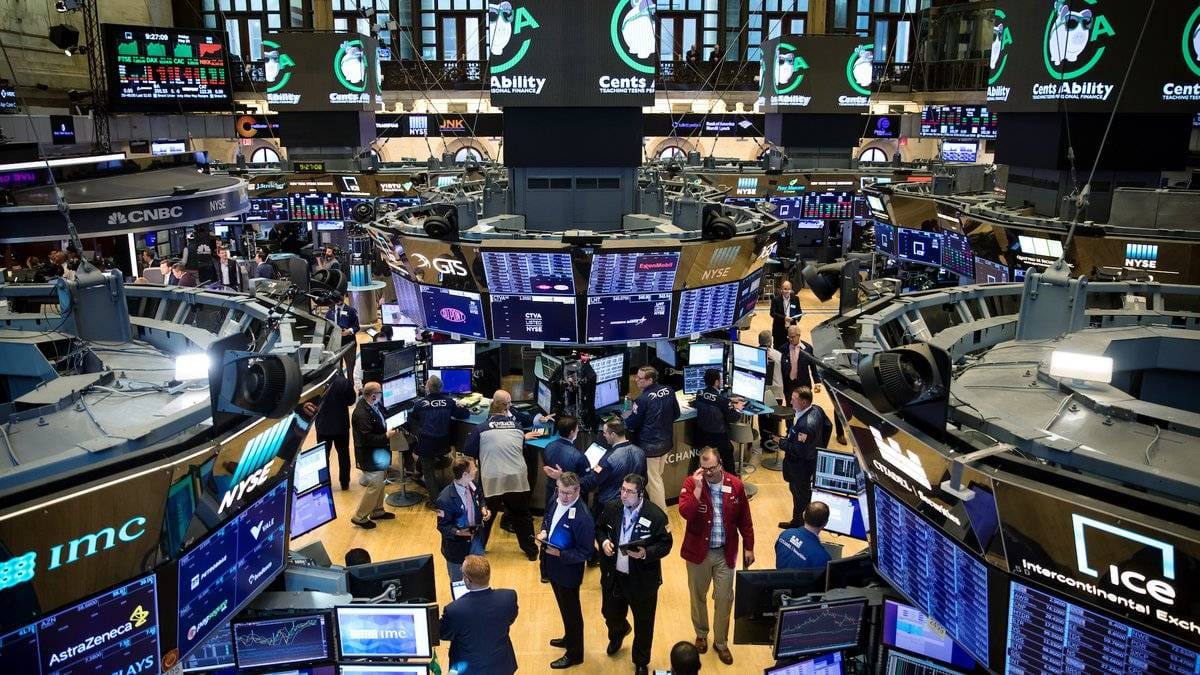
U.S. equity markets ended Thursday's session largely flat as investors weighed a mixed bag of economic data against a flurry of corporate earnings results and ongoing geopolitical developments in the Middle East. The S&P 500 settled at 7,520.36, gaining a modest 0.02%, while the Dow Jones Industrial Average added 182.60 points, or 0.36%, to close at 50,644.28. The Nasdaq Composite edged up 0.07% to 26,674.73. Markets had been under pressure earlier in the session following reports of fresh U.S. strikes near the Strait of Hormuz, but a late-session report that negotiators had reached a deal to extend the Iran ceasefire helped stabilize sentiment.
Market Overview
Thursday's session was defined by a tug-of-war between positive earnings surprises and macro headwinds. The Cboe Volatility Index (VIX) rose 0.86% to 16.43, reflecting modest nervousness among investors, though levels remain well below the elevated readings seen during the height of the Iran conflict earlier this year. WTI crude oil surged 2.13% to $90.55 per barrel as the Strait of Hormuz remained partially disrupted, adding inflationary pressure to an already complex economic backdrop.
Market breadth showed signs of improvement, with approximately 58% of S&P 500 stocks trading above their 50-day moving average, up from roughly 43% just two weeks ago. Despite this broadening, strategists caution that market strength remains relatively concentrated in technology and AI-related names, leaving indexes potentially vulnerable to a sharp reversal should macro conditions deteriorate further.
| Index | Close | Change | % Change |
|---|---|---|---|
| S&P 500 | 7,520.36 | +1.24 | +0.02% |
| Dow Jones Industrial Average | 50,644.28 | +182.60 | +0.36% |
| Nasdaq Composite | 26,674.73 | +18.55 | +0.07% |
| VIX (Volatility Index) | 16.43 | +0.14 | +0.86% |
| WTI Crude Oil | $90.55 | +$1.89 | +2.13% |
| 10-Year Treasury Yield | 4.47% | Unch. | — |
| U.S. Dollar Index | 99.14 | -0.06 | -0.06% |
| Bitcoin | $73,245 | -$1,455 | -1.94% |
Top Market Movers
Dell Technologies (DELL): Blockbuster AI-Driven Quarter
The session's most dramatic development came after the closing bell, when Dell Technologies reported fiscal Q1 FY2027 results that obliterated Wall Street expectations. Dell posted earnings per share of $4.86 against the consensus estimate of $2.96, a beat of $1.90. Revenue came in at $43.84 billion, surpassing the $35.74 billion forecast by more than $8 billion and representing an extraordinary 87.5% year-over-year increase. AI server revenue alone reached $16.1 billion in the quarter, with AI orders totaling $24.4 billion and the company's AI backlog hitting a record $51.3 billion. Dell raised its full-year guidance to $165–$169 billion in revenue with EPS of approximately $17.90 at the midpoint. Shares surged approximately 38.6% in after-hours trading to $440.99 from a regular-session close of $318.22.
Investment implications: Dell's results underscore the extraordinary pace of enterprise AI infrastructure buildout. The record backlog and raised guidance suggest demand is structural rather than cyclical, potentially benefiting the broader AI hardware supply chain including memory manufacturers, networking companies, and data center REITs. Investors in AI-adjacent names should monitor whether Dell's supply constraints — primarily in memory — ease in coming quarters, as this could signal a further acceleration in revenue recognition.
Snowflake (SNOW): AI Monetization Gains Traction
Snowflake reported Q1 FY2027 results the prior evening that sent shares surging more than 35% in Thursday's premarket session, with the stock maintaining much of those gains through the regular session. The cloud data platform company beat both revenue and earnings estimates, raising its fiscal year 2027 product revenue growth guidance to approximately 30.6%. Analysts at Wedbush raised their price target to $280 from $270, citing increased confidence in the company's AI monetization strategy through products such as Cortex and Snowflake Intelligence. The company also announced a $6 billion cloud deal with Amazon, further cementing its position in the enterprise AI data infrastructure space.
Investment implications: Snowflake's results challenge the narrative that the company was losing market share to competitors such as Databricks. The combination of accelerating product revenue growth and a major cloud partnership suggests the AI data platform market is large enough to support multiple winners. Investors should watch whether the Amazon deal translates into meaningful revenue acceleration in subsequent quarters.
Retail Earnings: Best Buy and Dollar Tree Outperform; Costco Lags
Thursday's pre-market session featured a wave of retail earnings that painted a nuanced picture of the consumer landscape. Best Buy (BBY) reported Q1 comparable sales growth of 2%, ahead of the approximately 1% analysts had anticipated, with earnings per share of $1.28 beating the $1.23 consensus. The company maintained its FY2027 adjusted EPS guidance of $6.30–$6.60, and shares rose nearly 10% in premarket trading. Dollar Tree (DLTR) delivered an even more impressive beat, with Q1 EPS of $1.74 against a $1.54 estimate, and raised its full-year adjusted EPS guidance by $0.20 on both ends to $6.70–$7.10. Costco (COST), by contrast, continued to underperform the broader Nasdaq, trading at $1,003.69 — down approximately 8.5% from its May high of $1,096.50 — despite raising its quarterly dividend to $1.47 per share from $1.30.
Investment implications: The divergence between Best Buy and Dollar Tree on one hand and Costco on the other reflects a bifurcated consumer environment. Rising gasoline prices linked to the Iran conflict appear to be pushing lower-income consumers toward value retailers, while Best Buy benefits from the early stages of an AI-enabled hardware upgrade cycle. Costco's underperformance may reflect valuation concerns at premium multiples rather than fundamental deterioration.
Economic Data & Fed Watch
Thursday's economic calendar was unusually heavy, with several key data releases arriving simultaneously before the market open. The April Personal Consumption Expenditures (PCE) price index — the Federal Reserve's preferred inflation gauge — came in slightly below expectations, providing a modest degree of relief. Headline PCE rose 0.4% month-over-month against a 0.5% consensus, while core PCE, which strips out food and energy, increased 0.2% versus the 0.3% forecast. On an annual basis, core PCE rose 3.3% — in line with expectations but up from 3.2% in March — while headline PCE climbed 3.8%.
The government's second estimate for Q1 2026 GDP was revised downward to 1.6% annualized growth from the initial estimate of 2.0%, raising concerns that elevated energy costs and the ongoing Iran conflict are beginning to weigh on economic activity. Personal income was flat in April while personal spending rose 0.5%, a combination that suggests consumers are drawing down savings to maintain spending levels — a pattern that may not be sustainable if energy prices remain elevated. The GDP Chain Deflator came in at 3.5%, down slightly from 3.6% in the prior report, while durable goods excluding transportation rose a solid 1.1% for the month.
The Federal Reserve held its benchmark federal funds rate steady at 3.50%–3.75% at its most recent meeting, and the next scheduled FOMC meeting is set for June 16–17, 2026. Market participants widely expect another hold, given that inflation remains well above the Fed's 2% target and geopolitical risks continue to cloud the economic outlook. The 10-year Treasury yield held steady at approximately 4.47–4.48%, while the U.S. Dollar Index edged down 0.06% to 99.14.
Investment implications: The slightly softer-than-expected PCE reading provides a marginal positive for rate-sensitive assets, but the downward GDP revision and the pattern of consumers spending beyond their income growth are concerning signals for the durability of the economic expansion. Fixed-income investors should note that the Fed appears unlikely to cut rates before September at the earliest, keeping pressure on longer-duration bonds. Equity investors should monitor whether the “K-shaped” economy — characterized by strong spending from high-income households and weakness at the lower end — continues to widen.
International Markets
Global markets reflected the same cautious tone that characterized U.S. trading. The Euro Area's EU50 index fell 0.37% to 6,045 points, weighed down by the escalation of U.S.-Iran tensions and concerns about the impact of higher energy prices on European manufacturing competitiveness. The MSCI Asia-Pacific index dipped 0.1–0.2%, snapping a five-day winning streak, as fresh U.S. strikes near the Strait of Hormuz undermined optimism for an imminent Middle East resolution. Brent crude surged 2.3% to approximately $96.50 per barrel during the Asian session before partially retreating.
In currency markets, the euro traded at approximately 1.1620 against the dollar, maintaining recent strength despite a slight daily dip. The British pound slipped to $1.3418, down 0.07%, as investors balanced geopolitical optimism against signs of economic weakness in the United Kingdom, including a contraction in private sector activity and rising unemployment to 5.0%. The Swiss franc remained near multi-month highs, benefiting from safe-haven demand. The ECB is expected to hold its key rates unchanged at its upcoming June 10–11 meeting, with the main refinancing rate near 2.15%.
Looking Ahead
The most significant near-term catalyst for markets will be the May employment situation report, scheduled for release on Friday, June 5, 2026. Economists will be closely watching whether the labor market continues to show resilience in the face of elevated energy costs and geopolitical uncertainty. The April report showed the U.S. economy added 115,000 jobs, above the 62,000 forecast but below March's upwardly revised 185,000. A strong May reading could reinforce the Fed's on-hold stance, while a significant miss could reignite rate-cut speculation.
The next FOMC meeting on June 16–17 will be closely scrutinized for any shift in the Fed's language regarding the timing of potential rate cuts. Fed Governor Miran has already dissented in favor of cuts, and any additional dissents could signal a growing internal debate about the appropriate policy path. On the earnings front, investors will be watching for any after-market reaction to Dell's blowout results when markets open on Friday, as well as any further developments in the Iran ceasefire negotiations that could influence crude oil prices and broader risk sentiment.
Domestically, the ECB's June 10–11 meeting and the SNB's June 18 meeting will be important for currency markets. Seasonally, June has historically been a weaker month for equities, and with the midyear point approaching, investors may consider rebalancing portfolios that have become overweight in high-flying technology and AI-related names following the strong year-to-date rally.
Disclaimer: This analysis is for informational and educational purposes only and should not be considered financial advice. Market conditions can change rapidly, and past performance does not guarantee future results. Always conduct your own research and consult with a qualified financial advisor before making investment decisions.