



Market Overview
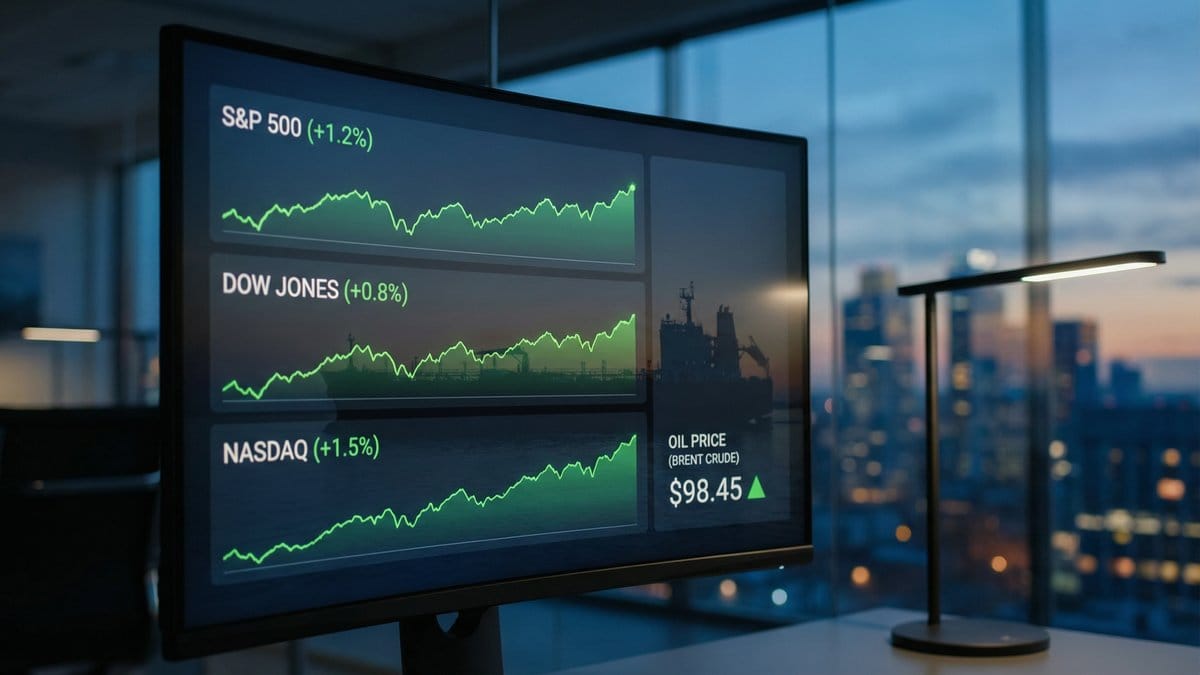
U.S. equity markets extended their winning streak on Thursday, April 9, 2026, closing higher for a second consecutive session as investors cautiously embraced optimism surrounding a fragile two-week ceasefire between the United States and Iran. The S&P 500 gained 0.62% to close at 6,824.66, reclaiming its 100-day and 200-day moving averages — a technically significant milestone that reinforced the bullish near-term bias. The Dow Jones Industrial Average rose 275.88 points (+0.58%) to settle at 48,185.80, while the Nasdaq Composite outperformed with a +0.83% advance to 22,822.42, driven by strength in technology and AI-related names.
| Index | Close | Change | % Change |
|---|---|---|---|
| S&P 500 | 6,824.66 | +41.85 | +0.62% |
| Dow Jones Industrial Average | 48,185.80 | +275.88 | +0.58% |
| Nasdaq Composite | 22,822.42 | +188.80 | +0.83% |
| Nasdaq 100 | 25,082.09 | +178.92 | +0.72% |
| Russell 2000 | ~2,635 | Modest gain | — |
Market sentiment was broadly constructive, though not without reservation. The Strait of Hormuz remains largely closed despite the ceasefire announcement, keeping crude oil prices elevated near the psychologically critical $100-per-barrel level. The CBOE Volatility Index (VIX) declined to 19.48 from a prior-week reading of 23.87, signaling a meaningful reduction in near-term fear, though the reading remains above the long-run average of approximately 17. Energy and technology sectors led sector performance, while defensive names in utilities and consumer staples lagged as risk appetite improved.
Friday morning, April 10, brings the highly anticipated March Consumer Price Index (CPI) release at 8:30 AM ET, which is expected to show headline inflation accelerating to approximately 3.3% year-over-year — the sharpest reading since May 2024 — largely driven by the surge in energy prices stemming from the Iran conflict and Hormuz disruptions. Markets are keenly focused on this data as it will shape Federal Reserve policy expectations heading into the second quarter.

Top Market Movers
Several notable developments drove outsized moves across individual equities and commodity markets on Thursday, reflecting the complex interplay of geopolitical risk, corporate fundamentals, and artificial intelligence investment themes.
Constellation Brands Surges on Earnings Beat
Shares of Constellation Brands (STZ) jumped 8.53% to close at $163.07, adding $12.81 per share, after the beverage giant — which markets Modelo Especial and Corona beer in the United States — reported quarterly results that exceeded Wall Street expectations on both the top and bottom lines. The company cited resilient consumer demand for its premium beer portfolio despite macroeconomic headwinds, and management maintained its full-year guidance. The result was particularly notable given broader concerns about consumer spending in an inflationary environment.
Investment implications: Constellation Brands' outperformance underscores the relative defensiveness of premium consumer staples within the beverage space. Investors seeking exposure to consumer discretionary with a degree of recession resilience may find the company's brand moat and consistent cash flow generation attractive, particularly if inflation moderates in the second half of 2026.
CoreWeave and Meta Platforms Rally on AI Infrastructure Deal
Cloud computing infrastructure provider CoreWeave (CRWV) surged 3.49% to $92.00 after announcing a significant expansion of its partnership with Meta Platforms (META), extending a compute services agreement through 2032. Meta shares climbed 2.61% to $628.39 on the news, reflecting investor enthusiasm for the company's continued investment in AI infrastructure. The deal reinforces the secular trend of hyperscalers locking in dedicated GPU compute capacity as artificial intelligence workloads scale dramatically.
Investment implications: The CoreWeave-Meta agreement is emblematic of the structural shift toward long-term AI infrastructure commitments. Companies with exposure to GPU compute, data center buildout, and AI model training infrastructure — including semiconductor names and power utilities serving data centers — remain compelling long-term themes even as near-term valuations reflect elevated expectations.
Lumentum Gains on JPMorgan Upgrade and Optical Networking Outlook
Lumentum Holdings advanced approximately 5.7% after JPMorgan analyst Samik Chatterjee reiterated an Overweight rating with a price target of $950, citing exceptional earnings growth visibility tied to the ramp in scale-up networking infrastructure. The analyst noted stronger-than-expected forward guidance following the company's Investor Briefing and meetings at the Optical Fiber Conference (OFC), pointing to multiple growth drivers across AI networking and data center interconnects.
Investment implications: Optical networking components are emerging as a critical bottleneck in AI infrastructure scaling. Companies supplying high-speed optical transceivers and interconnects stand to benefit disproportionately as data center operators race to upgrade network capacity. Lumentum's improving visibility into demand makes it a compelling name in the AI infrastructure supply chain.
Oil Markets: Volatility Near $100 per Barrel
Crude oil remained the most closely watched commodity, with WTI crude oscillating around the $98–$100 per barrel range throughout the session. Brent crude settled near $96.42 per barrel on Friday morning. Despite the U.S.-Iran ceasefire announcement, shipping traffic through the Strait of Hormuz — through which approximately 20% of global oil supply transits — remains effectively at a standstill. Goldman Sachs warned that if the Strait remains largely closed for another month, Brent crude could average above $100 per barrel throughout 2026. Barclays strategist Ajay Rajadhyaksha noted that pre-war oil price levels of $65–70 per barrel “are not coming back,” forecasting a Brent average of approximately $85 for the year.
Investment implications: Elevated oil prices represent a dual-edged dynamic: a tailwind for energy sector equities and a persistent headwind for inflation, consumer spending, and Federal Reserve policy flexibility. Energy sector ETFs and integrated oil majors with upstream production exposure remain attractive in a structurally higher oil price environment, while airlines, transportation, and consumer discretionary names face margin pressure.
Economic Data & Fed Watch
The economic data backdrop heading into April 10 is dominated by the imminent release of the March Consumer Price Index (CPI), scheduled for 8:30 AM ET on Friday. Consensus estimates compiled by FactSet project a headline CPI increase of approximately 3.3% year-over-year and a 0.9% month-over-month gain — the largest annual reading since May 2024 and a sharp acceleration from the 2.4% pace recorded in February. The surge is primarily attributable to the dramatic rise in energy prices following the outbreak of the U.S.-Iran conflict and the effective closure of the Strait of Hormuz. Core CPI, which excludes food and energy, is expected to rise approximately 2.7% annually, reflecting stickier underlying inflation pressures.
The inflation picture is further complicated by recent producer-side data. February's core Producer Price Index (PPI) rose 0.5% month-over-month and accelerated to 3.9% year-over-year — the highest reading in 13 months — signaling that pipeline inflationary pressures remain robust and could translate into sustained consumer price increases in the months ahead. The ISM Services PMI for March came in at 54.0, missing the 55.0 consensus forecast and easing from February's 56.1, suggesting some moderation in the dominant services sector.
Federal Reserve officials have adopted a cautious, data-dependent posture. Cleveland Fed President Beth Hammack explicitly warned that interest rates could rise further if inflation remains persistently elevated, reinforcing the market's interpretation that rate cuts are not imminent. Interest rate futures currently price in approximately a 30% probability of a single Fed rate cut before year-end, a notable shift from the more aggressive easing expectations that prevailed earlier in 2026. The 10-year U.S. Treasury yield settled near 4.28% following a well-received auction that cleared at 4.282%, roughly in line with pre-auction expectations. The U.S. Dollar Index (DXY) fell approximately 1.26% during the week to 98.91, reflecting some relief from geopolitical risk premiums as ceasefire optimism took hold.
Investment implications: A hotter-than-expected CPI print on Friday could trigger a meaningful repricing of rate cut expectations, pressuring rate-sensitive sectors including real estate investment trusts (REITs), utilities, and long-duration growth stocks. Conversely, an in-line or softer reading could provide a modest relief rally. Investors should maintain a balanced duration posture and consider inflation-protected securities (TIPS) as a hedge against persistent price pressures.
International Markets
Asian equity markets delivered broadly positive performance on Friday, April 10, with the region on track for its best weekly gain since 2022. South Korea's KOSPI led regional outperformance, surging 1.8% to 5,879.71, driven by strength in local technology stocks as investors rotated into export-oriented semiconductor and electronics names. Japan's Nikkei 225 advanced 1.6% to 56,789.58, with a standout contribution from Fast Retailing — the parent company of Uniqlo — which surged more than 10% after raising its full-year profit expectations, citing robust international demand.
Hong Kong's Hang Seng gained 0.7% to 25,919.12, while the Shanghai Composite rose 0.6% to 3,991.14. China's National Bureau of Statistics reported that the country's Consumer Price Index rose 1.0% year-over-year in March, below the 1.3% consensus estimate and down from the prior month's 1.3% reading, suggesting deflationary pressures remain a concern for the world's second-largest economy. Taiwan's Taiex gained 1.3% and India's Sensex added 0.7%, while Australia's ASX 200 underperformed with a modest 0.4% decline. European equity futures pointed to a higher open ahead of the U.S. CPI release, with the FTSE 100 hovering near 10,604.
In currency markets, the U.S. dollar strengthened modestly against the Japanese yen, with USD/JPY rising to 159.18 from 158.96. The euro edged slightly lower to $1.1694. Gold fell 0.5% to $4,791.90 per ounce, while silver declined 0.6% to $76.02, as some safe-haven demand was unwound amid ceasefire optimism. Bitcoin rose approximately 4.33% during the week to $71,963, benefiting from a notable development: Iran reportedly began demanding Bitcoin payments from oil tankers crossing the Strait of Hormuz, lending an unusual geopolitical dimension to cryptocurrency demand.
Looking Ahead
The week of April 13–17, 2026 promises to be one of the most consequential of the quarter, with the formal kickoff of the Q1 2026 earnings season and a series of critical economic data releases converging simultaneously. The most anticipated event on the earnings calendar is Goldman Sachs (GS), which reports Q1 2026 results before the market open on Monday, April 13. The investment banking giant's results will be closely scrutinized for insights into capital markets activity, trading revenues, and management commentary on the macroeconomic outlook. Also reporting during the week are JPMorgan Chase, Wells Fargo, Morgan Stanley, BlackRock, and Citigroup — a comprehensive sweep of the major U.S. financial institutions that will set the tone for the broader earnings season. Later in the week, Netflix and TSMC are also scheduled to report, providing critical data points on streaming subscriber trends and semiconductor demand, respectively.
On the economic data front, the Core Producer Price Index (PPI) for March is due on Tuesday, April 14, with consensus expectations pointing to a further 0.5% month-over-month increase that would push the annual rate toward 4.0%. Initial Jobless Claims, the NAHB Housing Market Index, and Industrial Production data are all scheduled for Thursday, April 16. The Bank of England Governor Andrew Bailey is scheduled to speak on Wednesday, April 15, with markets attentive to any signals regarding UK monetary policy amid elevated global inflation.
The single most critical wildcard for markets remains the outcome of the U.S.-Iran peace talks scheduled to begin in Islamabad, Pakistan on Saturday, April 11, with U.S. Vice President JD Vance leading the American delegation. A durable agreement that includes the reopening of the Strait of Hormuz would be powerfully deflationary for energy prices and could catalyze a significant relief rally across equities, particularly in rate-sensitive and consumer-oriented sectors. Conversely, a breakdown in negotiations or renewed hostilities would likely push crude oil back above $100 per barrel and reignite inflation concerns. Investors should closely monitor weekend news flow from Islamabad as a primary market catalyst heading into the new week.
Disclaimer: This analysis is for informational and educational purposes only and should not be considered financial advice. Market conditions can change rapidly, and past performance does not guarantee future results. Always conduct your own research and consult with a qualified financial advisor before making investment decisions.