



Market Overview
The U.S. stock market experienced a notable pullback on Monday, retreating from recent record highs as escalating geopolitical tensions in the Middle East overshadowed optimism surrounding a strong first-quarter earnings season. The S&P 500 declined by 28.37 points, or 0.39%, to close at 7,201.75, while the Dow Jones Industrial Average led the major indices lower, dropping 429.90 points, or 0.87%, to finish at 49,069.37. The tech-heavy Nasdaq Composite also slipped, shedding 43.78 points, or 0.17%, to end the session at 25,070.67. The small-cap Russell 2000 index followed the broader market trend, falling 16.83 points, or 0.60%, to 2,796.00.
Overall market sentiment shifted from bullish to cautious as investors digested reports of renewed hostilities between the United States and Iran. The disruption of a four-week ceasefire, marked by attacks on vessels in the Strait of Hormuz and an oil facility in the United Arab Emirates, triggered a flight to safety and a surge in energy prices. This geopolitical uncertainty dampened the enthusiasm that had propelled the S&P 500 and Nasdaq to all-time highs just days prior. Sector performance reflected this defensive posture, with ten of the eleven S&P 500 sectors posting declines. Materials and industrials were among the hardest hit, falling 1.37% and 0.89%, respectively, while energy stocks rallied on the back of soaring crude oil prices.
Top Market Movers
The day's trading session was characterized by significant moves in specific stocks and commodities, driven by a combination of geopolitical events, corporate earnings, and strategic business announcements.
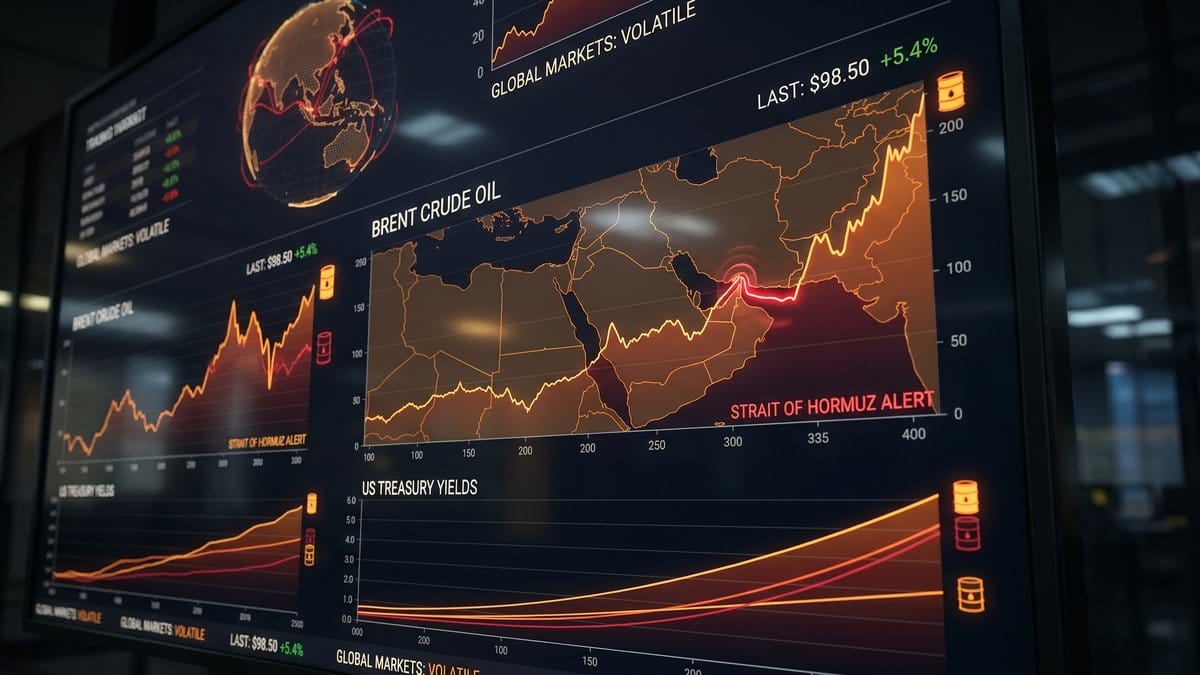
- Crude Oil Surge: Global oil prices spiked dramatically following the attacks in the Middle East. Brent crude futures surged $6.27, or 5.8%, to settle at $114.44 per barrel, while U.S. West Texas Intermediate (WTI) crude rose $4.48, or 4.4%, to close at $106.42. The escalation in the Strait of Hormuz, a critical chokepoint for global oil supplies, raised immediate concerns about potential supply disruptions. Investment implications: The sharp rise in oil prices benefits energy sector equities but poses a headwind for transportation and consumer discretionary stocks due to higher input and fuel costs.
- Logistics Sector Slump: Shares of major delivery firms took a significant hit after Amazon.com announced the rollout of “Amazon Supply Chain Services,” opening its vast logistics network to outside businesses. United Parcel Service (UPS) tumbled 9.26% to $97.60, while FedEx experienced a similar decline. Investment implications: Amazon's aggressive entry into the third-party logistics space intensifies competition, potentially compressing margins and market share for traditional carriers like UPS and FedEx.
- Palantir Technologies (PLTR): Palantir shares experienced volatility despite beating Wall Street estimates for first-quarter revenue and profit. The company reported an 85% jump in revenue, driven by strong demand from commercial clients and the U.S. government sector for its Artificial Intelligence Platform (AIP). However, shares slid slightly in premarket trading as investors evaluated the broader impact of AI tools on its software business. Investment implications: Palantir's strong fundamental performance underscores the growing enterprise adoption of AI, but its premium valuation leaves the stock vulnerable to short-term pullbacks if growth expectations are not perfectly met.
- Tyson Foods (TSN): Tyson Foods rallied 3.9% after reporting better-than-expected quarterly earnings and raising its full-year income forecast. The company successfully navigated a challenging environment by offsetting a drop in demand for high-priced beef with increased sales of more affordable proteins like chicken and pork, alongside higher pricing across its product lines. Investment implications: Tyson's ability to adapt to shifting consumer preferences and maintain pricing power highlights the resilience of diversified consumer staples companies in an inflationary environment.
Economic Data & Fed Watch
The macroeconomic landscape remains complex, with investors closely monitoring inflation data, Treasury yields, and commentary from Federal Reserve officials to gauge the future path of monetary policy.
U.S. Treasury yields jumped on Monday, with the benchmark 10-year yield rising 7 basis points to 4.448%, marking its biggest daily increase in nearly six weeks. This upward movement was largely driven by the surge in oil prices, which fanned concerns about a potential resurgence in inflation. The U.S. Treasury also announced that it expects to borrow $189 billion in the second quarter, $79 billion higher than its February estimate, primarily due to lower-than-projected net cash flows.
On the monetary policy front, New York Federal Reserve President John Williams stated that the central bank's policy is “well-positioned” to handle the current economic uncertainty. Williams noted that while inflation is challenged by tariffs and energy costs, it is expected to remain around 3% this year before gradually moving back toward the Fed's 2% target in 2027. He also indicated that interest rates will eventually need to be lowered to reflect easing inflation, though the timing remains uncertain. Investment implications: The combination of rising Treasury yields and persistent inflation concerns suggests that the Federal Reserve may maintain a “higher for longer” stance on interest rates, which could continue to pressure growth stocks and elevate borrowing costs for corporations and consumers.
International Markets
Global markets exhibited mixed performance as investors weighed the implications of the Middle East conflict against regional economic developments.
In Asia, markets diverged. Japan's Nikkei 225 index managed a 0.38% gain, maintaining its position as one of the top-performing global indices year-to-date with an 18.2% increase. Conversely, Hong Kong's Hang Seng index fell 0.83%, and India's BSE SENSEX continued its struggles, remaining down over 9% for the year. European markets broadly trended lower, pressured by the geopolitical tensions and the potential for increased U.S. tariffs on European car imports. Germany's DAX and France's CAC 40 both experienced declines, reflecting the cautious sentiment permeating global equities.
The currency markets also reacted to the geopolitical instability, with the U.S. dollar strengthening as a safe-haven asset. Notably, the Indian Rupee hit a record low of 95.39 against the USD, highlighting the economic risks faced by emerging markets highly dependent on oil imports amid fading hopes for peace in the Middle East.
Looking Ahead
As the week progresses, market participants will be laser-focused on a barrage of critical economic data and high-profile corporate earnings reports.
The economic calendar is headlined by the April Non-Farm Payrolls (NFP) report, scheduled for release on Friday. Consensus estimates project the addition of 49,000 jobs and an unemployment rate holding steady at 4.3%. Earlier in the week, investors will scrutinize the ISM Services PMI, JOLTS job openings, and ADP employment data for early indications of labor market strength and economic momentum.
The first-quarter earnings season continues in full swing, with several major technology and consumer companies slated to report. Key earnings to watch include Advanced Micro Devices (AMD), Shopify (SHOP), Pfizer (PFE), Walt Disney (DIS), and Uber (UBER). AMD's results will be particularly scrutinized for updates on its AI chip traction and competition with Nvidia, while Disney's report will provide insights into consumer spending on entertainment and the profitability of its streaming business. These upcoming catalysts have the potential to either reignite the recent market rally or exacerbate the current pullback, depending on whether they meet or fall short of elevated expectations.
Disclaimer: This analysis is for informational and educational purposes only and should not be considered financial advice. Market conditions can change rapidly, and past performance does not guarantee future results. Always conduct your own research and consult with a qualified financial advisor before making investment decisions.