




Photo: AJ Hudson / Unsplash. Illustrative Chevrolet pickup, not the forthcoming redesigned model.
Stock Introduction & Thesis: Cheap Earnings Need Durable Profits
General Motors’ latest earnings beat did not settle its investment debate. The automaker is generating substantial cash from trucks, but rising input costs and a major product changeover threaten the durability of those profits. Its low valuation therefore presents a specific question: are investors overlooking resilience, or correctly discounting a cyclical earnings peak?
General Motors (NYSE: GM) sells vehicles through Chevrolet, GMC, Cadillac and Buick, with financing supplied by GM Financial. North American pickups and sport-utility vehicles remain central profit drivers. Electric vehicles, international operations and connected services broaden the business, but they do not yet eliminate its dependence on American consumers buying profitable vehicles. [1]
The thesis is cautiously constructive: cash generation and repurchases can support shareholder value even without rapid sales growth. However, buybacks cannot permanently compensate for weaker pricing, higher production costs or product-market gaps. Investors need sustainable operating improvement, not simply fewer shares dividing the same earnings.
This analysis uses information available October 27, 2026, including the September-quarter filings and October 26 closing price. It treats 2026 guidance as management’s forecast, not a guaranteed result, and does not mistake conditional comments about 2027 for formal guidance. The attraction is valuation discipline, rather than an assumption that cheap stocks inevitably recover.
Recent Developments & Catalysts: The Truck Changeover Matters
GM reported third-quarter results October 20. Revenue reached $50.015 billion, while adjusted diluted earnings were $3.70 per share. Reuters reported that this exceeded the $3.63 LSEG analyst estimate. Nevertheless, the shares fell as investors weighed a less reassuring outlook against the backward-looking beat. [2] [3]
Management narrowed full-year adjusted earnings guidance to $12.75–$13.75 per share and adjusted earnings before interest and taxes, or EBIT, to $14.5–$15.5 billion. More encouragingly, it raised adjusted automotive free-cash-flow guidance to $11.5–$12.5 billion, from $9.5–$11.5 billion. That improves the funding outlook for investment and capital returns, although the cash measure excludes specified adjustments. [2]
The Chevrolet Silverado and GMC Sierra transition is the immediate execution test. GM’s earnings-call discussion indicated approximately 35,000 fewer full-size pickup units year over year in the fourth quarter because of changeover downtime. Successful introductions could improve pricing and mix, but disrupted production could absorb those benefits. Management expects North American pricing tailwinds to largely offset that quarterly volume pressure. [4]
The board also authorized $20 billion of multiyear repurchases. This is permission, not a commitment to spend immediately. Commodity, logistics and memory-chip inflation is expected to total approximately $2 billion in 2026. Management’s suggestion that 2027 can improve depends on resilient demand and moderating costs; it is not an unconditional earnings promise. [5]
Investment implications: Watch launch execution and actual cash conversion. A repurchase headline is less valuable if the underlying business must spend more simply to maintain its competitive position.
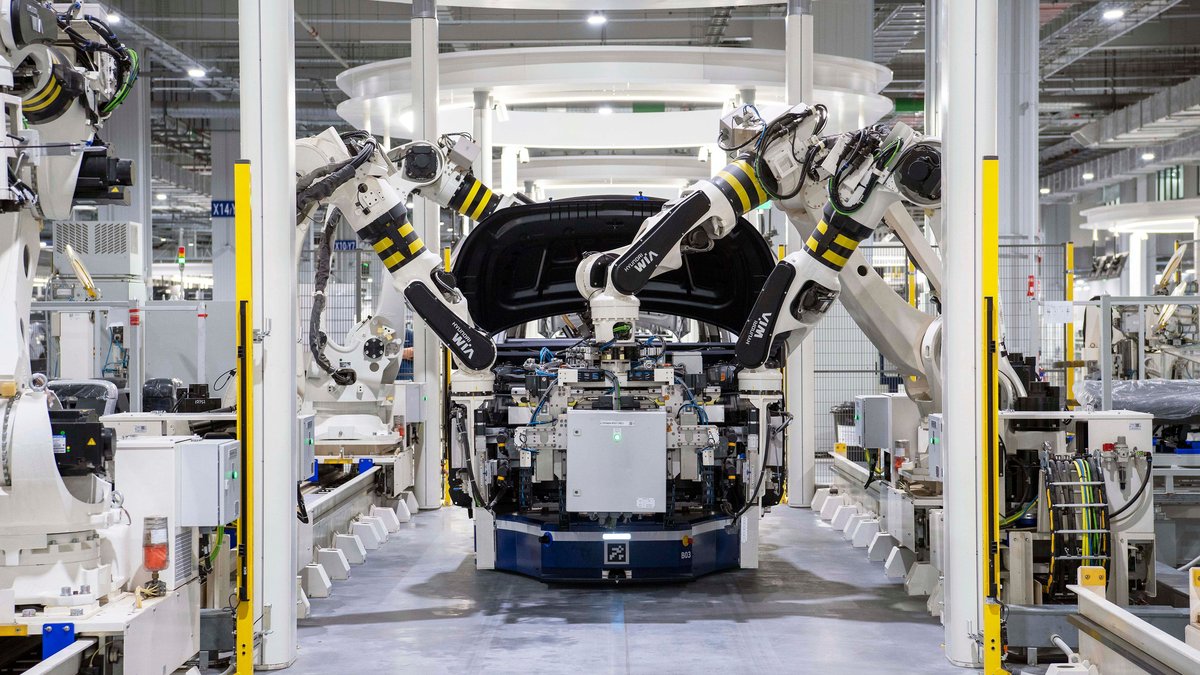
Photo: Hyundai Motor Group / Pexels. Automotive industry context; this is not a GM plant.
Financial Analysis: Separate Operating Progress From Adjustments
Quarterly revenue increased 2.9% from $48.591 billion a year earlier. Adjusted EBIT rose 21.6% to $4.106 billion, with its margin expanding to 8.2% from 6.9%. GAAP diluted earnings climbed to $3.73 from $1.35, but that dramatic comparison partly reflects smaller special charges, not equivalent growth in recurring profitability. Adjusted diluted earnings increased 32.2% from $2.80. [2]
North America generated $3.592 billion of adjusted EBIT at an 8.7% margin. Warranty improvement, vehicle mix and favorable EV inventory adjustments helped. International adjusted EBIT fell to $28 million from $226 million, while GM Financial’s adjusted pretax earnings declined to $668 million from $804 million. The recovery was therefore concentrated, not uniform. [5]
Automotive operating cash flow was $8.049 billion. Subtracting $2.333 billion of capital expenditure produces $5.716 billion before GM’s additional adjustments; reported adjusted automotive free cash flow was $5.882 billion. These automotive-only measures are not consolidated cash flow. Tariff-payment timing also helped the quarterly comparison, limiting its usefulness as a repeatable run rate. [2]
Automotive cash and marketable debt securities totaled $23.116 billion against $15.800 billion of automotive debt at September 30. GM Financial’s funding must be assessed separately because it finances receivables and leased vehicles. Meanwhile, diluted weighted-average shares fell approximately 8% to 887 million, amplifying per-share growth. [1]
Investment implications: Liquidity supports flexibility, but adjusted cash flow should not obscure real restructuring payments. Track earnings before repurchase effects and cash remaining after unavoidable transition spending.
Valuation & Competitive Position: A Discount With Conditions
At the October 26 close of $76.31, GM traded at 5.76 times its $13.25 midpoint 2026 adjusted EPS guidance. Using the $10.22 midpoint GAAP EPS forecast instead gives 7.47 times. Both are forecast-based multiples, not trailing P/E ratios. A reliable PEG ratio is withheld because no verified long-term EPS-growth forecast supports it. [6] [2]
The primary valuation approach applies assumed cyclical earnings multiples. Illustrative twelve-month bear, base and bull values are $50, approximately $86 and $105: respectively, sustainable adjusted EPS of $10, $13.25 and $14 multiplied by 5, 6.5 and 7.5. These are analytical scenarios, not consensus targets. Sensitivity is substantial: $10 EPS at 5–7.5 times implies $50–$75; $14 implies $70–$105.
As a cash-flow cross-check, the disclosed September share-count snapshot implies approximately $64.8 billion of equity value at that price. Guidance implies a 17.8%–19.3% adjusted automotive cash-flow yield, not conventional consolidated FCF yield; subsequent repurchases and excluded cash charges limit comparability.
GM’s truck franchise remains valuable, but Toyota’s hybrid strength exposes a product gap. GM has promised hybrids without specifying launch timing. [7]
Investment implications: Low multiples offer potential upside, not protection against falling earnings.
Risks & Outlook: Demand and Cash Quality Decide the Thesis
The central risk is simultaneous pressure on volume, pricing and costs. Higher steel, aluminum or logistics expenses can erode truck margins, while affordability constraints encourage buyers to postpone purchases or choose smaller vehicles. Increased incentives could support deliveries while weakening profitability.
Trade-policy changes, supplier disruption and launch delays add uncertainty. GM Financial faces consumer-credit and residual-value risk. EV realignment also remains a cash issue: management expected roughly $1 billion of additional related payments in the fourth quarter, with further payments in 2027. Excluding these costs from adjusted measures does not eliminate them. [5]
The outlook is cautiously constructive, with moderate confidence. The thesis strengthens if truck launches preserve margins and cash conversion remains healthy without relying on payment timing. It weakens if incentives rise, costs fail to moderate or buybacks mask deteriorating operating earnings. GM is a potential value opportunity, but its discount requires proof of durable profits—not merely another headline earnings beat.
Sources
Sources: GM SEC filings and earnings materials; Reuters; earnings-call transcript; Yahoo Finance historical pricing.
Disclaimer: This analysis is for informational and educational purposes only and should not be considered financial advice. Individual stock investments carry significant risks including company-specific and market risks. Always conduct your own research and consult with a qualified financial advisor before making investment decisions.