



After a decade in the doldrums, the uranium market is experiencing a powerful resurgence, positioning it as one of the most compelling commodity stories for 2026 and beyond. A perfect storm of structural supply deficits, a global nuclear renaissance, and a new, explosive demand driver in the form of Artificial Intelligence data centers is creating a powerful bullish thesis. While the spot price has been volatile, the underlying fundamentals point toward a sustained period of higher prices, creating a significant opportunity for investors in uranium mining stocks.
This deep dive analysis will unpack the critical supply and demand dynamics shaping the market, explore the investment landscape, and profile key mining companies across the risk spectrum, providing a comprehensive guide for investors looking to gain exposure to the nuclear fuel cycle.
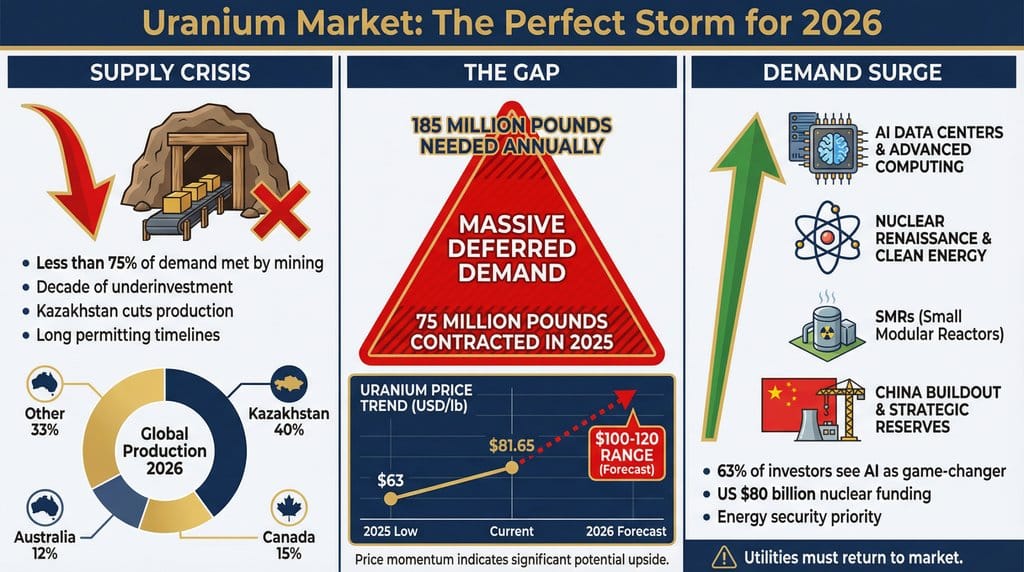
The Supply Crisis: A Decade of Underinvestment Comes Home to Roost
The core of the uranium bull thesis lies in a simple, stark reality: the world is not producing enough uranium to meet its needs. For years following the 2011 Fukushima disaster, low prices led to a severe lack of investment in new mine development and exploration. The industry requires approximately 185 million pounds of uranium annually to fuel the global reactor fleet, but mined production is expected to meet less than 75% of this demand. [1] This structural deficit has been papered over by secondary supplies (stockpiles, decommissioned warheads), but these sources are dwindling.
The situation is exacerbated by the concentration of supply. Kazakhstan, through its state-owned entity Kazatomprom, accounts for over 40% of global primary production. [2] Recent announcements of production cuts from Kazatomprom, citing difficulties in procuring necessary materials like sulfuric acid, have sent a clear signal: the era of cheap, plentiful uranium is over. Producers are now exercising supply discipline, refusing to sign long-term contracts at prices that do not incentivize the development of new mines, which carry a price tag of $80-$100 per pound and take 5-10 years to bring online.
The Demand Surge: A Three-Headed Monster
While supply is constrained, demand is accelerating from multiple powerful sources, creating a classic commodity squeeze.
1. The Nuclear Renaissance: Governments worldwide are embracing nuclear power as a reliable, carbon-free energy source to meet climate goals and ensure energy security. The U.S. government has allocated up to $80 billion in funding for new reactors, and countries across Europe and Asia are extending the lives of existing plants and announcing aggressive new build schedules, most notably in China. [1]
2. The AI Game-Changer: The exponential growth of Artificial Intelligence is creating an unprecedented new source of electricity demand. Power-hungry data centers run by tech giants like Microsoft, Google, and Amazon require 24/7 baseload power that renewables alone cannot provide. This has led them to actively explore nuclear energy, including Small Modular Reactors (SMRs), to power their operations. A recent survey found that 63% of investors believe AI-related consumption will become a material factor in nuclear planning, a demand driver that was not on the radar even two years ago. [3]
3. Deferred Utility Contracting: In 2025, utilities significantly delayed their long-term uranium purchasing, contracting for only 75 million pounds—just 50% of the annual replacement rate. This massive amount of deferred demand must eventually come to market, and as utilities return to secure fuel for the latter half of the decade, they will be competing for limited supply, putting significant upward pressure on prices. [1]
The Investment Landscape: Navigating the Uranium Sector
For investors, the uranium thesis can be accessed in several ways. Physical uranium trusts like the Sprott Physical Uranium Trust (SPUT) offer direct exposure to the commodity price. However, uranium mining equities provide operational leverage, meaning their stock prices can appreciate at a much faster rate than the underlying commodity price during a bull market.
The mining sector can be broken down into three distinct tiers, each with its own risk-reward profile. The key to building a uranium portfolio is to understand these tiers and allocate capital according to your risk tolerance.
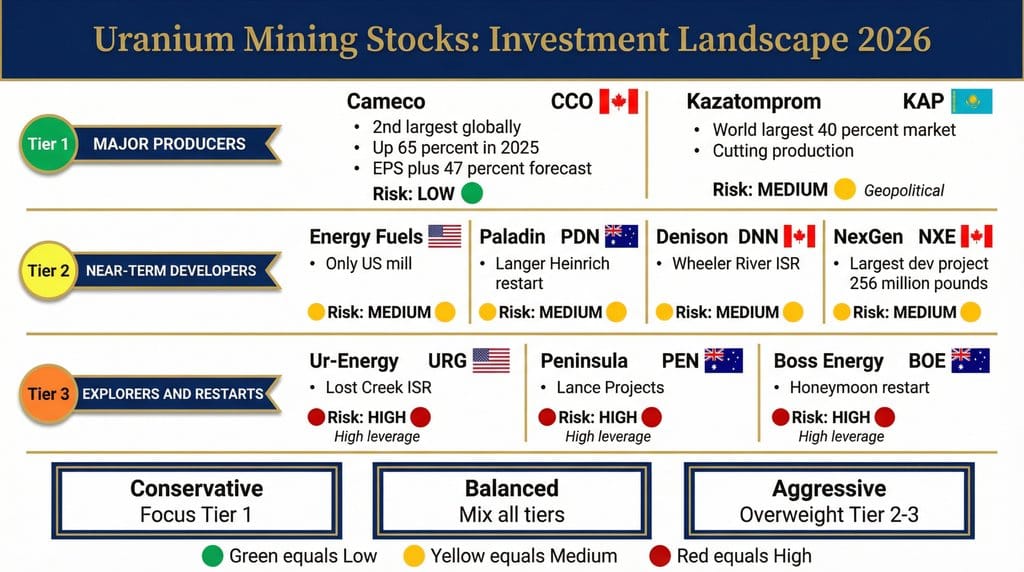
Tier 1: Major Producers
These are the established giants of the industry with operating mines, significant production, and long-term contracts. They offer the lowest risk and are the most suitable for conservative investors.
- Cameco (TSX: CCO, NYSE: CCJ): As the second-largest producer globally and based in the stable jurisdiction of Canada, Cameco is the blue-chip stock of the sector. With its stock up over 65% in 2025 and strong earnings growth forecast, it is a core holding for any uranium portfolio. [4]
- Kazatomprom (LSE: KAP): The world’s undisputed production leader, offering unparalleled scale. However, its ownership by the Kazakhstan government and its geographic location introduce significant geopolitical risk that investors must weigh carefully.
Tier 2: Near-Term Developers & Mid-Tier Producers
This group consists of companies with assets that are either already in production on a smaller scale or are expected to begin production in the near future. They offer a blend of growth potential and operational progress, carrying moderate risk.
- Energy Fuels (NYSE: UUUU): A key U.S. producer operating the only conventional uranium mill in the country. Its domestic position makes it a strategic asset for American energy independence.
- Paladin Energy (ASX: PDN): An Australian company restarting its Langer Heinrich mine in Namibia, poised to become a significant producer once again.
- Denison Mines (TSX: DNN, NYSE: DNN): Focused on developing the high-grade Wheeler River project in Canada’s Athabasca Basin using advanced in-situ recovery (ISR) methods.
- NexGen Energy (TSX: NXE, NYSE: NXE): Owns the Rook I project, the largest development-stage uranium project in Canada, which holds the potential to be a world-class, low-cost mine.
Tier 3: Explorers & Restarts
This is the highest-risk, highest-reward segment of the market. These companies are either exploring for new deposits or restarting formerly shuttered mines. Their success is highly dependent on continued high uranium prices and operational execution, but they offer the most explosive upside potential.
- Ur-Energy (NYSE: URG): A smaller U.S. ISR producer with its Lost Creek facility in Wyoming.
- Peninsula Energy (ASX: PEN): Focused on its Lance Projects in Wyoming, another U.S.-based ISR play.
- Boss Energy (ASX: BOE): An Australian company restarting its Honeymoon Project in South Australia.
Risks and Considerations
Despite the powerful bull case, investing in uranium is not without risk. The sector is notoriously cyclical and volatile. A global economic downturn could temper electricity demand, and a nuclear accident anywhere in the world could negatively impact public perception and regulatory sentiment. Geopolitical events, particularly concerning Kazakhstan or Russia, could disrupt supply chains in unpredictable ways. Investors should be prepared for volatility and view uranium as a long-term investment based on fundamentals, not short-term price movements.
Conclusion: A Multi-Year Opportunity
The uranium market in 2026 is defined by a clear and widening structural supply deficit at a time of accelerating, multi-faceted demand. The decade of underinvestment has created a situation where significantly higher prices are required to incentivize the new production needed to fuel the world’s nuclear reactors and power the AI revolution. While risks remain, the fundamental thesis is one of the strongest in the commodity space. For investors with a multi-year time horizon and an appropriate risk tolerance, a diversified portfolio of uranium mining stocks offers a compelling opportunity to capitalize on the resurgence of nuclear energy.
References
[1] Sprott Asset Management. (2025, December 23). Uranium Outlook 2026. Retrieved from https://sprott.com/insights/uranium-outlook-2026/
[2] World Nuclear Association. (2025, December 4). Uranium and Nuclear Power in Kazakhstan. Retrieved from https://world-nuclear.org/information-library/country-profiles/countries-g-n/kazakhstan
[3] Canadian Mining Journal. (2025, December 26). AI boom set to turbocharge uranium demand in 2026. Retrieved from https://www.canadianminingjournal.com/news/ai-boom-set-to-turbocharge-uranium-demand-in-2026/
[4] The Motley Fool. (2026, January 2). Should You Buy Cameco While It’s Below $100?. Retrieved from https://www.fool.com/investing/2026/01/02/should-you-buy-cameco-while-its-below-100/
> Disclaimer: This article is for informational and educational purposes only. It does not constitute investment advice. The commodities market, particularly uranium, is highly volatile and subject to significant risks. Please consult with a qualified financial advisor before making any investment decisions.