



Market Overview
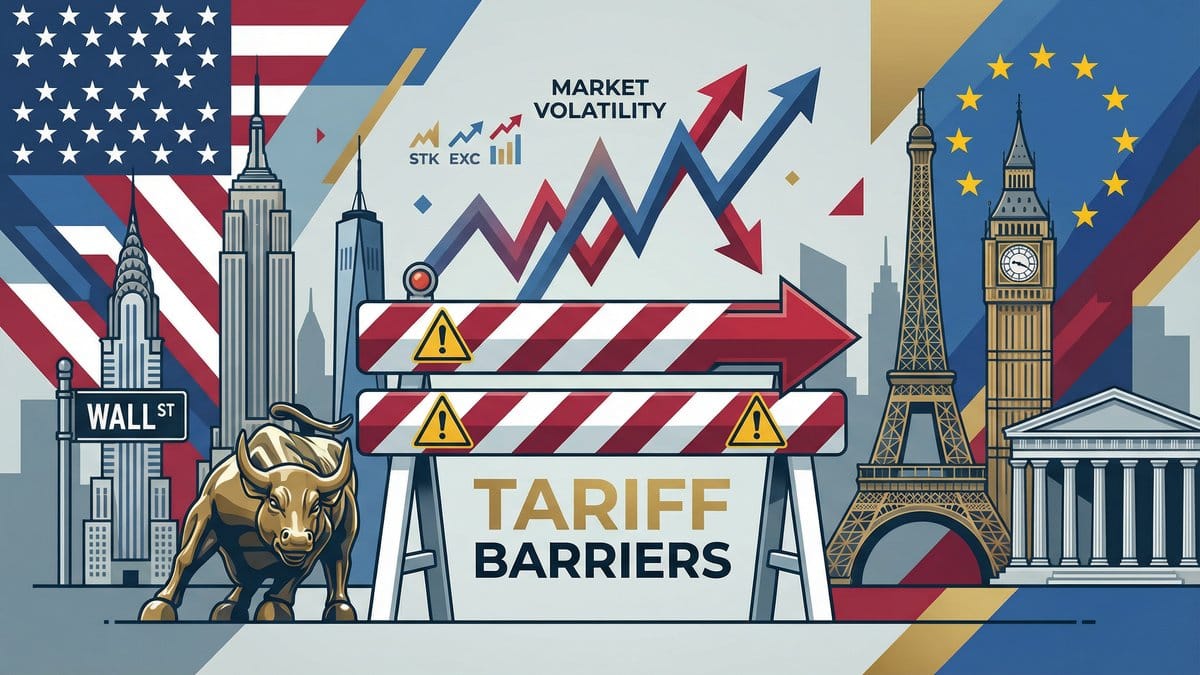
U.S. stock futures are pointing to a sharply lower open on Tuesday, January 20, 2026, as investors return from a long weekend to a fresh wave of geopolitical uncertainty. The negative sentiment is primarily driven by President Trump's unexpected tariff threats against several European allies over the proposed purchase of Greenland. Dow Futures were last down 1.45%, while S&P 500 and Nasdaq futures were indicating losses of 1.57% and 1.82%, respectively. This follows a mixed session on Friday, where major indices like the S&P 500 and Nasdaq Composite saw slight declines. The Russell 2000, a barometer for smaller-cap stocks, is also expected to open lower. The overall market theme is one of risk-aversion, with investors flocking to safe-haven assets like gold and questioning the stability of transatlantic trade relations. The technology and consumer discretionary sectors are expected to be among the hardest hit, given their global supply chains and sensitivity to trade tensions.
Top Market Movers
Precious Metals Surge on Safe-Haven Demand
Gold and silver prices have surged as investors seek refuge from the brewing trade storm. Gold futures (GC=F) jumped over 3% to $4,734 per ounce, approaching record highs. Silver also saw a significant rally, briefly touching a new all-time high of $94.7295 per ounce. The move reflects deep-seated anxiety in the market and a flight to safety. Investment implications: The rally in precious metals is a classic fear trade. Investors are rotating out of riskier assets and into traditional safe havens. This trend is likely to continue as long as the geopolitical uncertainty persists. Companies in the precious metals mining sector, such as Newmont (NEM) and Barrick Gold (GOLD), could see their stock prices benefit from the higher commodity prices.
Major Technology Stocks Under Pressure
Futures for the tech-heavy Nasdaq 100 are down sharply, indicating a difficult session for major technology stocks. Companies like Apple (AAPL), Microsoft (MSFT), and Amazon (AMZN) are particularly vulnerable to trade disruptions due to their extensive global operations and supply chains. The threat of retaliatory tariffs from the European Union could significantly impact their sales and profitability. Investment implications: The technology sector, which has been a market leader, is now facing significant headwinds. Investors may consider reducing their exposure to large-cap tech stocks and rotating into more defensive sectors. The uncertainty surrounding the tariff situation makes it difficult to predict the full impact on earnings, but it is likely to be negative in the short term.
European Automakers Brace for Impact
Shares of European automakers are expected to come under pressure following President Trump's tariff threats. Companies like Volkswagen (VWAGY), BMW (BMWYY), and Mercedes-Benz (MBGYY) are major exporters to the United States and would be directly impacted by any new tariffs. The European Union has already indicated that it is considering retaliatory measures, which could further escalate the trade dispute. Investment implications: The automotive sector is highly cyclical and sensitive to trade policy. The threat of new tariffs creates significant uncertainty for European automakers and could lead to a decline in their stock prices. Investors should be cautious about their exposure to this sector until there is more clarity on the trade situation.
Economic Data & Fed Watch
The primary focus for investors this week will be the escalating trade tensions between the U.S. and Europe. However, there are also several key economic data points to watch. The latest inflation data from the U.S. showed a slight uptick, with the Consumer Price Index (CPI) rising 0.3% month-over-month. This was slightly above the consensus forecast of 0.2%. The Federal Reserve will be closely monitoring these developments as it considers its next move on interest rates. The recent rise in Treasury yields, with the 10-year note approaching 4.3%, suggests that the bond market is pricing in a more hawkish Fed. The U.S. dollar has been struggling against a basket of major currencies, reflecting the uncertainty surrounding the trade situation. Investment implications: The combination of rising inflation and a more hawkish Fed could create a challenging environment for stocks. Higher interest rates would increase borrowing costs for companies and could weigh on corporate earnings. The uncertainty surrounding the trade situation is also likely to dampen investor sentiment and could lead to further market volatility.
International Markets
The geopolitical tensions are having a significant impact on international markets. European stocks fell sharply on Tuesday, with the Stoxx 600 index down 0.7%. The index had already posted its worst day since November on Monday. Asian markets were also mostly lower, tracking the weakness in Europe. The sell-off in global equities reflects the growing concern among investors about the potential for a full-blown trade war between the U.S. and Europe. The situation is particularly concerning for export-oriented economies in Asia, which are heavily reliant on global trade. Currency markets are also experiencing volatility, with the U.S. dollar weakening against the euro and the Japanese yen.
Looking Ahead
Investors will be closely watching for any new developments in the U.S.-Europe trade dispute. President Trump is scheduled to speak at the World Economic Forum in Davos on Wednesday, and his comments will be scrutinized for any clues about his intentions. The Supreme Court is also expected to rule soon on the legality of the President's use of the International Emergency Economic Powers Act to impose tariffs. On the economic front, the earnings season will continue to be a major focus, with reports due from several key companies, including Netflix (NFLX), Intel (INTC), and Johnson & Johnson (JNJ). Corporate guidance will be closely watched for any signs of a slowdown in business activity due to the trade tensions.
Disclaimer: This analysis is for informational and educational purposes only and should not be considered financial advice. Market conditions can change rapidly, and past performance does not guarantee future results. Always conduct your own research and consult with a qualified financial advisor before making investment decisions.