



Market Overview
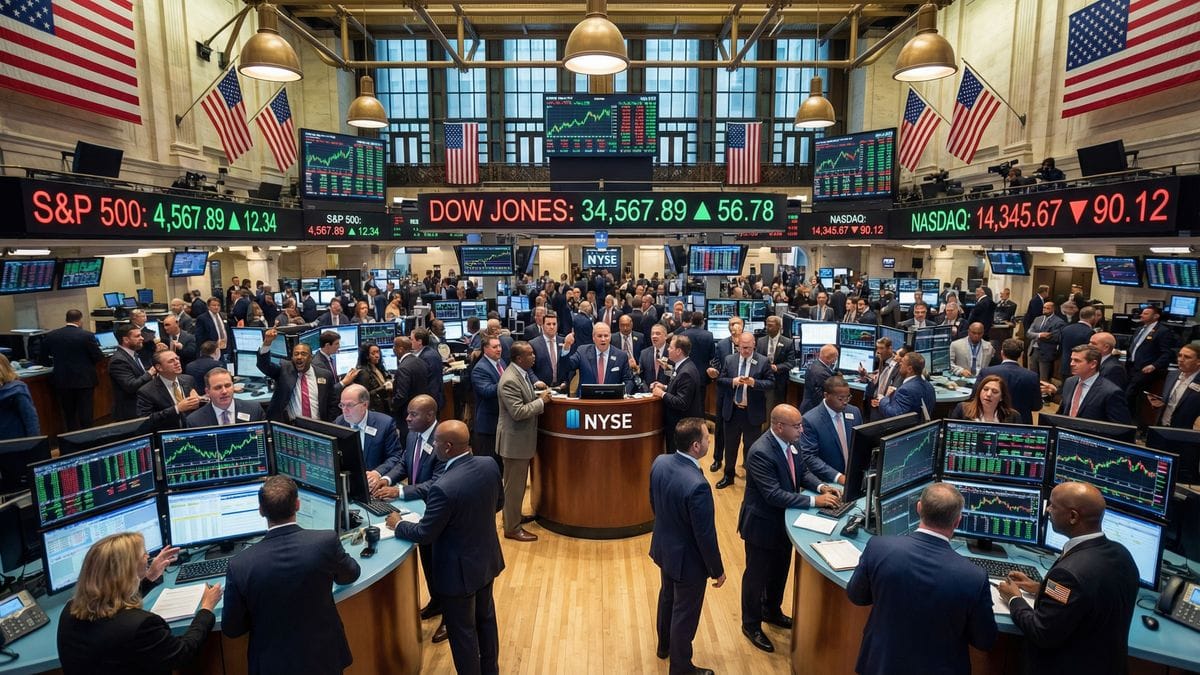
U.S. equity markets delivered a strong back-to-back performance on Wednesday, February 25, 2026, as investors embraced a blockbuster earnings report from semiconductor giant Nvidia and a broad-based rally in the technology sector. The S&P 500 advanced 0.81% to close at 6,946.13, while the tech-heavy Nasdaq Composite led the major indices, surging 1.26% to 23,152.08. The Dow Jones Industrial Average added 307.65 points, or 0.63%, settling at 49,482.15. The small-cap Russell 2000 also participated in the rally, gaining 0.4% to close at 2,663.33.
| Index | Close | Change | % Change |
|---|---|---|---|
| S&P 500 | 6,946.13 | +55.89 | +0.81% |
| Dow Jones Industrial Average | 49,482.15 | +307.65 | +0.63% |
| Nasdaq Composite | 23,152.08 | +288.40 | +1.26% |
| Russell 2000 | 2,663.33 | +11.00 | +0.41% |
Overall market sentiment was decidedly bullish, driven by renewed confidence in the artificial intelligence investment thesis following Nvidia's record quarterly results. The technology sector was the standout performer, with software and semiconductor stocks seeing significant buying interest. The broader market also benefited from easing concerns about AI disruption to existing software business models, as Anthropic's recent product announcements positioned AI as complementary to, rather than a replacement for, enterprise software platforms. Despite relatively weak market breadth — with more NYSE-listed names declining than advancing — the major cap-weighted indices closed firmly in positive territory, underscoring the outsized influence of large-cap technology stocks on overall market performance.
Top Market Movers
Nvidia (NVDA): Record $68.1 Billion Quarter Beats All Expectations
Nvidia reported fiscal fourth-quarter revenue of $68.1 billion, a staggering 73% increase year-over-year and 20% above the prior quarter, handily surpassing analyst estimates of $66.21 billion. Adjusted earnings per share came in at $1.62, beating the consensus estimate of $1.53. The company's data center segment, which encompasses its AI chip business, was the primary growth engine, with revenue rising 75% year-over-year. For fiscal 2026, Nvidia reported total revenue of $215.9 billion, up 65% year-over-year. Looking ahead, the company guided for first-quarter fiscal 2027 revenue of approximately $78 billion, representing 77% year-over-year growth and significantly exceeding the analyst consensus of $72.8 billion. The stock rose 1.4% during the regular session and continued to gain in after-hours trading following the earnings release.
Investment implications: Nvidia's results provide powerful validation of the ongoing AI infrastructure buildout. The company's dominance in the AI chip market, combined with its accelerating revenue growth, makes it a compelling long-term holding for investors seeking exposure to the AI megatrend. However, given the stock's premium valuation, investors should be prepared for continued volatility as the market digests these results and assesses the sustainability of this growth trajectory.
Axon Enterprise (AXON): AI Drives 40% Software Growth
Axon Enterprise surged more than 20% on Wednesday after reporting a strong fourth-quarter earnings and revenue beat. The company's software business grew 40% during the quarter, driven by AI-enhanced demand for its public safety technology products. CEO Rick Smith stated that AI “will create value that our customers simply cannot replicate,” directly addressing investor concerns about AI disruption to software business models. The strong results helped the stock recover significantly from a more than 25% decline earlier in 2026.
Investment implications: Axon's results illustrate that AI can be a powerful growth accelerant for software companies with strong domain expertise and proprietary data assets. Investors should look for similar companies where AI enhances rather than threatens the core business model, particularly in specialized verticals such as public safety, healthcare, and financial services.
First Solar (FSLR): Earnings Miss Triggers 12% Decline
Not all stocks participated in the rally. First Solar fell more than 12% after the company missed fourth-quarter earnings expectations and provided weak full-year guidance. The solar panel manufacturer faces a challenging environment characterized by tariff uncertainty, competitive pressures, and shifting policy dynamics. Multiple Wall Street analysts downgraded or lowered their price targets on the stock following the disappointing report.
Investment implications: First Solar's struggles highlight the risks facing the clean energy sector amid evolving trade policy and competitive dynamics. Investors in this space should carefully assess companies' exposure to tariff risk and their ability to maintain competitive advantages in an increasingly crowded market.
Software Sector Broad Rally: IGV ETF Gains 3%
The iShares Expanded Tech-Software Sector ETF (IGV) climbed 3% on Wednesday, extending its recovery from the prior session. Stocks such as Palantir Technologies, Microsoft, and Oracle all posted meaningful gains. Fundstrat's Tom Lee noted that extreme trading volumes in the ETF over the past two sessions historically coincide with market bottoms, suggesting the recent software sector selloff may be nearing exhaustion. Oracle received an upgrade from Oppenheimer, which cited a “favorable risk/reward” profile following the stock's significant pullback.
Investment implications: The software sector's recovery, if sustained, could represent a significant buying opportunity for long-term investors. Companies with strong AI integration strategies and recurring revenue models are particularly well-positioned to benefit from the next phase of enterprise technology adoption.

Economic Data & Fed Watch
The macroeconomic backdrop remains a source of uncertainty for investors. The advance estimate for fourth-quarter 2025 GDP, released last week, showed the U.S. economy grew at an annualized rate of just 1.4%, significantly below the consensus estimate and the slowest pace of growth since the COVID-19 pandemic year of 2020. The Commerce Department attributed part of the slowdown to the government shutdown, which shaved approximately one percentage point off quarterly growth. Full-year 2025 GDP growth came in at 2.2%, slightly above the longer-term trend but the weakest annual performance in recent years.
On the inflation front, the Federal Reserve's preferred measure — the Personal Consumption Expenditures (PCE) price index — remains above the central bank's 2% target. Federal Reserve officials have been consistent in their messaging: rate cuts are not imminent. Chicago Fed President Austan Goolsbee stated that cuts are not appropriate until there is more conclusive evidence that inflation is on a sustained downward path. Boston Fed President Susan Collins echoed this view, indicating that interest rates are likely to remain unchanged “for some time.” The Fed held its benchmark federal funds rate steady at its most recent meeting, with the interest rate on reserve balances maintained at 3.65%. The 10-year Treasury yield has been trading around 4.04% to 4.06%, reflecting the market's expectation of a prolonged pause in the rate-cutting cycle. The U.S. dollar remained broadly stable against major currencies.
Investment implications: The combination of slowing economic growth and a patient Federal Reserve creates a complex environment for investors. Fixed income investors may find value in intermediate-term Treasuries at current yield levels, while equity investors should focus on companies with pricing power and resilient earnings growth that can withstand a higher-for-longer interest rate environment.
International Markets
International equity markets presented a mixed picture on Thursday, February 26, 2026. In Europe, the Euro STOXX 50 climbed 0.9% to close at a record high of 6,172, while the broader STOXX Europe 600 gained 0.7% to reach its own record of 633. However, individual country indices were more subdued, with Germany's DAX edging down 0.2% and the UK's FTSE 100 falling 0.1% in early trading, while France's CAC 40 gained 0.3%. European markets were navigating a mixed corporate earnings season, with results from companies such as Schneider Electric and Syensqo adding to the complex picture. Tariff uncertainty, stemming from the U.S. administration's evolving trade policy, continued to weigh on investor sentiment across the continent.
In Asia, markets were also mixed but generally positive. Japan's Nikkei and South Korea's Kospi both hit fresh record highs, buoyed by the positive lead from Wall Street and the strong Nvidia results, which boosted sentiment toward technology and semiconductor stocks across the region. Hong Kong's Hang Seng index posted a more modest gain of 0.7% to 26,766, supported by the city's 2026/27 budget announcement, which projected an earlier-than-expected return to fiscal surplus. Chinese mainland markets lagged their regional peers. Gulf markets eased as investors adopted a cautious stance ahead of a third round of U.S.-Iran diplomatic discussions. Currency movements were relatively contained, with the U.S. dollar remaining broadly stable.
Looking Ahead
The economic calendar for the remainder of the week includes the release of initial jobless claims on Thursday, which will be closely watched as an early indicator of labor market health. Any deterioration in claims data could amplify concerns about the economic slowdown signaled by the weak Q4 GDP print. The Eurozone Economic Sentiment index is also due, providing a read on business and consumer confidence across the single currency area.
The earnings season continues to be a major market driver. With over 360 companies scheduled to report on Thursday alone, there is ample potential for market-moving surprises. Investors will also be monitoring developments in U.S.-Iran relations and any further announcements on trade policy, both of which have the potential to introduce significant volatility into markets. Looking further ahead, the next Federal Open Market Committee (FOMC) meeting is scheduled for March 18-19, 2026, and investors will be scrutinizing every piece of economic data between now and then for clues on the Fed's next move. The revised Q4 GDP estimate, due on March 13, will be particularly important in shaping rate expectations. The upcoming March jobs report (Non-Farm Payrolls) will also be a critical data point for the Fed's deliberations.
From a technical perspective, the S&P 500's ability to hold above the psychologically important 6,900 level will be a key indicator of whether the current rally has staying power. A sustained break above this level could open the door to a retest of the index's all-time highs, while a failure to hold could signal a more prolonged period of consolidation or correction. Investors are advised to maintain a disciplined, diversified approach and to avoid making outsized bets in either direction given the current level of uncertainty.
Disclaimer: This analysis is for informational and educational purposes only and should not be considered financial advice. Market conditions can change rapidly, and past performance does not guarantee future results. Always conduct your own research and consult with a qualified financial advisor before making investment decisions.