



Energy Market Overview
Global energy markets are experiencing one of the most dramatic supply shocks in recent memory, as escalating conflict in the Middle East has disrupted the flow of oil and liquefied natural gas (LNG) through the Strait of Hormuz. As of March 6, 2026, Brent crude settled at approximately $85.41 per barrel overnight before retreating to $83.55 per barrel in early Asian trade, while U.S. West Texas Intermediate (WTI) closed at $81.01 per barrel — its highest since July 2024 — before easing to $78.76 per barrel. Both benchmarks have surged approximately 16% since February 28, when Iran's Islamic Revolutionary Guard Corps announced the effective closure of the Strait of Hormuz, a critical artery handling roughly one-fifth of the world's oil and LNG supply, according to ICIS and Rystad Energy.
On the natural gas front, Henry Hub spot prices have edged into the low-$3 per MMBtu range, recovering from late-January cold-weather spikes. The shutdown of QatarEnergy's LNG export facilities — forced by military actions targeting the Ras Laffan complex — has removed nearly a quarter of global LNG supply, reinforcing the United States as the critical marginal supplier to both European and Asian buyers. Meanwhile, U.S. renewables generated a record 26% of all electricity in 2025, according to the EIA, underscoring the sector's continued structural momentum.

Oil Market Analysis
The oil market's dramatic price surge is rooted in a geopolitical shock of historic proportions. The U.S.-Israeli military campaign targeting Iran, which began on February 28, 2026, has effectively blockaded the Strait of Hormuz, stranding hundreds of tanker vessels and choking off supplies to global markets. Iraq's Rumaila field has already begun hitting storage capacity limits, forcing production curtailments, while South Korean and Indian refiners have reduced operating rates as they struggle to secure replacement crude volumes in an increasingly tight market.
OPEC, which had announced a production adjustment of 206,000 barrels per day for April 2026, now faces a far more complex supply calculus. Analysts surveyed by Reuters in late February had forecast Brent averaging $63.85 per barrel for full-year 2026 — a figure that now appears deeply conservative. Goldman Sachs has revised its baseline scenario upward, with an upside case projecting prices near $100 per barrel before normalizing. China, the world's largest crude importer, has directed refiners to slash diesel and gasoline exports as a precautionary measure, while India pivots toward West African grades to plug the supply gap. The Trump administration is actively considering options to stabilize markets, including U.S. Navy escorts for tankers navigating the conflict zone.
Investment implications: Integrated majors with diversified production outside the Middle East — including U.S. Permian Basin shale producers — stand to benefit from elevated prices and widening margins. Investors should remain alert to the risk of rapid de-escalation, which could trigger a sharp price reversal. Exposure to U.S.-focused producers with low break-even costs is prudent. Sources: ICIS, Reuters, OPEC, Goldman Sachs.
Natural Gas & LNG
The global LNG market has been upended by the forced shutdown of QatarEnergy's export facilities, which represent nearly a quarter of world LNG supply. Rystad Energy expects replacement volumes to come primarily from U.S. free-on-board (FOB) cargoes and West African LNG, intensifying competition between European and Asian buyers for Atlantic Basin cargoes. U.S. natural gas futures climbed approximately 3% on March 5, driven by a larger-than-expected storage withdrawal and heightened geopolitical risk sentiment, per Reuters. Forward prices for Winter 2026/27 delivery posted gains of 22.5 cents to $4.770/MMBtu over the past week, per Natural Gas Intelligence.
Domestically, U.S. natural gas production has rebounded from storm-related freeze-offs and trends above year-ago levels. Cheniere Energy, the largest U.S. LNG exporter, is positioned to benefit significantly, with three expansion projects slated for completion in 2026, 2028, and 2029. U.S. LNG developers signed sale and purchase agreements for a record 40 million tons per annum in 2025, according to the EIA, cementing America's role as the world's swing LNG supplier.
Investment implications: The LNG supply shock is a structural positive for U.S. natural gas producers and exporters. Companies with significant LNG export capacity — particularly Cheniere Energy (LNG) and New Fortress Energy — are well-positioned to capture premium pricing. Investors should also monitor Henry Hub basis differentials and storage trajectory as the market re-prices the geopolitical risk premium. Sources: AGA, EIA, Rystad Energy, Natural Gas Intelligence, Reuters.
Renewable Energy & Transition
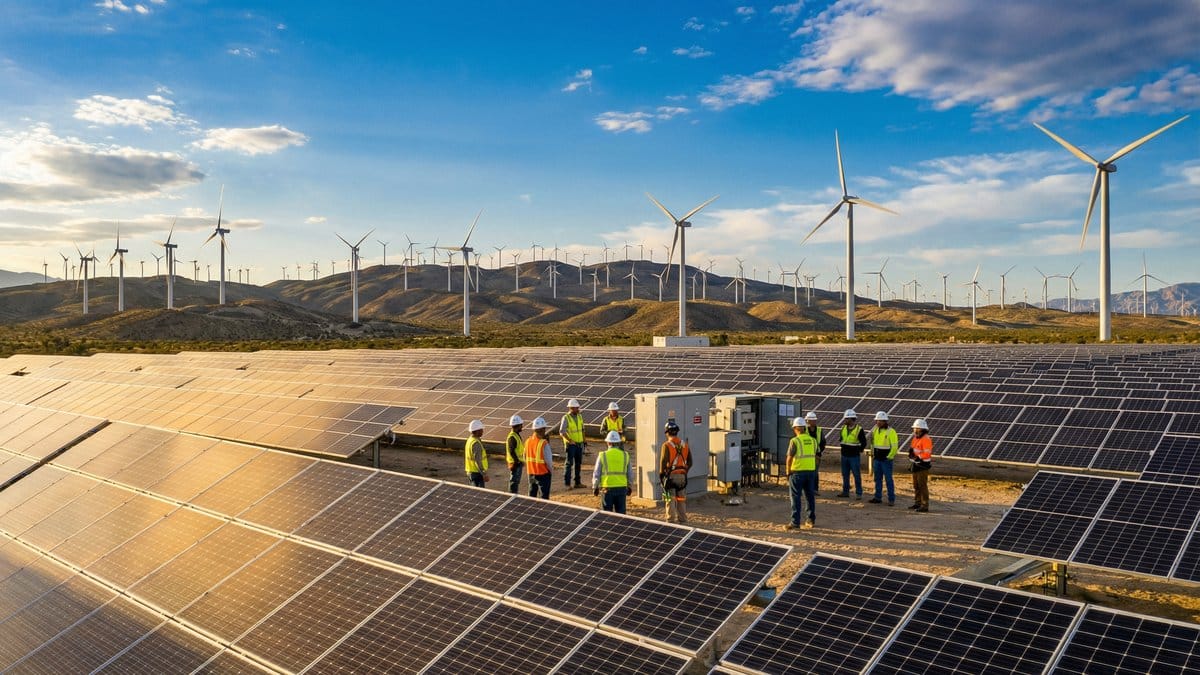
Despite the near-term dominance of fossil fuel headlines, the structural energy transition continues to accelerate. U.S. utilities generated approximately 1,162 terawatt-hours of electricity from renewable sources in 2025 — a 10% increase over the prior year — representing 26% of all U.S. electricity generation, according to the EIA. This milestone was achieved even as the Trump administration implemented policies aimed at curtailing green energy incentives. The economics of renewables have proven resilient: solar and wind installations are now cheaper to build than fossil fuel alternatives in most scenarios without subsidies, per Lazard.
The EIA projects that 93% of new generation capacity coming online in 2026 will come from wind, solar, and batteries, with solar accounting for 51% of new utility-scale additions. Wood Mackenzie forecasts renewables will account for nearly one-third of all U.S. electricity by 2030. Internationally, Canada and India signed bilateral agreements this week to advance solar and wind development, while China's solar power generation overtook wind for the first time, underscoring the rapid global scaling of photovoltaic technology.
Investment implications: The renewable sector's structural growth trajectory remains intact despite near-term policy headwinds. Investors with a multi-year horizon should consider exposure to solar developers, battery storage manufacturers, and grid infrastructure companies. Expiring federal incentive deadlines may accelerate near-term project completions, creating a catalyst for sector outperformance. Sources: EIA, Wood Mackenzie, Lazard, IEA.
Energy Stocks & Outlook
The energy sector has emerged as the standout performer in U.S. equity markets in 2026. The Energy Select Sector SPDR ETF (XLE) has surged more than 20% year-to-date, outpacing the near-flat S&P 500, according to State Street Investment Management. ExxonMobil announced its 38th consecutive annual dividend increase and continues to repurchase approximately $20 billion in shares annually, breaking out to a new all-time high in early 2026. EOG Resources broke above its 50-day and 200-day moving averages, with UBS raising its price target to $149 and Jefferies to $146. Cheniere Energy is a standout beneficiary of the LNG supply dislocation, while Diamondback Energy continues to attract attention for its Permian Basin efficiency. Goldman Sachs reports that renewable energy stocks outperformed oil and gas equities in 2025 and continue to attract long-term institutional capital.
The near-term outlook for energy equities hinges on the duration of the Middle East conflict. A prolonged Strait of Hormuz blockade would sustain elevated commodity prices and support further upside for integrated majors and U.S. shale producers. Any diplomatic resolution could trigger a rapid correction. Investors should maintain diversified exposure across both traditional and renewable energy segments. Sources: State Street, Benzinga, Goldman Sachs, UBS, Jefferies, Bloomberg.
Disclaimer: This analysis is for informational and educational purposes only and should not be considered financial advice. Energy sector investments carry significant commodity price volatility and geopolitical risks. Always conduct your own research and consult with a qualified financial advisor before making investment decisions.