



Market Overview
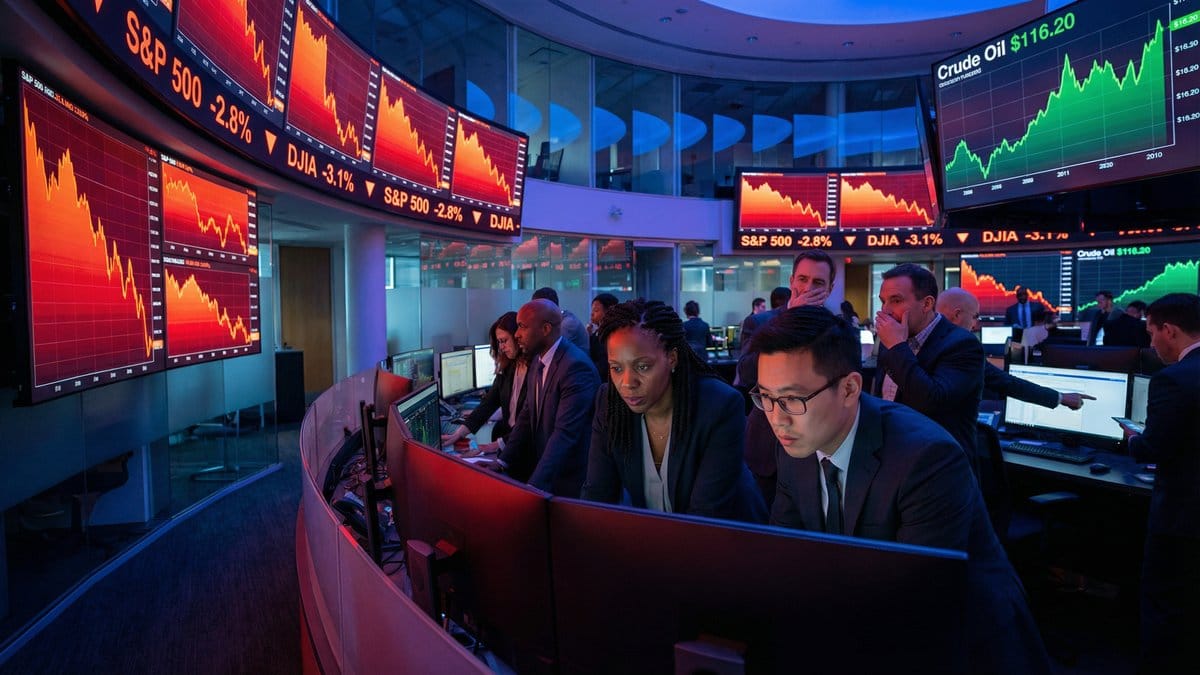
The U.S. equity markets remain under sustained pressure as investors grapple with escalating geopolitical tensions and shifting monetary policy expectations. The major indices closed out the previous week on a decidedly sour note, marking the fifth consecutive week of losses for the broader market. The S&P 500 shed approximately 1.67% to close at 5,368.85, bringing its year-to-date decline to roughly 7%. The Dow Jones Industrial Average plunged nearly 800 points, or 1.73%, to finish at 45,166.64. The tech-heavy Nasdaq Composite experienced the steepest drop, sliding 2.15% to close at 20,948.36. Both the Dow Jones and the Nasdaq have now officially entered correction territory, having fallen more than 10% from their respective recent peaks.
| Index | Last Close | Change | % Change | YTD |
|---|---|---|---|---|
| S&P 500 | 5,368.85 | ▼ 91.35 | -1.67% | -7.0% |
| Dow Jones | 45,166.64 | ▼ 793.46 | -1.73% | -8.0% |
| Nasdaq Composite | 20,948.36 | ▼ 460.85 | -2.15% | -10.0% |
| Russell 2000 | 2,063.74 | ▼ 38.20 | -1.82% | -9.5% |
| VIX (Fear Index) | 30.77 | ▲ 2.14 | +7.47% | — |
Overall market sentiment remains deeply bearish and oversold. The CBOE Volatility Index (VIX), often referred to as Wall Street's fear gauge, remains elevated above the 30 level, reflecting heightened anxiety among market participants. The traditional negative correlation between equities and bonds has broken down, as tighter monetary policy concerns and inflation fears drive yields higher, weighing simultaneously on both asset classes. The ongoing instability stemming from the US-Israeli war with Iran, now entering its fifth week, has severely dampened hopes for a swift resolution and continues to cast a long shadow over global markets.
Sector performance has been starkly divided. While the broader market and technology sectors have faced intense selling pressure, the energy sector has emerged as a notable bright spot. Energy stocks have surged in tandem with skyrocketing crude oil prices, providing one of the few areas of refuge for investors seeking to hedge against the current geopolitical and inflationary risks. Exxon Mobil (XOM) gained 3.36% on Friday, reflecting the broad outperformance of integrated oil majors.
Top Market Movers
The most significant market development continues to be the relentless surge in global oil prices. Brent crude, the international benchmark, surged past $116 per barrel, climbing more than 3% in early Monday trading after the Houthi militants in Yemen entered the Middle East conflict over the weekend, firing missiles at Israel. West Texas Intermediate (WTI) crude also jumped above the critical $100 mark. The energy market is facing unprecedented disruption as the Strait of Hormuz remains effectively closed, choking off an estimated 15 to 16 million barrels of oil per day from the global market. Brent crude is now up approximately 56% since the Iran war began, putting it on track for its biggest monthly gain on record, according to Bloomberg.
Investment implications: The sustained spike in energy costs is likely to act as a significant tax on consumers and businesses alike, threatening to compress corporate profit margins across transportation, manufacturing, and retail sectors. Investors may continue to find tactical opportunities in traditional energy producers and oilfield services companies, though the extreme volatility warrants cautious position sizing and disciplined risk management.
In the technology sector, the so-called “Magnificent Seven” stocks wiped out approximately $850 billion in market capitalization over the past week. This decline was led by Meta and Google, following their loss in a landmark lawsuit regarding the companies' responsibilities in curbing social media addiction. A sector-specific shock further compounded losses after Google announced its TurboQuant algorithm, which claims to reduce memory requirements for large language models by a factor of six. This triggered a sharp sell-off in memory chip manufacturers, with Micron falling 15.5% and SanDisk declining 13.2% over the week. A death cross has also formed on the Nasdaq 100, with the 50-day moving average crossing below the 200-day moving average, signaling potential further downside.
Investment implications: The rapid repricing of mega-cap technology stocks suggests that the artificial intelligence premium is being aggressively reassessed. While the long-term structural growth story for AI remains intact, near-term multiple compression could continue as rising yields erode the present value of future earnings. Investors should scrutinize semiconductor exposure, particularly in memory-centric names, as technological efficiency gains may temporarily disrupt demand forecasts.
Safe-haven assets have seen renewed interest amid the equity market turmoil. Gold prices advanced to $4,554.00 per ounce, gaining 0.66%, as investors sought traditional stores of value. Similarly, Bitcoin showed resilience, climbing 1.46% to trade near $67,600, highlighting its growing role as an alternative hedge against systemic instability. The concurrent strength in both traditional and digital safe-haven assets underscores the depth of current market anxiety.
Investment implications: Allocating a portion of portfolios to non-correlated assets like precious metals may provide necessary stabilization while geopolitical uncertainties remain unresolved. The gold-to-equity ratio has expanded meaningfully, suggesting that the market is pricing in a prolonged period of elevated risk.

Economic Data & Fed Watch
The macroeconomic landscape is becoming increasingly complex for the Federal Reserve, as surging energy prices threaten to reignite inflationary pressures just as economic growth shows signs of vulnerability. The futures market has experienced a dramatic repricing of monetary policy expectations. For the first time this cycle, traders have shifted the probability that the Federal Reserve will actually raise interest rates by the end of 2026 to 52%, completely abandoning earlier hopes for rate cuts, according to CME FedWatch data.
Recent commentary from Federal Reserve officials has reinforced this hawkish pivot. Fed Governor Barr, in a speech on March 26, expressed deep concern about prolonged inflation remaining stubbornly above the central bank's 2% target, noting that core inflation and nonhousing services inflation remain elevated. The Wall Street Journal reported that Fed officials are signaling that the era of rate cuts may be definitively over. Economists now expect the Personal Consumption Expenditures (PCE) index—the Fed's preferred inflation gauge—to jump to 3.4% this month, with UBS forecasting the measure will end the year at 3%, well above the Fed's target.
Treasury yields have reacted sharply to these shifting expectations. The 2-year Treasury yield climbed back to 4%, while the benchmark 10-year Treasury yield rose as high as 4.48% last week before seeing a slight retreat in early Monday trading, as bond investors began shifting their focus from inflation risks toward the growing threat of a recession. The US dollar has strengthened broadly against a basket of major currencies, supported by the prospect of higher-for-longer interest rates, adding additional pressure on emerging market assets.
Investment implications: The rising probability of further monetary tightening fundamentally alters the valuation calculus for long-duration assets, particularly growth stocks and long-term bonds. Investors should prepare for a prolonged period of elevated borrowing costs by prioritizing companies with strong balance sheets, robust free cash flow generation, and the pricing power necessary to pass on higher input costs to consumers. Short-duration fixed income instruments may offer an attractive risk-reward profile in this environment.
International Markets
Global equity markets mirrored the weakness seen on Wall Street, as the ripple effects of the Middle East conflict and rising energy costs dampened international sentiment. In Asia, markets experienced significant drawdowns. Japan's Nikkei 225 shed 3.4% on Monday, bringing its total losses for the month of March to nearly 13%. South Korea's Kospi dropped 3.0%, while the broader MSCI Asia-Pacific index outside Japan fell 1.3%. Chinese blue chips showed relative resilience, declining only 0.2%, as domestic policy support provided a partial buffer against global headwinds.
The Hang Seng Index in Hong Kong recorded its fourth consecutive week of negative returns, declining 1.3% to close below the psychologically important 25,000 level for the first time since August 2025. Corporate earnings in the region showed mixed results: Pop Mart plunged 28.6% despite reporting 185% revenue growth, as investors expressed concern about the company's heavy reliance on the Labubu/Monsters franchise. Kuaishou fell 14.4% as its capital expenditure guidance of approximately RMB 26 billion for 2026—nearly double 2025 levels—stoked concerns about AI-driven margin pressure. European futures also pointed lower, with EUROSTOXX 50 and DAX futures both declining 0.7%, while FTSE futures dipped 0.4%.
In currency markets, the Australian dollar (AUD/USD) retreated to a two-month low near $0.6875, falling 2.1% over the week. The commodity-sensitive currency was pressured by softer domestic inflation data—with Australian consumer prices unchanged month-on-month in February and annual inflation easing to 3.7%—and growing concerns that a prolonged Middle East conflict could curb global business activity, thereby reducing demand for Australia's key industrial metal exports, including copper and iron ore.
Looking Ahead
As investors navigate a holiday-shortened trading week—with markets closed on Friday, April 3, for Good Friday—attention will be laser-focused on critical labor market data. The centerpiece of the economic calendar is the March jobs report from the Bureau of Labor Statistics, due Friday. Economists are forecasting an increase of approximately 55,000 jobs and an unemployment rate of 4.4%. This report takes on heightened significance as market participants seek clarity following the extreme volatility seen in the January (+130,000) and February (-92,000) payroll numbers. Notably, markets will be closed when the report is released, meaning the full price reaction will occur at Monday's open.
Earlier in the week, investors will digest the Job Openings and Labor Turnover Survey (JOLTS) on Tuesday and the ADP private payrolls report on Wednesday, which will provide preliminary insights into the health of the employment landscape. The Conference Board's Consumer Confidence index, also due Tuesday, will offer a crucial read on how surging gasoline prices and market turbulence are impacting consumer psychology. Challenger job cuts data is expected on Thursday.
On the corporate earnings front, the calendar is relatively light, but quarterly results from consumer bellwether Nike (NKE) on Tuesday will be closely scrutinized for indications of shifting consumer spending patterns in a high-inflation, high-energy-cost environment. Earnings from critical minerals companies USA Rare Earth (USAR) and Trilogy Metals (TMQ) will also provide a health check on the materials sector ahead of the highly anticipated, though currently delayed, meeting between US President Trump and Chinese President Xi Jinping. Any developments on the Iran war front—particularly ceasefire negotiations or further escalation—remain the single most important potential catalyst for markets in either direction.
Disclaimer: This analysis is for informational and educational purposes only and should not be considered financial advice. Market conditions can change rapidly, and past performance does not guarantee future results. Always conduct your own research and consult with a qualified financial advisor before making investment decisions.