



Stock Introduction & Thesis
Microsoft Corporation (MSFT) stands as a titan in the global technology landscape, operating across three primary segments: Productivity and Business Processes, Intelligent Cloud, and More Personal Computing. The company's business model is deeply entrenched in enterprise software, cloud computing infrastructure, and increasingly, artificial intelligence. Microsoft's flagship products, including the Office 365 suite, Windows operating system, and the Azure cloud platform, generate massive, recurring revenue streams that provide a robust foundation for continuous innovation and capital expenditure.
The core investment thesis for Microsoft in April 2026 centers on its unique position to monetize the artificial intelligence revolution. While the broader market has experienced volatility, leading to a significant 22% pullback in Microsoft's stock price from its all-time highs, the underlying business fundamentals remain exceptionally strong. The company is transitioning from an infrastructure provider to an “agentic” business leader, embedding AI capabilities directly into workflows used by billions globally. This strategic pivot, combined with a temporary compression in valuation multiples, presents a compelling entry point for long-term investors seeking exposure to high-quality, cash-generative growth.

Recent Developments & Catalysts
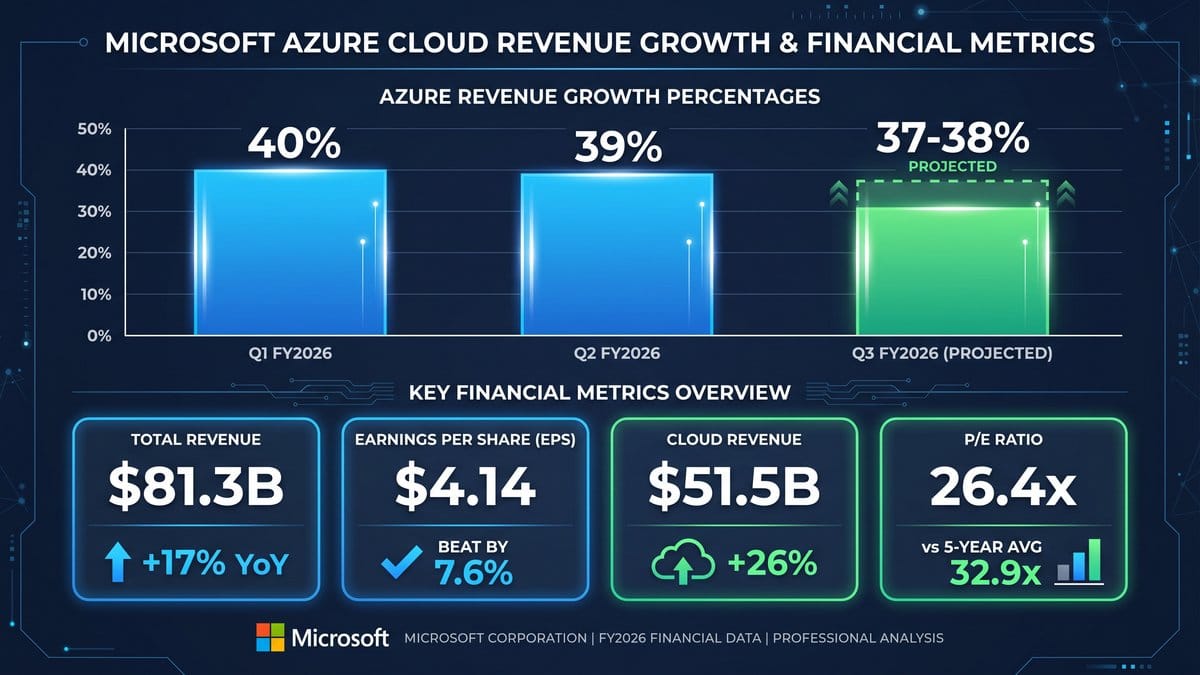
The most significant near-term catalyst for Microsoft is its upcoming fiscal third-quarter 2026 earnings report, scheduled for April 29. Investors are keenly focused on two primary metrics: the growth trajectory of the Azure cloud platform and the adoption rate of the Copilot virtual assistant. In the most recent quarter (Q2 FY2026), Azure revenue grew at a blistering pace of 39% year-over-year, solidifying its position as Microsoft's fastest-growing segment. The market will be looking for confirmation that this momentum is sustainable, particularly given the massive $625 billion order backlog for cloud infrastructure reported at the end of 2025.
Furthermore, the rollout of Microsoft 365 Copilot represents a massive monetization opportunity. Currently, businesses have purchased approximately 15 million Copilot licenses, representing a modest penetration rate of just 3.7% among the 400 million existing 365 enterprise users. Any acceleration in this adoption rate, driven by demonstrated productivity gains, could significantly boost near-term revenue forecasts and alleviate concerns regarding the return on investment for Microsoft's aggressive AI capital expenditures. Analysts at Evercore and Bank of America have both reiterated bullish stances ahead of the April 29 report, with Wall Street consensus expecting EPS of $4.04 to $4.05, representing 16.8% year-over-year growth.
Investment implications: The upcoming earnings report serves as a critical inflection point. A strong showing in Azure growth and Copilot adoption could rapidly reverse the recent stock pullback, validating the company's heavy investments in AI infrastructure and reaffirming its leadership position in the sector. Investors who position ahead of this catalyst may benefit from a meaningful re-rating of the stock.
Financial Analysis
Microsoft's financial performance has been nothing short of stellar, demonstrating the resilience and scalability of its business model. For the fiscal year 2025, the company reported a staggering $281.7 billion in total revenue, representing a 15% year-over-year increase. Operating income grew even faster, surging 17% to $128.5 billion, highlighting the company's ability to expand margins even as it scales operations. This robust top and bottom-line growth continued into the second quarter of fiscal 2026, where revenue hit $81.3 billion — a 17% increase — and earnings per share (EPS) reached $4.14, beating analyst estimates by over 7.6%.
The Intelligent Cloud segment, driven primarily by Azure, remains the undisputed engine of this financial powerhouse. In Q2 FY2026, Microsoft Cloud revenue surpassed $51.5 billion, growing 26% year-over-year. The company's commercial remaining performance obligation surged 110% to a record level, providing exceptional revenue visibility for the coming quarters. This consistent, high-margin revenue generation provides Microsoft with the unparalleled financial flexibility required to fund its massive capital expenditure program, which reached $37.5 billion in Q2 alone — up 66% year-over-year — as the company aggressively builds out the data centers necessary to support future AI workloads.
Investment implications: Microsoft's ability to generate massive free cash flow while simultaneously investing heavily in future growth initiatives is a rare and highly attractive characteristic. The consistent double-digit growth in both revenue and EPS provides a strong margin of safety for investors, even in the face of macroeconomic uncertainties. The 110% year-over-year growth in the commercial backlog is a particularly powerful indicator of future revenue durability.
Valuation & Competitive Position
Following the recent market correction, Microsoft's valuation has become increasingly attractive. Based on trailing twelve-month earnings of $15.98 per share and a stock price of approximately $418, the stock is currently trading at a price-to-earnings (P/E) ratio of approximately 26.4x. This represents a significant discount to its five-year historical average P/E of 32.9x, and it is also lower than the broader Nasdaq-100 technology index, which trades at a P/E of 32.4x. This multiple compression suggests that the market has aggressively priced in concerns regarding AI capital expenditures and potential macroeconomic headwinds, potentially creating a meaningful mispricing opportunity.
Competitively, Microsoft occupies an enviable position. In the cloud infrastructure market, Azure holds an estimated 22% to 24% global market share, firmly entrenched as the primary challenger to Amazon Web Services (AWS). More importantly, Microsoft's deep integration of OpenAI's technology across its product suite gives it a distinct first-mover advantage in the enterprise AI space. Unlike competitors who are still developing their AI strategies, Microsoft is already monetizing these capabilities at scale through products like Copilot, creating a sticky ecosystem that is difficult for rivals to disrupt. The GF Score of 97/100 from GuruFocus further underscores the company's exceptional fundamental quality.
Investment implications: The current valuation presents a compelling risk-to-reward scenario. Investors are essentially able to purchase shares of a dominant, high-growth technology leader at a discount to its historical averages, providing significant upside potential. A simple reversion to the five-year average P/E multiple would imply a 24% increase in the stock price from current levels, before accounting for any additional earnings growth.
Risks & Outlook
Despite the strong bullish case, investing in Microsoft is not without risks. The most prominent concern centers on the company's massive capital expenditure cycle. With projected CapEx reaching unprecedented levels to build AI infrastructure, there is a risk that the return on investment may take longer to materialize than the market anticipates. If Copilot adoption stalls or if enterprise customers balk at the additional subscription costs, Microsoft's margins could face significant pressure in the near term.
Additionally, the company's heavy reliance on OpenAI presents a unique vulnerability. OpenAI itself has flagged this dependency as a key risk factor in its pre-IPO documents, and any disruption in the partnership could negatively impact Microsoft's AI roadmap. Furthermore, the broader macroeconomic environment, including the geopolitical conflict between the U.S. and Iran that has driven oil price volatility, could dampen enterprise IT spending and slow Azure growth. The potential overstatement of the $625 billion backlog — of which $281 billion is attributable to OpenAI alone — is another factor that warrants careful monitoring.
However, the long-term outlook remains overwhelmingly positive. Microsoft's entrenched position in enterprise software, combined with its aggressive and well-funded push into artificial intelligence, positions the company to be a primary beneficiary of the next major technological paradigm shift. For investors with a long-term horizon, the current pullback offers a rare opportunity to acquire a generational compounder at a reasonable valuation.
Disclaimer: This analysis is for informational and educational purposes only and should not be considered financial advice. Individual stock investments carry significant risks including company-specific and market risks. Always conduct your own research and consult with a qualified financial advisor before making investment decisions.