



Imagine two retirees who both start with a $1 million portfolio, withdraw $40,000 annually, and experience the exact same average annual return of 6.5% over a 20-year period. You might assume they end up with identical portfolio balances. However, if one retiree experiences market losses in the first few years of retirement while the other experiences those same losses at the end of the 20-year period, their final portfolio values could differ by hundreds of thousands of dollars. This phenomenon is known as sequence of returns risk, and it represents one of the most critical yet misunderstood threats facing retirees today.
Sequence of returns risk occurs when the timing and order of investment returns—particularly negative returns early in retirement combined with portfolio withdrawals—significantly depletes savings and shortens portfolio longevity. Unlike general market volatility, which affects all investors, this specific retirement risk emerges when you are forced to withdraw funds during market downturns. By selling assets at depressed prices to fund your living expenses, you permanently lock in those losses. This reduces your principal base and severely limits your portfolio's ability to recover and benefit from subsequent market rebounds.
The five years immediately preceding and following your retirement date constitute what financial researchers identify as the “fragile decade.” During this critical window, your portfolio faces maximum exposure to sequence risk because large balances meet regular withdrawals amid potential market turbulence. Understanding and mitigating this risk is essential for ensuring your retirement savings last a lifetime.

Understanding the Mechanics of Dollar Cost Ravaging
To fully grasp sequence of returns risk, it is helpful to understand the concept of “dollar cost ravaging.” During your working years, you likely utilized dollar cost averaging—investing a fixed amount of money at regular intervals, which allowed you to buy more shares when prices were low and fewer shares when prices were high. This strategy works brilliantly during the accumulation phase.
However, in retirement, the math works in reverse. When you withdraw a fixed amount of money from your portfolio during a market downturn, you are forced to sell a larger number of shares to generate the same amount of cash. Those shares are permanently removed from your portfolio and can never participate in future market gains. This compounding depletion effect limits your recovery potential even when markets eventually rebound. According to research from the Social Security Administration and independent financial analysts, negative returns during the first five years of retirement account for a significant majority of retirement plan failures.
Action steps: First, calculate your essential living expenses—the absolute minimum you need to cover housing, food, healthcare, and utilities. Second, evaluate your guaranteed income sources, such as Social Security, pensions, or annuities. Third, determine the gap between your essential expenses and your guaranteed income. This gap represents the amount you must withdraw from your investment portfolio, and minimizing this required withdrawal rate during the fragile decade is your primary defense against sequence of returns risk.
The Three-Bucket Strategy: A Defensive Architecture
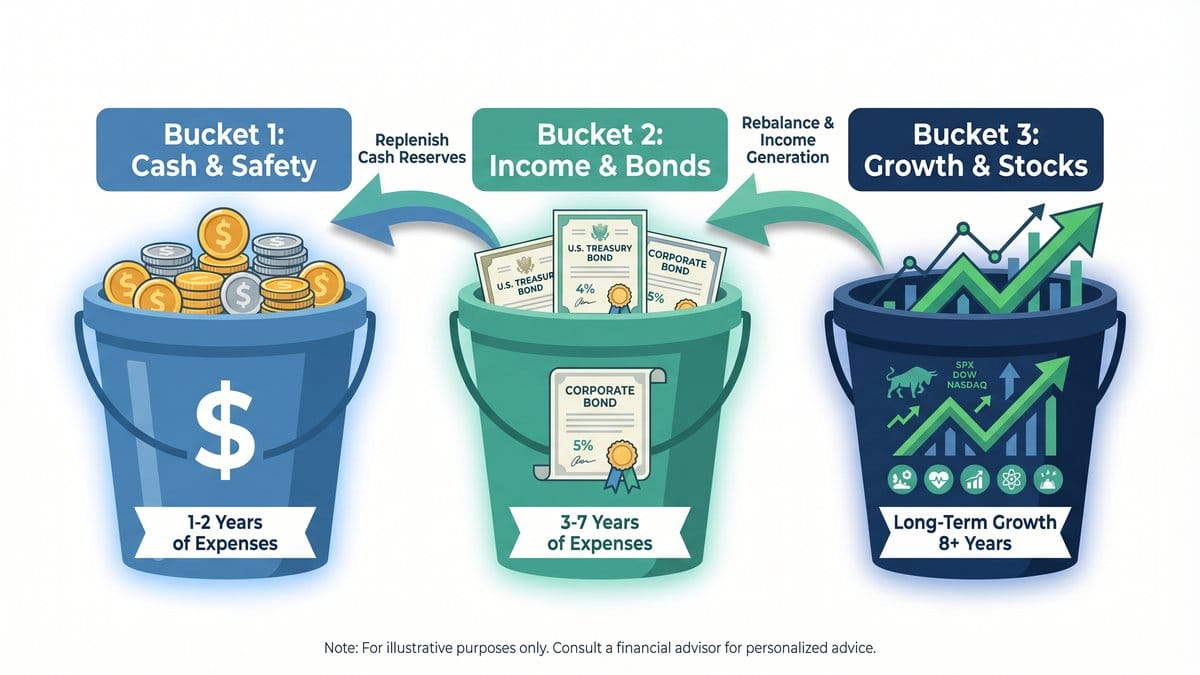
One of the most effective methods for mitigating sequence of returns risk is implementing a time-segmented approach, commonly known as the bucket strategy. This strategy divides your retirement assets into distinct pools based on when you will need the money, providing both practical protection and psychological comfort during market volatility.
The first bucket is designed for immediate cash needs and safety. It typically holds one to two years' worth of living expenses in highly liquid, risk-free assets such as cash, high-yield savings accounts, or short-term certificates of deposit (CDs). This bucket ensures that you can meet your daily financial obligations without ever being forced to sell stocks during a market crash.
The second bucket focuses on income and stability, designed to cover expenses for years three through seven of retirement. This bucket is generally invested in conservative, income-producing assets like high-quality corporate bonds, U.S. Treasuries, and dividend-paying stocks. The goal is to outpace inflation while maintaining a lower risk profile than the broader stock market.
The third bucket is dedicated to long-term growth and is intended for money you will not need for at least eight years. This bucket holds the majority of your equity investments, such as domestic and international stocks, real estate investment trusts (REITs), and growth-oriented mutual funds. Because you have secured your short- and medium-term needs in the first two buckets, you can afford to let this third bucket ride out market fluctuations and capture long-term compounding growth.
Investment and Tax Implications
Implementing a robust defense against sequence of returns risk requires a fundamental shift in how you view your investment portfolio. During your accumulation years, your primary objective was maximizing total return. In retirement, your objective must shift to maximizing risk-adjusted income and preserving capital during downturns.
Investment implications: You must actively manage the replenishment of your cash buffer. During prolonged bull markets, you should periodically harvest gains from your growth bucket (Bucket 3) to refill your cash and income buckets (Buckets 1 and 2). Conversely, during a bear market, you rely entirely on your cash and income buckets to fund your lifestyle, allowing your growth bucket the necessary time to recover without the drag of withdrawals.
From a tax perspective, the order in which you draw from different account types matters significantly. The IRS requires you to begin taking Required Minimum Distributions (RMDs) from traditional IRAs and 401(k) plans starting at age 73 (as established under the SECURE 2.0 Act). Strategic coordination between taxable accounts, tax-deferred accounts, and tax-free Roth accounts can help you manage your taxable income, potentially keeping you in lower tax brackets and reducing the impact of Medicare premium surcharges (IRMAA). Furthermore, consider dynamic withdrawal strategies rather than rigidly adhering to a fixed withdrawal rate. Even a modest reduction in discretionary spending during a year when your portfolio experiences negative returns can dramatically improve the long-term survival rate of your portfolio.
Common Mistakes to Avoid
The most prevalent mistake retirees make regarding sequence of returns risk is relying solely on average historical returns for their financial planning. Averages mask the volatility that can destroy a portfolio during the withdrawal phase. Assuming a steady 7% return every year is a dangerous planning fallacy that fails to account for the reality of market cycles.
Another critical pitfall is panic selling. Many retirees successfully build a cash buffer but still succumb to emotional decision-making during severe market downturns, selling their equity positions at the bottom of the market. A protection strategy only works if you have the discipline to follow it when the pressure is highest. Additionally, failing to account for the impact of inflation on your cash bucket can slowly erode your purchasing power. While your cash buffer must be safe, your overall portfolio must still generate enough growth to combat long-term inflation. Finally, many retirees underestimate healthcare costs in retirement. According to AARP research, a retired couple may need well over $300,000 to cover healthcare expenses throughout retirement—a major variable that must be factored into your sequence risk planning.
Next Steps and Resources
Protecting your retirement from sequence of returns risk requires proactive planning before the next market downturn occurs. Start by stress-testing your current portfolio to see how it would perform if you experienced a 20% to 30% market decline in your first year of retirement. If the results are concerning, begin building your cash buffer immediately—even while you are still working.
Review your asset allocation to ensure it aligns with a time-segmented bucket strategy, and establish clear rules for when and how you will replenish your cash reserves. For additional guidance, consult the Social Security Administration's online resources regarding how delaying benefits can increase your guaranteed income floor, thereby reducing your reliance on portfolio withdrawals. The IRS also provides detailed publications on RMD rules and tax-efficient withdrawal strategies. Consider speaking with a fiduciary financial advisor who specializes in retirement income planning to help you construct a resilient withdrawal architecture tailored to your specific needs and timeline.
Disclaimer: This analysis is for informational and educational purposes only and should not be considered financial or tax advice. Retirement planning involves complex tax and legal considerations that vary by individual circumstances. Always conduct your own research and consult with a qualified financial advisor and tax professional before making retirement planning decisions.