




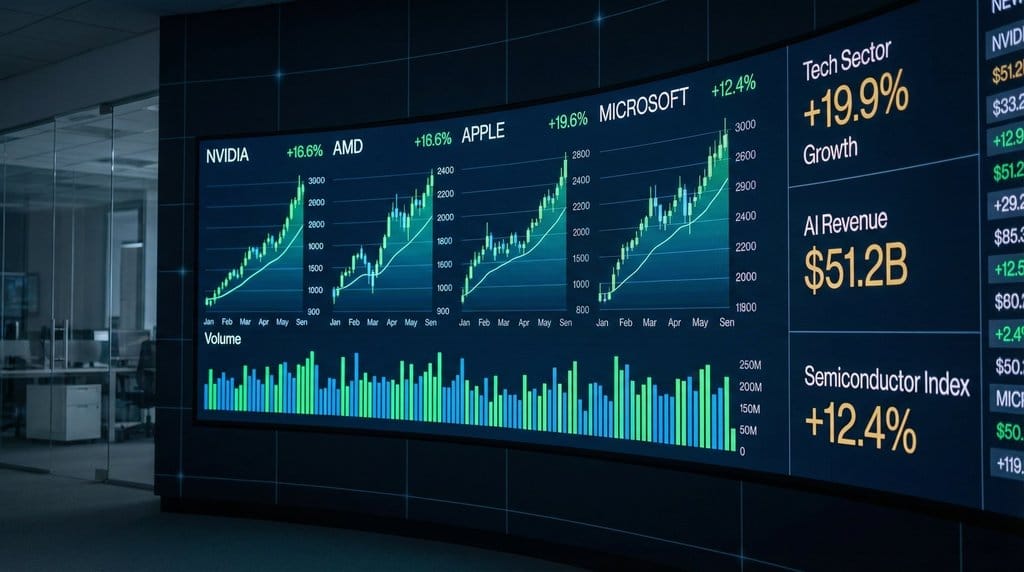
The technology sector experienced a mixed but eventful week, largely influenced by the announcements and sentiment emerging from the Consumer Electronics Show (CES) 2026. While the broader market showed signs of a potential rally beyond just tech, with nine out of the S&P 500’s 11 sectors making gains, the tech-heavy Nasdaq saw some profit-taking and volatility. The FAANG portfolio registered a slight year-to-date dip of -0.36% as of January 8, 2026, though some market analysts point to a nearly 5% return for the group in early January trading, highlighting the day-to-day fluctuations in the current environment. The Philadelphia Semiconductor Index, a key barometer for the chip sector, dropped approximately 2%, with major players like Nvidia and AMD seeing modest pullbacks of 1.7% and 1.6% respectively. This suggests a period of consolidation and investor recalibration after a strong 2025, where the S&P 500 delivered a robust 17.9% return, largely dominated by the artificial intelligence theme. Despite the short-term volatility, the outlook for the tech sector in 2026 remains optimistic, with Zacks projecting a significant +19.9% earnings growth for the calendar year.
Tech Week in Review
The technology sector experienced a mixed but eventful week, largely influenced by the announcements and sentiment emerging from the Consumer Electronics Show (CES) 2026. While the broader market showed signs of a potential rally beyond just tech, with nine out of the S&P 500’s 11 sectors making gains, the tech-heavy Nasdaq saw some profit-taking and volatility. The FAANG portfolio registered a slight year-to-date dip of -0.36% as of January 8, 2026, though some market analysts point to a nearly 5% return for the group in early January trading, highlighting the day-to-day fluctuations in the current environment. The Philadelphia Semiconductor Index, a key barometer for the chip sector, dropped approximately 2%, with major players like Nvidia and AMD seeing modest pullbacks of 1.7% and 1.6% respectively. This suggests a period of consolidation and investor recalibration after a strong 2025, where the S&P 500 delivered a robust 17.9% return, largely dominated by the artificial intelligence theme. Despite the short-term volatility, the outlook for the tech sector in 2026 remains optimistic, with Zacks projecting a significant +19.9% earnings growth for the calendar year.
Big Tech & AI Developments
Big Tech and AI developments continue to be the primary drivers of market sentiment and investment. CES 2026 was a showcase for the relentless pace of innovation, with AI and robotics taking center stage. Nvidia once again asserted its dominance, unveiling new chip technologies and announcing that its next-generation AI server systems are rolling out sooner than expected. The company’s strategic vision extends beyond chips, with a stated ambition to become the “Android of generalist robotics”. The insatiable demand for Nvidia’s products was underscored by reports of the company being “sold out” of cloud GPUs in the previous quarter, even with data center revenues hitting an astounding $51.2 billion. AMD is not standing still, with CEO Lisa Su solidifying the company’s position as a strong number two in the AI chip race and announcing plans for yotta-scale AI computing for massive models. Intel is also making a comeback, bolstered by multi-billion dollar investments from the US government and even rival Nvidia, aimed at stabilizing its finances and ramping up production.
Investment implications: The AI arms race among Big Tech is intensifying, with capital expenditures set to soar. Meta Platforms, for example, is projected to spend over $100 billion on capex in 2026, a move that initially spooked investors but signals the immense infrastructure build-out required for next-generation AI. This creates a multi-faceted investment landscape. Direct investment in chip leaders like Nvidia and AMD remains a core strategy, while the resurgence of Intel presents a potential turnaround play. Furthermore, the entire semiconductor supply chain, including foundries like Taiwan Semiconductor (TSM), stands to benefit from this escalating demand. The acquisition of the executive coaching AI tool Convogo by OpenAI also points to the expanding application layer of AI, creating opportunities in specialized AI software and services.
Emerging Tech Trends
Beyond the headlines from the AI giants, several other technology trends are gathering momentum and present significant investment opportunities. Cybersecurity is evolving rapidly in response to new threats, many of which are themselves AI-driven. The focus is shifting from simple defense to building resilience, with an emphasis on identity as the new security perimeter and the growing threat of ransomware being used for disruption rather than just data theft. The advent of quantum computing is also forcing a proactive shift towards post-quantum encryption to secure data for the long term. In Fintech, the integration of AI, blockchain, and cloud computing is transforming financial services. AI agents are being deployed for autonomous banking tasks, while the Fintech-as-a-Service (FaaS) model is gaining traction, enabled by scalable, API-driven architectures on the cloud.
Investment implications: The increasing complexity of the digital world creates a fertile ground for investment in specialized technology sectors. Cybersecurity firms focused on AI-powered threat detection, identity and access management, and post-quantum cryptography are poised for growth. In fintech, companies providing the underlying infrastructure for digital transformation, such as cloud providers and API platforms, are attractive long-term investments. The convergence of 5G, IoT, and edge computing is another powerful trend, set to revolutionize industries from healthcare, with IoT medical devices for chronic disease management, to robotics and autonomous systems. This creates opportunities in companies developing the hardware and software for this interconnected future, including ultra-secure IoT devices and the platforms that manage them.
Tech Stock Spotlight
In this week’s spotlight, we focus on two companies that represent different but equally compelling investment theses in the current tech landscape: Micron Technology (MU) and Palo Alto Networks (PANW).
Micron Technology (MU) is increasingly being referred to as “the Nvidia of AI memory,” a testament to its critical role in the AI hardware ecosystem. While GPUs provide the processing power, high-bandwidth memory is essential for feeding the massive datasets that AI models require. Micron is a key supplier of this specialized memory, and as the complexity and size of AI models continue to grow, so too will the demand for its products. Trading at an attractive forward price-to-earnings (P/E) multiple of just 7.1x, Micron appears undervalued compared to the high-flying valuations of other AI players. This presents a compelling opportunity for investors to gain exposure to the AI boom at a more reasonable entry point.
Palo Alto Networks (PANW) is a leader in the cybersecurity space, a sector that is becoming ever more critical as our world becomes more digital. The company has consistently been recognized as a core stock to own for the long term, and its comprehensive security platform is well-positioned to address the evolving threat landscape. With the rise of AI-driven cyberattacks and the increasing importance of cloud security, Palo Alto Networks’ integrated approach, which spans network security, cloud security, and security operations, is a key differentiator. The company’s strong financial performance and consistent innovation make it a cornerstone investment for any tech-focused portfolio.
Investment implications: Both Micron and Palo Alto Networks offer exposure to powerful secular growth trends. Micron provides a picks-and-shovels play on the AI revolution, with a more attractive valuation than many of its peers. Palo Alto Networks, on the other hand, offers a defensive growth opportunity, as cybersecurity spending is non-discretionary and set to increase regardless of the broader economic climate. Both stocks are worthy of consideration for a diversified technology portfolio.
Week Ahead for Tech
The coming weeks will be crucial for the tech sector as earnings season kicks off. Netflix (NFLX) is scheduled to report on January 20, followed by Apple (AAPL) on January 29. Apple’s results will be closely watched, with the company guiding for 10-12% year-over-year revenue growth, driven by iPhone and services, and impressive gross margin projections of 47-48%. Beyond earnings, the fallout from CES 2026 will continue to reverberate, with new partnerships and product announcements shaping the competitive landscape. The partnership between Boston Dynamics and Google DeepMind to equip humanoid robots with advanced AI capabilities is a significant development to watch. Other key events on the horizon include the potential Discord IPO in March and the transition of Apple’s credit card portfolio from Goldman Sachs to JPMorgan Chase. These events, coupled with the ongoing macroeconomic trends, will provide plenty of catalysts for the tech sector in the weeks and months ahead.
Investment implications: Investors should pay close attention to the upcoming earnings reports from Big Tech, as they will provide a clearer picture of the demand environment and the impact of AI investments on profitability. Any surprises, either positive or negative, could have a significant impact on market sentiment. The developments in the robotics and AI space also warrant close monitoring, as they could signal the emergence of the next major growth vector for the tech industry.
Disclaimer: This analysis is for informational and educational purposes only and should not be considered financial advice. Always conduct your own research and consult with a qualified financial advisor before making investment decisions.