



Precious metals markets surged to new heights in the second week of January, with gold and silver reaching unprecedented levels. A confluence of escalating geopolitical risks, expectations of a more dovish U.S. Federal Reserve, and a weakening dollar fueled a powerful rally, extending the bullish momentum from a record-breaking 2025. This report delves into the key drivers, market performance, and strategic considerations for investors in the current environment.
Gold Market Update
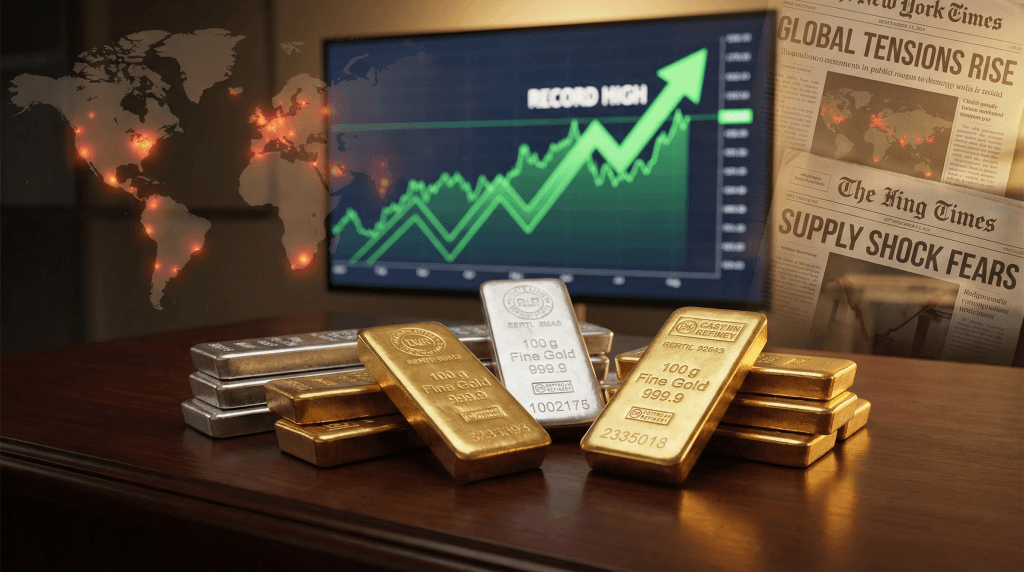
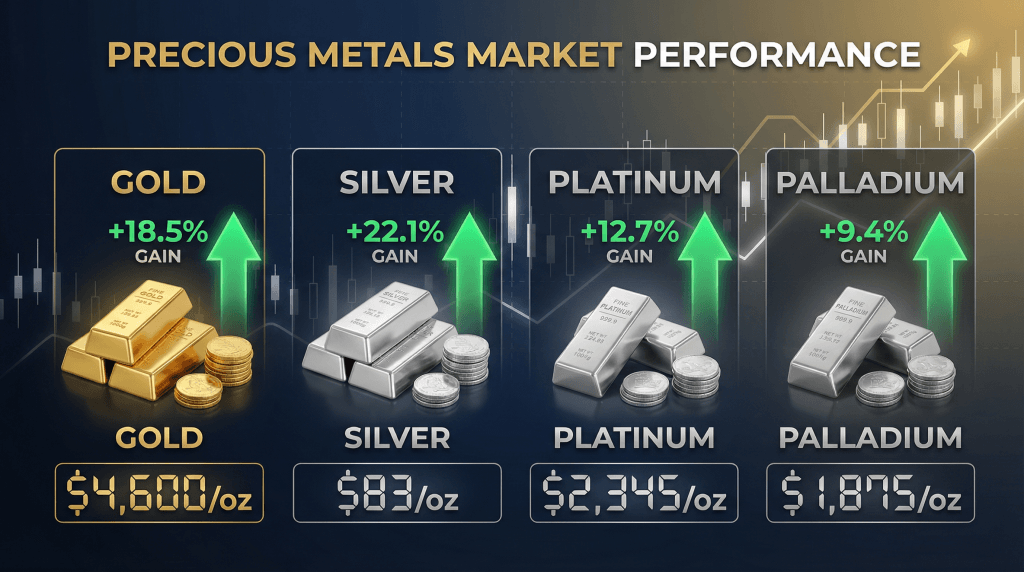
Gold prices shattered previous records, breaking through the $4,600 per ounce level for the first time on Monday, January 12 [1]. Spot gold saw a significant 1.3% jump to $4,469.49 per ounce, after hitting a record high of $4,600.33 earlier in the day, while U.S. gold futures for February delivery firmed 2% to $4,591.10 [1]. The primary catalyst for this surge has been a flight to safety amid rising geopolitical instability. Tensions in Iran, where unrest has led to significant casualties, coupled with a more assertive U.S. foreign policy, have heightened investor anxiety and bolstered demand for safe-haven assets [1].
Furthermore, the market is increasingly pricing in the likelihood of at least two Federal Reserve rate cuts in 2026. Recent U.S. employment data showed a slowdown in job growth, particularly in the construction, retail, and manufacturing sectors, which may provide the Fed with the justification to ease monetary policy [1]. The weakening U.S. dollar, which has retreated from a one-month high, has also provided a tailwind for gold, making it more attractive for holders of other currencies. This sentiment is echoed by Bank of America, which forecasts gold to average $4,538 per ounce in 2026, with the potential to reach $5,000 per ounce [4].
Investment implications: The current environment underscores gold’s role as a crucial portfolio hedge against geopolitical and economic uncertainty. The divergence of gold’s price from its historical inverse correlation with real yields suggests that macroeconomic and geopolitical factors are currently the dominant drivers [3]. Investors should consider maintaining or increasing their allocation to gold to safeguard against potential market volatility. The strong upward momentum, supported by robust central bank buying and under-investment by institutional and retail sectors, suggests that the rally may have further to run.
Silver Market Update
Silver also experienced a spectacular rally, reaching an all-time high of $83.96 per ounce before settling around $82.72, a 3.5% increase on the day [1]. Silver’s dual nature as both a precious and industrial metal means it benefits from both safe-haven demand and the ongoing global push towards electrification and green energy. The market is currently in its fifth consecutive year of a physical deficit, with industrial consumption, particularly from the photovoltaics sector, consistently outpacing mine supply [3]. This fundamental tightness in the physical market makes silver highly sensitive to any supply disruptions and provides a strong floor for prices.
Bank of America’s research suggests that silver could significantly outperform gold in the current cycle. The gold-to-silver ratio, which currently stands at approximately 59, is well above its historical lows. A reversion to the 2011 low of 32 would imply a silver price of $135 per ounce, while a return to the 1980 low of 14 could see silver prices soar to an astonishing $309 per ounce [4]. This potential for outsized returns makes silver an attractive proposition for investors with a higher risk tolerance.
Investment implications: Silver presents a compelling investment case for those seeking to capitalize on both the safe-haven trade and the long-term structural demand from industrial applications. The persistent supply deficit and the potential for a significant compression in the gold-to-silver ratio suggest that silver has substantial upside potential. While more volatile than gold, silver’s unique fundamentals offer the prospect of superior returns in the current market environment.
Gold/Silver Ratio & Other Precious Metals
The gold-to-silver ratio has been a key focus for precious metals investors, having exhibited significant volatility in 2025. After breaching 100 for the first time since 2020, the ratio compressed to below 60 for the first time in over a decade [3]. This dynamic, where silver often lags gold’s initial breakout but then moves with greater intensity, creates opportunities for tactical investors. The current ratio of around 59 suggests that silver remains undervalued relative to gold and could be poised for further outperformance [4].
Platinum and palladium, the other two major precious metals, are trading on a distinct set of fundamentals. Their prices are heavily influenced by industrial demand, particularly from the automotive sector, and supply concentration risks in key producing regions like South Africa and Russia [3]. Platinum reached a record peak of $2,478.50 per ounce on December 29 and was trading at $2,345.40 on January 12, while palladium gained 3.3% to $1,875.68 [1]. These metals are behaving more like industrial commodities, offering diversification away from the monetary and financial drivers of gold and silver, but also exposing investors to the cyclical risks of the global auto industry [3].
Investment implications: The gold-to-silver ratio remains a critical indicator for assessing the relative value of the two primary monetary metals. A continued decline in the ratio would favor an overweight position in silver. For investors seeking to diversify their precious metals holdings further, platinum and palladium offer exposure to industrial trends. However, it is crucial to understand that their performance is more closely tied to the global economic cycle and specific industrial demand drivers rather than the safe-haven and monetary-hedging properties of gold and silver.
Week Ahead for Precious Metals
The week ahead will be dominated by the release of key U.S. economic data, which will be closely scrutinized for its potential impact on the Federal Reserve’s monetary policy trajectory. The main event will be the December Consumer Price Index (CPI) report on Tuesday. The Cleveland Fed’s Inflation Nowcasting model is predicting a 0.2% month-over-month increase, which would translate to a 2.6% year-over-year rate, a slight moderation from the previous month [5]. A softer-than-expected inflation reading would reinforce expectations for Fed rate cuts and likely provide further impetus for the precious metals rally.
Other important data releases include November retail sales and the Producer Price Index (PPI) on Wednesday, and December existing home sales and initial unemployment claims on Thursday [5]. A slew of speeches from Fed officials throughout the week, including New York Fed President John Williams and several Fed Governors, will also be closely watched for any hints about the central bank’s thinking ahead of the January 28 FOMC meeting [5]. Any rhetoric that is perceived as dovish will be bullish for precious metals.
Investment implications: The upcoming economic data, particularly the CPI report, will be a major catalyst for the precious metals market in the short term. Investors should be prepared for potential volatility around these releases. A continuation of the disinflationary trend would be highly supportive of gold and silver prices, while any upside surprises in inflation could temper rate cut expectations and lead to a temporary pullback. Monitoring the commentary from Fed officials will also be crucial for gauging the likely path of monetary policy.
Investment Strategy
The current market environment, characterized by elevated geopolitical risk, expectations of monetary easing, and a weakening dollar, remains highly favorable for precious metals. Gold continues to be an essential portfolio diversifier and a hedge against systemic risks. The ongoing structural demand from central banks and the under-allocation by both institutional and retail investors provide a solid foundation for further price appreciation [3] [4].
Silver, with its strong industrial demand profile and the potential for significant outperformance relative to gold, offers a more aggressive way to play the precious metals theme. The persistent physical deficit and the prospect of a contracting gold-to-silver ratio make it a compelling investment for those with a higher risk appetite [3] [4]. A diversified approach, with a core holding in gold and a satellite position in silver, may be the most prudent strategy for most investors.
Investment implications: Investors should consider a multi-faceted approach to their precious metals allocation. A core holding in physical gold or gold-backed ETFs provides a fundamental hedge against a range of risks. For those seeking higher returns, an allocation to silver and even select precious metals mining equities could be considered. Given the strong performance of the sector, it is important to avoid chasing prices and instead look for opportunities to accumulate on any pullbacks. The long-term fundamentals for precious metals remain firmly intact, and any near-term volatility should be viewed as a buying opportunity.
Disclaimer: This analysis is for informational and educational purposes only and should not be considered financial or investment advice. Precious metals investments can be volatile and carry risks. Only invest what you can afford to lose. Always conduct your own research and consult with a qualified financial advisor before making investment decisions. Past performance does not guarantee future results. The author and Market Wealth Pro do not hold positions in the assets discussed unless otherwise stated.