



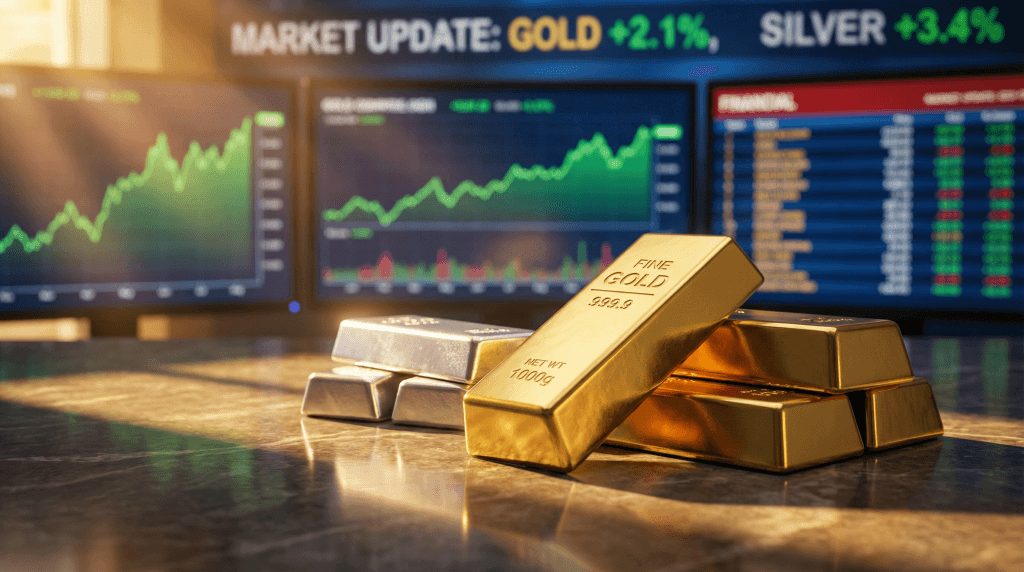
Precious Metals Hit Historic Highs as Rally Accelerates
Gold has surged to a record $4,576.80, and silver has crossed the $75 mark in a powerful rally driven by escalating geopolitical tensions, a weakening U.S. dollar, and supply constraints. This surge has turned precious metals trading into one of finance's most profitable sectors, attracting both institutional and amateur investors.
Why it matters for investors: The historic precious metals rally reflects deep concerns about geopolitical stability and currency devaluation. With gold and silver reaching unprecedented levels, investors are seeking safe-haven assets amid uncertainty. The surge in bullion prices is creating significant opportunities in mining stocks and precious metals ETFs, while also signaling potential inflation concerns and dollar weakness that could impact broader portfolio positioning.
Santa Rally Drives S&P 500 Toward 7,000 Milestone
The S&P 500 and Dow Jones Industrial Average have reached all-time highs as the traditional year-end “Santa rally” takes hold, with the S&P 500 approaching the 7,000 milestone. The technology sector, led by gains in companies like Nvidia, continues to be a primary driver of this market momentum.
Why it matters for investors: The sustained equity rally into year-end demonstrates strong investor confidence and positive momentum heading into 2026. The S&P 500's approach to the psychologically significant 7,000 level, combined with broad market participation, suggests the bull market remains intact. Technology leadership, particularly in AI-related stocks, continues to drive gains, making this sector critical for portfolio performance.
Copper Hits Record High Amid Tariff Fears and Supply Concerns
The price of copper has surged past $12,000 per tonne, driven by concerns over potential tariffs and global supply shortages. This significant move in the industrial metal, often seen as an economic bellwether, signals strong demand expectations and anxieties about supply chain stability.
Why it matters for investors: Copper's record-breaking rally serves as a key economic indicator, often called “Dr. Copper” for its ability to predict economic health. The surge suggests expectations of robust industrial demand and potential supply constraints, which has implications for manufacturing stocks, infrastructure plays, and emerging market investments. The tariff concerns add a geopolitical dimension that could affect global trade and supply chains.
Dollar Heads for Worst Week Since June as Fed Policy Outlook Shifts
The U.S. dollar is on track for its worst weekly performance since June, influenced by mixed signals from the Federal Reserve regarding future interest rate policy. While some officials anticipate inflation to cool and rates to decline, others expect no cuts in the near future, creating uncertainty for the market.
Why it matters for investors: Dollar weakness has far-reaching implications across asset classes, boosting commodities (especially gold and oil), benefiting U.S. exporters, and affecting international investment returns. The divergent Fed commentary highlights ongoing uncertainty about the inflation trajectory and interest rate policy for 2026. Investors must navigate this uncertainty while positioning portfolios for potential rate cuts that could support risk assets, or a higher-for-longer scenario that would favor defensive positioning.
Big Tech Shifts $120 Billion in AI Data Center Debt Off Balance Sheets
Technology giants are increasingly using creative financing to move massive AI infrastructure debt, estimated at $120 billion, off their balance sheets. This trend is pushing U.S. corporate bond sales toward record levels and binding Wall Street more closely to the fortunes of the AI industry.
Why it matters for investors: This massive off-balance-sheet financing reveals both the scale of Big Tech's AI infrastructure buildout and the creative methods being used to fund it. The move has significant implications for tech stock valuations, corporate bond markets, and the broader AI investment thesis. Investors need to understand these financing structures and their risks, as Wall Street becomes increasingly tied to the success or failure of the AI revolution. The near-record corporate bond issuance also signals important dynamics in credit markets.