




Energy Week in Review
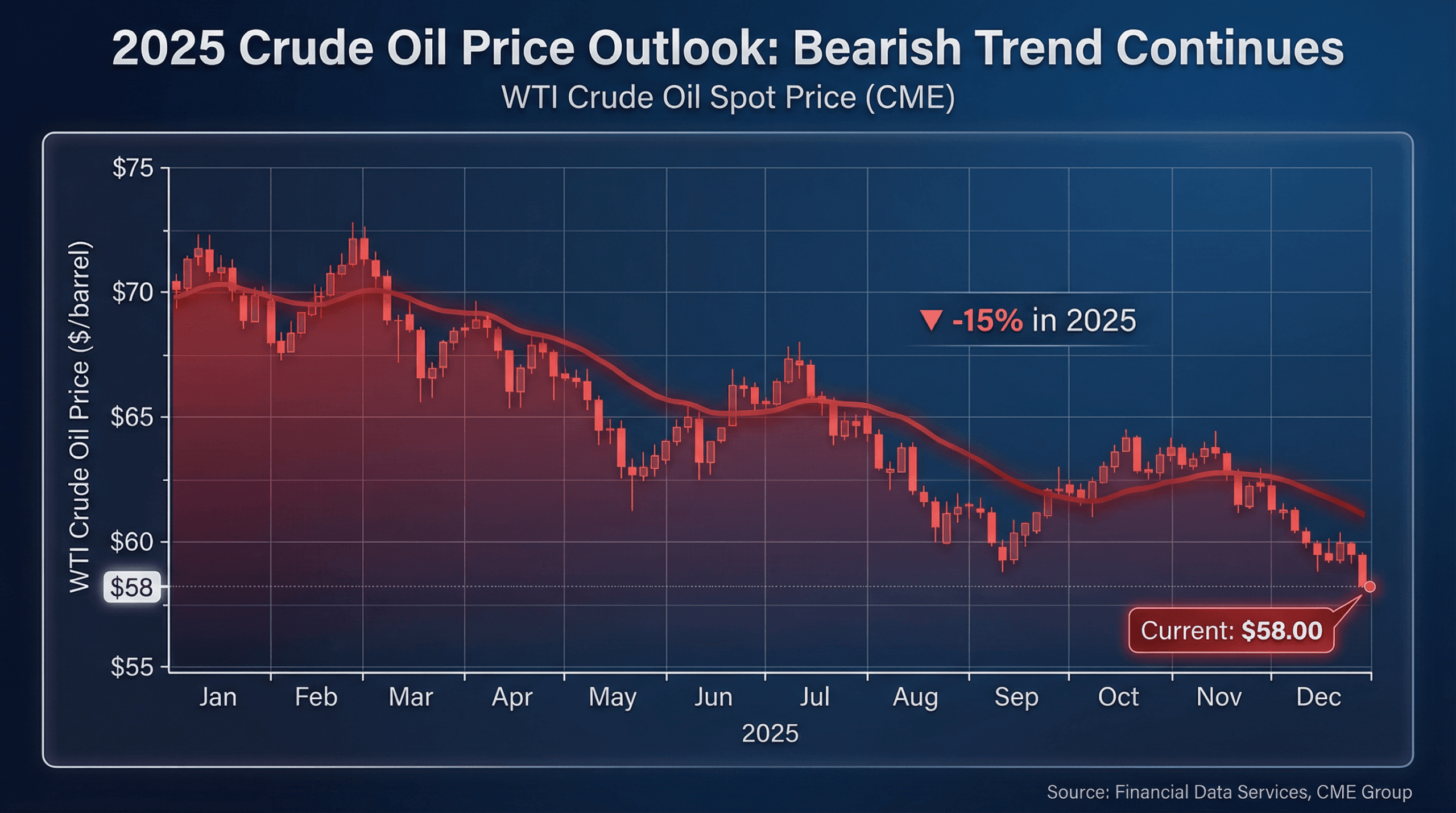
The final week of 2025 saw the energy sector at a crossroads, defined by persistent oversupply in oil markets, a surge in natural gas prices due to cold weather, and unabated momentum in renewable energy. Crude oil prices remained under pressure, with Brent crude on track for its longest stretch of annual losses in recent memory, falling over 15% in 2025 as supply consistently outpaced demand. West Texas Intermediate (WTI) crude hovered around $58 per barrel, reflecting the broader market sentiment. In contrast, natural gas prices experienced a significant uptick, driven by a cold snap across the United States, with the January 2026 contract climbing to $4.43. The renewable energy sector, particularly solar and battery storage, continued its remarkable growth trajectory, closing out a year of record-breaking capacity additions. This divergence between legacy and clean energy markets highlights the complex transition underway, presenting both challenges and opportunities for investors as the new year approaches.
Oil & Natural Gas Markets
Crude oil markets concluded 2025 on a bearish note, with prices struggling to find a floor amid a global supply glut. WTI crude futures for February delivery settled around $58.00 per barrel, while Brent, the international benchmark, faced its most significant annual decline since the 2020 pandemic, dropping by 17%. The primary driver of this weakness has been the persistent imbalance between supply and demand. Non-OPEC+ producers, particularly the United States, have ramped up production, while global demand growth has been softer than anticipated. In response, OPEC+ is widely expected to maintain its current production pause through the first quarter of 2026, a decision likely to be confirmed at their upcoming meeting. However, this move is seen as insufficient to meaningfully tighten the market in the near term. Natural gas, on the other hand, has been a story of weather-driven volatility. A blast of cold weather across the U.S. sent prices soaring, with the prompt-month contract gaining ground. The U.S. Energy Information Administration (EIA) has also raised its 2025 production forecast, indicating a robust supply landscape that will continue to influence prices.
Investment implications: The current oil market environment favors companies with low production costs and strong balance sheets that can weather a period of depressed prices. The oversupply situation may continue to weigh on exploration and production (E&P) companies, while midstream operators with fee-based contracts could offer more stability. For natural gas, the short-term outlook is bullish due to winter demand, but the longer-term picture will depend on production levels and weather patterns. Investors should watch for opportunities in companies with exposure to both oil and gas, as well as those with a growing presence in liquefied natural gas (LNG) exports.
Renewable Energy Developments
The renewable energy sector was a beacon of growth in 2025, with solar and battery storage leading the charge. Solar energy has now been the largest source of new U.S. generating capacity for 25 consecutive months, with total utility-scale solar capacity expanding from 91.82 GW to 158.43 GW in that period. In September 2025 alone, solar accounted for a staggering 98% of new U.S. electrical generating capacity. Wind energy also posted strong growth, adding 11.7 GW of new capacity over the past two years, outpacing natural gas. The most remarkable story of 2025, however, may be the rise of battery storage. U.S. installed battery storage capacity surpassed 39 GW, a 43% increase from 2024, and is projected to reach 204 GW in the coming years. This growth is critical for grid stability and will enable further penetration of intermittent renewable energy sources. The EIA now forecasts that all net new generating capacity in 2026 may come from renewables and battery storage, a testament to the sector's unstoppable momentum.
Investment implications: The rapid growth of renewable energy and battery storage presents a compelling long-term investment thesis. Companies involved in the solar and wind supply chains, from manufacturing to installation, are well-positioned for continued expansion. The battery storage market, in particular, is poised for exponential growth, offering opportunities in battery manufacturers, technology providers, and project developers. As the clean energy transition accelerates, investors should also consider companies focused on green hydrogen and other emerging technologies. The recent policy shifts have created some uncertainty, but the underlying economic and environmental drivers of renewable energy remain firmly in place.
Energy Stocks & Investment Opportunities
Despite the challenging commodity price environment, several energy stocks demonstrated resilience and offered attractive investment opportunities in the final week of 2025. In the traditional oil and gas space, Occidental Petroleum (OXY), Diamondback Energy (FANG), and Devon Energy (DVN) were top performers, with gains of 2.6%, 2.2%, and 1.8% respectively on December 30th. These companies have benefited from their operational efficiency and strategic asset positioning. Dividend-paying stocks also remained a focus for income-oriented investors. NextEra Energy (NEE) and TotalEnergies (TTE) were highlighted as attractive high-yield opportunities, while Northern Oil & Gas (NOG) was recognized for its impressive 8.22% dividend yield. The Energy Select Sector SPDR ETF (XLE) has outperformed crude oil in 2025 and is rated a Hold for 2026, supported by a 3.12% yield and an attractive P/E ratio. However, investors should remain cautious, as some energy stocks are showing signs of being overbought, with high Relative Strength Index (RSI) levels that could signal a potential correction.
Investment implications: A selective approach is crucial in the current energy market. Investors should focus on companies with strong fundamentals, including low debt levels, positive cash flow, and a commitment to shareholder returns through dividends and buybacks. The divergence between oil and gas prices suggests that a balanced portfolio with exposure to both commodities may be prudent. For those with a higher risk tolerance, beaten-down exploration and production companies could offer significant upside if oil prices recover. The renewable energy sector, while facing some policy headwinds, continues to offer compelling long-term growth prospects.
Week Ahead for Energy
The first week of 2026 will be critical for the energy markets, with several key catalysts on the horizon. The most immediate focus will be the OPEC+ meeting, where the cartel is expected to formalize its decision to maintain the current production pause. While this outcome is largely priced in, any deviation from the plan could trigger significant market volatility. The EIA will also be in the spotlight as it launches its new information release system on January 7th for its weekly petroleum and natural gas storage reports. The first crude oil inventory report of the new year will be closely watched, with forecasts pointing to a draw of 2.0 million barrels. The ongoing cold weather in the U.S. will continue to be a major driver for natural gas prices, and traders will be monitoring weather forecasts closely. As Q1 2026 earnings season approaches, investors will begin to shift their focus to individual company performance, with a particular emphasis on production guidance and capital expenditure plans for the year ahead.
Investment implications: The week ahead is likely to be characterized by heightened volatility as the market digests the OPEC+ decision and the latest inventory data. Traders should be prepared for sharp price swings in both oil and natural gas. Long-term investors should use any market weakness as an opportunity to add to positions in high-quality energy companies. The upcoming earnings season will provide a clearer picture of how companies are navigating the current market environment and their outlook for 2026. As always, a diversified portfolio and a disciplined investment approach are essential for success in the dynamic energy sector.
Disclaimer: This article is for informational purposes only and should not be considered investment advice. The energy markets are highly volatile, and investors should conduct their own research and consult with a qualified financial advisor before making any investment decisions. The author and publisher are not responsible for any losses that may be incurred as a result of relying on the information contained in this article.