



Market Overview
Global financial markets experienced significant turbulence on Monday, March 2, 2026, as investors reacted to a major geopolitical shock following extensive U.S. and Israeli military strikes on Iran over the weekend. The escalation, which resulted in the death of Iran's Supreme Leader Ayatollah Ali Khamenei, sent shockwaves through risk assets and triggered a massive flight to safety.
U.S. equity futures plunged in pre-market trading, signaling a sharply lower open for Wall Street. Dow Jones Industrial Average futures tumbled 1.6%, shedding over 800 points. S&P 500 futures sank 1.7%, while the tech-heavy Nasdaq 100 futures dived 2.0%. The Russell 2000 futures also retreated by 1.72%, indicating broad-based weakness across both large-cap and small-cap equities.
The overall market sentiment has shifted dramatically from cautious optimism to risk-aversion. This geopolitical crisis compounds an already uneasy environment for equities, as the S&P 500 and Nasdaq both closed February in negative territory amid renewed volatility in artificial intelligence and software stocks. The primary theme dominating trading desks today is the potential for a broader regional conflict in the Middle East and its immediate impact on global energy supplies and inflation trajectories.
Sector performance is highly polarized. Energy and defense sectors are seeing massive inflows, while travel, leisure, and traditional risk assets are facing intense selling pressure. The volatility index (VIX) has spiked significantly, reflecting heightened anxiety among market participants.
Top Market Movers
1. Crude Oil Prices Surge on Supply Disruption Fears
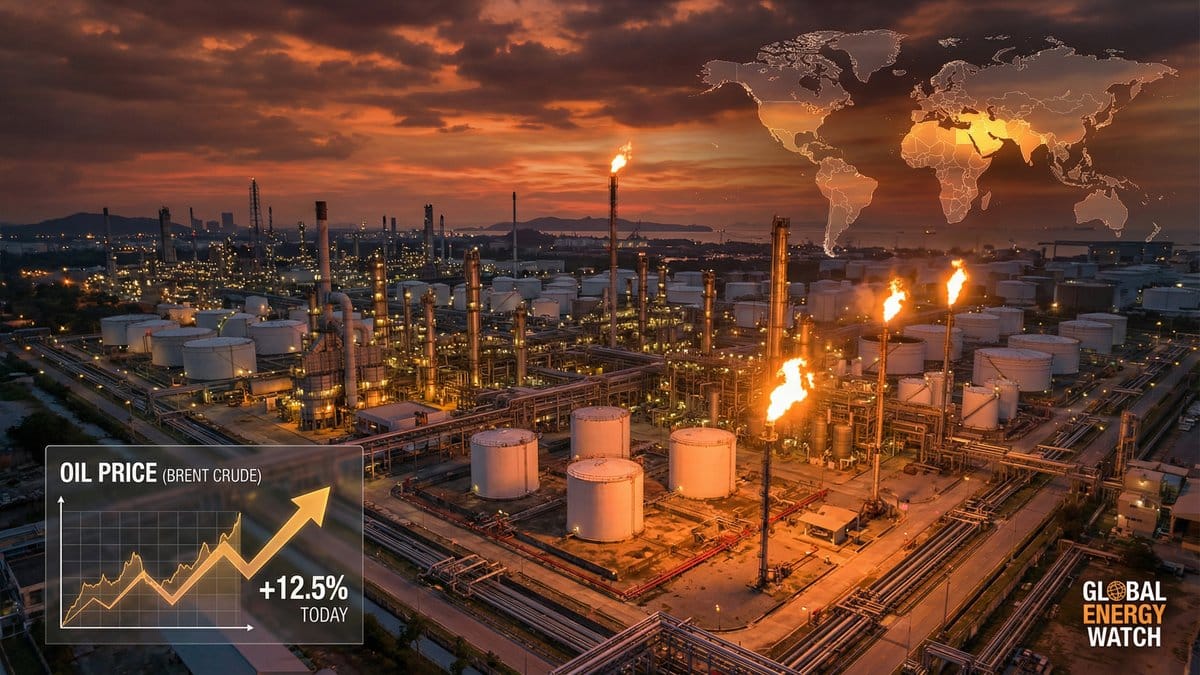
Oil markets reacted violently to the Middle East escalation. Brent crude futures, the international benchmark, initially surged 13% to trade above $82 per barrel before moderating to around $79.69, still up over 9%. U.S. West Texas Intermediate (WTI) crude jumped approximately 9% to cross the $73 mark. Iran is OPEC's fourth-largest producer, and traders are heavily pricing in the risk of disruptions to traffic through the Strait of Hormuz, the world's most critical chokepoint for crude flows.
Investment implications: The sharp rise in energy costs presents a dual threat to the broader market: it acts as a tax on consumers, potentially slowing economic growth, and threatens to reignite inflationary pressures just as central banks were considering policy easing. Energy sector equities, however, are positioned for significant short-term outperformance.
2. Gold Reaches Record Territory in Flight to Safety
Gold prices accelerated their historic rally as investors sought traditional safe-haven assets. Gold futures jumped 3.18% to top $5,414 an ounce, adding to a remarkable year-to-date gain of approximately 25%. The precious metal had already posted its seventh consecutive monthly gain in February—the longest such streak since 1973—driven by central bank buying and shifting global monetary policies.
Investment implications: Gold's continued strength underscores deep-seated concerns about geopolitical stability and currency debasement. It remains a critical portfolio hedge, though investors should be mindful of potential short-term pullbacks given the velocity of the recent ascent.
3. Defense and Aerospace Stocks Rally
European defense contractors saw immediate and substantial gains in early trading, a trend expected to carry over to U.S. defense primes. Companies like BAE Systems (+6.8%), Saab (+7%), and Leonardo (+6%) posted strong advances as the prospect of prolonged military engagement and increased global defense spending became apparent.
Investment implications: The defense sector is likely to see sustained institutional support as geopolitical risk premiums are repriced higher across the board. These stocks offer a defensive posture within equity allocations during periods of international conflict.
4. Travel and Leisure Equities Tumble
Airlines and cruise operators faced severe selling pressure due to a combination of surging jet fuel costs and widespread airspace disruptions in the Middle East. Major European carriers like International Consolidated Airlines and Lufthansa dropped over 6%, while cruise operator Carnival PLC shed 7.6%.
Investment implications: The travel sector faces immediate headwinds from both operational disruptions and margin compression due to higher energy input costs. Investors may want to reduce exposure to these highly cyclical and energy-sensitive names until the geopolitical situation stabilizes.
Economic Data & Fed Watch
While geopolitical events dominate the headlines, critical economic data remains in focus for monetary policy. The Federal Reserve held rates unchanged at its January meeting, and markets are currently pricing in two rate cuts for 2026, likely in July and October. However, the sudden inflationary shock from spiking oil prices complicates the Fed's path forward.
Federal Reserve Governor Christopher Waller recently indicated that the central bank's March rate decision will hinge heavily on upcoming employment data. The February Nonfarm Payrolls (NFP) report, due this Friday, is highly anticipated. Consensus expectations point to a gain of 60,000 jobs, a significant cooling from January's stronger-than-expected 130,000 print, with the unemployment rate expected to remain steady at 4.3%.
In the bond market, the flight to safety initially pressured yields, but inflation fears tied to oil prices have caused a reversal. The benchmark 10-year U.S. Treasury yield edged higher to 3.98%, while the U.S. Dollar Index appreciated by roughly 0.3% as international capital sought the safety of U.S. assets.
Investment implications: The Fed is now caught between a potential growth slowdown caused by geopolitical shock and renewed inflationary pressures from energy markets. This stagflationary risk scenario typically favors defensive sectors, commodities, and short-duration fixed income over long-duration growth equities.
International Markets
Global markets uniformly reflected the risk-off sentiment. In Europe, the pan-European Stoxx 600 opened down 1.8%, with major indices including Germany's DAX (-1.83%), France's CAC 40 (-1.74%), and the U.K.'s FTSE 100 (-0.88%) all trading firmly in negative territory. The only bright spots were oil and gas exporters, such as Norway's Equinor and Vår Energi, which both surged over 9%.
Asian markets experienced similar downward pressure. The Nikkei 225, Hang Seng, and ASX 200 all slumped, heavily weighed down by airline and logistics stocks reacting to Middle East airspace closures and the broader implications for global trade routes.
Currency markets saw the U.S. dollar and Swiss franc gain ground as traditional safe havens, while emerging market currencies tied to oil importers faced significant pressure.
Looking Ahead
The trajectory of the markets this week will be dictated primarily by developments in the Middle East, specifically any disruptions to the Strait of Hormuz and the scale of retaliatory actions. However, investors must also navigate a busy economic calendar.
Key data releases include the ISM Manufacturing PMI on Monday, which will provide insights into the health of the industrial sector following January's strong reading. Wednesday brings the ADP private employment report and the Fed's Beige Book, offering anecdotal evidence on regional economic conditions.
Corporate earnings will also command attention, with major reports scheduled from Broadcom (AVGO) on Wednesday, Marvell Technology (MRVL) on Thursday, and retail giants Target (TGT) and Costco (COST) on Friday. These reports will provide crucial updates on AI infrastructure spending and consumer resilience, respectively.
Disclaimer: This analysis is for informational and educational purposes only and should not be considered financial advice. Market conditions can change rapidly, and past performance does not guarantee future results. Always conduct your own research and consult with a qualified financial advisor before making investment decisions.