



Global financial markets are navigating a dramatically altered landscape as the fourth day of the U.S.-Israeli military conflict with Iran continues to reverberate across every asset class. Tuesday, March 3, 2026, opens with U.S. equity futures under significant pressure — S&P 500 futures are off 0.9%, Nasdaq 100 futures have declined 1.2%, and Dow Jones futures have shed approximately 428 points — as investors weigh the compounding risks of an oil supply shock, rising inflation expectations, and sustained geopolitical uncertainty. Monday's session offered a preview of the bifurcated market that is emerging: while the broader S&P 500 eked out a fractional gain of 0.1% and the Nasdaq Composite recovered to close up 0.4%, the Dow Jones Industrial Average slipped 0.2%, masking the dramatic intraday swings that characterized the session.

Market Overview
Monday's close left major U.S. indices in mixed territory, a deceptively calm surface concealing intense volatility beneath. The S&P 500 added approximately 36 points (+0.1%) to close near the 5,750 level, while the Nasdaq Composite recovered from a steep morning decline of as much as 1.6% to finish up 0.4%. The Dow Jones Industrial Average shed roughly 73 points (-0.2%), weighed down by its more cyclical and consumer-facing components. The Russell 2000 small-cap index also posted modest gains, reflecting some resilience in domestically focused businesses less exposed to global supply chain disruptions.
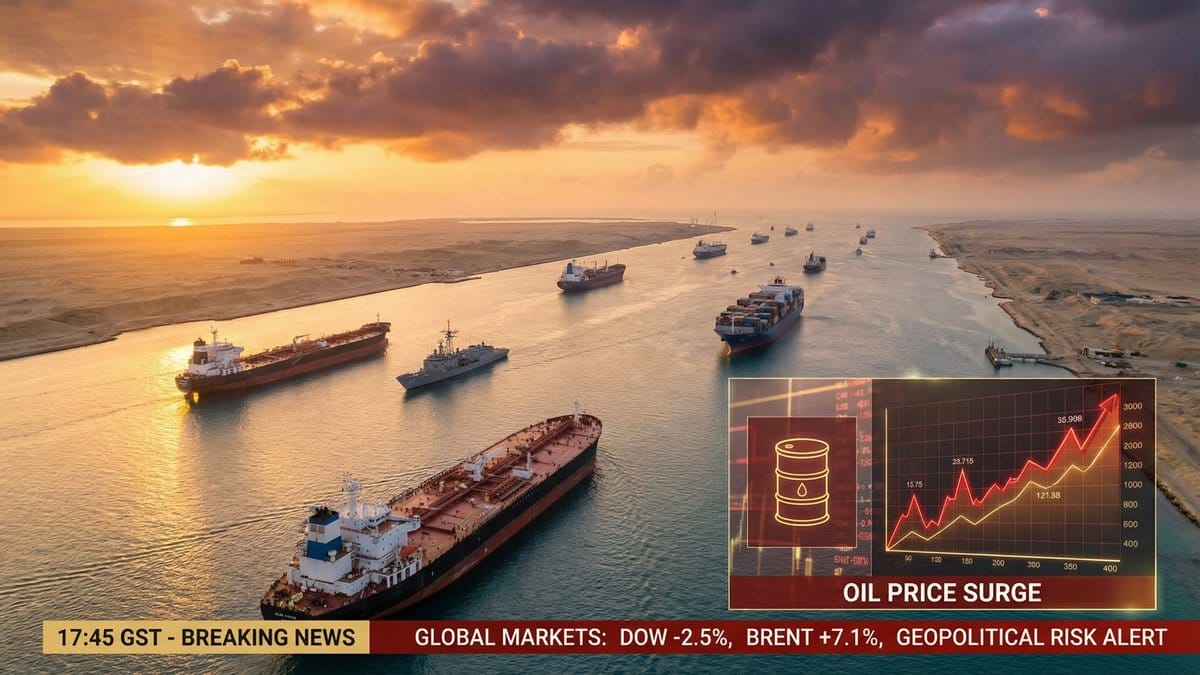
The dominant theme driving markets is the escalating military conflict in the Middle East. Early Saturday, a U.S.-Israeli strike killed Iran's Supreme Leader, Ali Khamenei, triggering a wave of Iranian retaliation against Israeli and American interests across the region. President Trump confirmed on Sunday that U.S. combat operations in Iran would continue for several more weeks. The most alarming development came late Monday when Iranian state media claimed the Strait of Hormuz — through which approximately 20% of the world's oil supply transits — had been closed, with Iran threatening to set fire to any vessel attempting passage.
Sector performance was sharply divided. Energy and defense stocks surged as the primary beneficiaries of the conflict, while travel-related sectors — airlines and cruise lines — bore the brunt of selling pressure. Technology stocks showed mixed results, with the broader sector facing headwinds from rising Treasury yields and AI valuation concerns, even as select names like Nvidia rebounded from recent losses.
| Index | Monday Close Change | Tuesday Pre-Market |
|---|---|---|
| S&P 500 | +0.1% (+36 pts) | Futures -0.9% |
| Dow Jones Industrial Average | -0.2% (-73 pts) | Futures -428 pts (-0.9%) |
| Nasdaq Composite | +0.4% | Futures -1.2% |
| Russell 2000 | Modest gain | Under pressure |
Top Market Movers
Defense Contractors Lead the S&P 500 Higher. Defense and government-services companies were the standout performers of Monday's session. Northrop Grumman (NOC) surged 6.0% to lead the S&P 500, followed by RTX Corporation (RTX) with a gain of 4.7% and Lockheed Martin (LMT) up 3.4%. Palantir Technologies (PLTR), the data analytics firm with deep ties to U.S. defense and intelligence agencies, jumped 5.8% and ranked among the biggest gainers in both the S&P 500 and Nasdaq. The collective message from markets is unambiguous: investors are pricing in a prolonged military engagement that will require sustained procurement of advanced weapons systems, surveillance technology, and logistical support.
Investment implications: Defense sector outperformance is likely to persist as long as the conflict continues. Investors may consider the iShares U.S. Aerospace & Defense ETF (ITA) or the SPDR S&P Aerospace & Defense ETF (XAR) for diversified exposure. However, valuations have moved sharply higher in a short period, and any de-escalation signals could trigger rapid profit-taking.
Energy Stocks Surge on Oil Price Spike. West Texas Intermediate crude oil futures surged 8% on Monday to $72.50 per barrel as the Strait of Hormuz closure threat sent shockwaves through global energy markets. U.S. oil majors were immediate beneficiaries: Exxon Mobil (XOM) and Chevron (CVX) each advanced more than 1%, while Occidental Petroleum (OXY) gained 2% and Phillips 66 (PSX) climbed 3.8%. With Iran threatening to disrupt one of the world's most critical chokepoints for oil transit, energy analysts are warning that sustained closure — even a partial one — could push WTI toward $90 or higher, with significant implications for global inflation.
Investment implications: The energy sector is positioned as a near-term hedge against geopolitical risk. However, investors should note that oil price spikes driven by supply disruptions tend to be mean-reverting once tensions ease. The broader inflationary impact of elevated oil prices could paradoxically weigh on energy-consuming sectors and the overall equity market. Monitoring the actual status of Strait of Hormuz shipping lanes will be critical in the coming days.
Travel and Leisure Stocks Collapse. The inverse of the defense and energy trade played out brutally in travel-related equities. Cruise line operators suffered the most severe losses: Norwegian Cruise Line Holdings (NCLH) plunged 10.5%, Carnival Corporation (CCL) fell 7.6%, and Royal Caribbean Group (RCL) declined 3.3%. Major U.S. airlines also sold off sharply, with American Airlines Group (AAL) falling 4.4%, Delta Air Lines (DAL) down 2.2%, and United Airlines Holdings (UAL) shedding 2.4%. The combination of surging jet fuel costs, potential route disruptions through Middle Eastern airspace, and a broader pullback in consumer risk appetite created a perfect storm for the sector.
Investment implications: The travel sector faces a dual headwind of higher fuel costs and weakened consumer confidence. Near-term recovery is unlikely without clear signals of conflict de-escalation. Investors with existing positions may consider hedging strategies or reducing exposure until the geopolitical outlook clarifies.
Nvidia Rebounds Despite Broader Tech Pressure. Nvidia (NVDA) shares rebounded nearly 3% on Monday, recouping a portion of the 5.5% and 4.0% declines suffered in the prior two sessions — losses that came despite the company reporting blockbuster quarterly results. The rebound suggests that long-term investors view the recent pullback as an overreaction, particularly given Nvidia's dominant position in AI accelerator chips. However, Tuesday's pre-market data shows NVDA down 2.58%, reflecting renewed pressure as broader risk-off sentiment returns. Gold futures advanced nearly 2% to $5,335 per ounce, approaching their late-January record above $5,625, as investors sought safe-haven assets.
Investment implications: Nvidia's volatile price action underscores the tension between strong fundamental performance and elevated valuation multiples in an uncertain macro environment. Gold's renewed advance signals that institutional investors are actively rotating into safe-haven assets, a trend that may continue if the conflict escalates further.
Economic Data & Fed Watch
The macroeconomic backdrop entering this week was already complex before the Middle East conflict added a new layer of uncertainty. Markets closed last week digesting mixed signals: the January Producer Price Index showed final demand prices rising 2.9% year-over-year, indicating that inflation progress, while ongoing, remains incomplete. The Federal Reserve's preferred inflation metrics have been trending in the right direction, but not quickly enough to justify near-term rate cuts, and the new geopolitical shock threatens to reverse some of that progress through elevated energy prices.
The Federal Open Market Committee's next meeting is scheduled for March 17–18, and CME FedWatch data currently assigns a high probability to a policy hold. Fed Chair Jerome Powell and his colleagues have consistently emphasized a data-dependent approach, and the February Employment Situation report — due Friday, March 6 — will be the most important data point before that meeting. Analysts will scrutinize payroll growth, wage inflation, and labor force participation for signals about whether the labor market is cooling sufficiently to warrant a more accommodative stance. A softer jobs report could ease front-end yields and revive rate-cut expectations; a strong report would reinforce the higher-for-longer narrative.
This week also brings the ISM Services PMI on Wednesday, March 4, following Monday's ISM Manufacturing release, and the Fed's Beige Book — a qualitative survey of regional economic conditions — also due Wednesday. The 10-year Treasury yield rose sharply on Monday to 4.05% from 3.95% at Friday's close, reflecting both the inflationary implications of higher oil prices and a flight from risk assets. The U.S. Dollar Index strengthened 1% to 98.56, as investors sought the safety of the world's reserve currency. Bitcoin, which had fallen as low as $63,000 in the immediate aftermath of Saturday's strikes, recovered to $69,200 by Monday's close.
Investment implications: The combination of rising oil prices, a stronger dollar, and elevated Treasury yields creates a challenging environment for equities broadly. If energy prices remain elevated heading into the March FOMC meeting, the Fed may face renewed pressure to maintain its restrictive stance even as growth concerns mount — a stagflationary scenario that historically has been particularly damaging for risk assets. Investors should monitor the 10-year yield closely; a sustained move above 4.25% could trigger broader equity selling.
International Markets
Asian equity markets bore the brunt of the overnight selling, with South Korea's KOSPI index suffering the most dramatic losses — plunging 7.2% in what analysts described as the worst single-day decline for the index since the early days of the COVID-19 pandemic. South Korea's market had been closed on Monday for a national holiday, meaning Tuesday's session absorbed two days of geopolitical shock simultaneously. Japan's Nikkei 225 fell 3.1%, and Asian shares broadly declined 2.9%, marking the worst two-day slump for the region since April 2025. China's Shanghai Composite also declined, though losses were more contained as Chinese authorities signaled readiness to deploy stabilization measures if necessary.
European markets opened sharply lower on Tuesday morning. The UK's FTSE 100 fell 1.2% to 1.5%, Germany's DAX declined 2.1% to 2.56%, and France's CAC 40 shed 1.8% to 2.17%. European markets are particularly sensitive to energy price shocks given the continent's higher dependence on imported oil and natural gas. The euro weakened against the dollar as investors priced in the potential for stagflationary pressures across the eurozone. Gulf stock exchanges remained closed following the initial strikes, adding to the uncertainty about the full extent of regional financial market disruption.
| Market | Performance (March 3) | Key Driver |
|---|---|---|
| South Korea KOSPI | -7.2% | Catching up after Monday holiday; Iran shock |
| Japan Nikkei 225 | -3.1% | Risk-off, yen strengthening |
| Germany DAX | -2.1% to -2.56% | Energy exposure, inflation fears |
| France CAC 40 | -1.8% to -2.17% | Geopolitical risk premium |
| UK FTSE 100 | -1.2% to -1.5% | Energy offset partially by BP, Shell gains |
Looking Ahead
The remainder of the week is packed with market-moving events that will compete for investor attention alongside the ongoing geopolitical developments. On the earnings front, Tuesday's pre-market session features results from AutoZone (AZO), Target Corporation (TGT), Sea Limited (SE), Viking Holdings (VIK), On Holding (ONON), and Best Buy (BBY). Target's results will be particularly closely watched given the current consumer spending environment and the company's recent leadership transition. AutoZone is trading up 3.38% in pre-market, suggesting the market may already be pricing in a beat. Later in the week, Broadcom (AVGO), CrowdStrike (CRWD), and Berkshire Hathaway (BRK.A/BRK.B) are among the most anticipated reports.
On the economic calendar, the ISM Services PMI on Wednesday will provide a timely read on the health of the dominant services sector of the U.S. economy. The Fed's Beige Book, also due Wednesday, will offer qualitative color on regional economic conditions and could influence expectations ahead of the March 17–18 FOMC meeting. Friday's February Employment Situation report is the week's most consequential data release — consensus estimates call for approximately 175,000 non-farm payrolls and a steady unemployment rate near 4.1%, though the geopolitical backdrop makes forecasting particularly difficult.
Beyond the scheduled calendar, the most important variable remains the trajectory of the Middle East conflict. Any credible signals of ceasefire negotiations or de-escalation could trigger a sharp reversal in the current defensive positioning, with energy and defense stocks potentially giving back gains while airlines, cruise lines, and technology names rebound. Conversely, any escalation — particularly if the Strait of Hormuz closure is confirmed or extended — could push oil prices significantly higher and deepen the equity market correction. Investors should maintain diversified portfolios and consider the role of commodities, particularly gold and energy, as portfolio hedges in the current environment.
Disclaimer: This analysis is for informational and educational purposes only and should not be considered financial advice. Market conditions can change rapidly, and past performance does not guarantee future results. Always conduct your own research and consult with a qualified financial advisor before making investment decisions.