



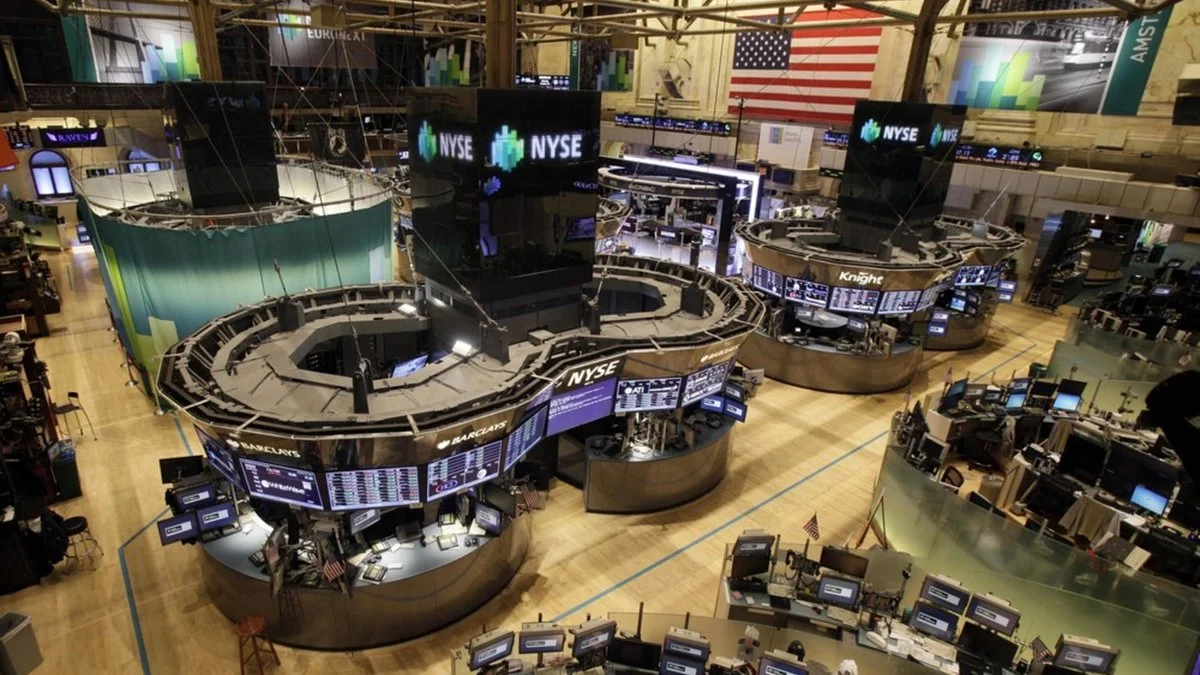
U.S. equity markets closed in mixed fashion on Monday, May 18, 2026, as investors navigated a complex backdrop of easing geopolitical tensions, persistent bond market stress, and heightened anticipation ahead of Nvidia's closely watched earnings report scheduled for Wednesday. The S&P 500 slipped a marginal 5.45 points, or 0.07%, to close at 7,403.05, while the Dow Jones Industrial Average bucked the trend with a gain of 159.95 points, or 0.32%, finishing at 49,686.12. The Nasdaq Composite bore the brunt of technology sector weakness, falling 134.41 points, or 0.51%, to 26,090.73. The small-cap Russell 2000 declined 0.65%, and the CBOE Volatility Index (VIX) edged up 0.45% to close at 17.90, reflecting modest but persistent investor unease.
Market Snapshot: Monday, May 18, 2026
| Index | Close | Change | % Change |
|---|---|---|---|
| S&P 500 | 7,403.05 | -5.45 | -0.07% |
| Dow Jones Industrial Average | 49,686.12 | +159.95 | +0.32% |
| Nasdaq Composite | 26,090.73 | -134.41 | -0.51% |
| Russell 2000 | 2,775.10 | — | -0.65% |
| VIX (Fear Index) | 17.90 | — | +0.45% |
Geopolitics: Iran-U.S. Tensions Ease, Oil Retreats
The most significant macro development of the session was the de-escalation of the Iran-U.S. standoff that had rattled markets last week. President Trump announced he had called off a scheduled military strike against Iran, with the White House confirming that the two nations are engaged in “serious negotiations.” Iran, for its part, has demanded compensation for war-related damage and an end to the U.S. naval blockade as preconditions for any formal agreement. While the news provided some relief to equity markets, oil prices remained elevated as traders assessed the durability of the diplomatic overture. Brent crude fell 1.96% to $109.90 per barrel, and WTI crude declined 1.20% to $103.13 per barrel, still well above levels that would be considered comfortable for inflation-sensitive sectors of the economy.
Bond Market Stress: 30-Year Yield Hits 2007 High
The bond market continued to send a stark warning to policymakers and equity investors alike. The 30-year Treasury yield climbed to 5.15%, its highest level since July 2007, while the 10-year Treasury yield rose to 4.623%, the highest since February 2025. These elevated yields reflect persistent inflation concerns, a heavy U.S. debt issuance calendar — with an estimated $8 trillion in federal debt maturing this year — and growing uncertainty about the Federal Reserve's policy path under newly confirmed Chair Kevin Warsh. The bond market's message is unambiguous: inflation remains sticky, and rate cuts are not imminent. This dynamic continued to weigh on rate-sensitive sectors, including technology and real estate, even as defensive and energy names outperformed.
| Treasury Instrument | Yield | Change |
|---|---|---|
| 13-Week T-Bill | 3.568% | — |
| 5-Year Treasury Note | 4.280% | +0.52% |
| 10-Year Treasury Note | 4.623% | +0.61% |
| 30-Year Treasury Bond | 5.150% | +0.37% |
Sector Performance: Energy Leads, Technology Lags
Sector rotation was evident on Monday, with defensive and commodity-linked sectors outperforming while technology continued to face headwinds. Energy was the clear standout, surging +1.64% on the session and extending its year-to-date lead to an impressive +31.51%, driven by elevated crude oil prices and strong earnings from major producers. Consumer Defensive stocks gained +1.34%, and Real Estate advanced +1.23% as investors sought yield alternatives. Financial Services added +0.94%, buoyed by the steeper yield curve. On the downside, Technology fell -1.03%, weighed down by pre-earnings caution surrounding Nvidia and broader concerns about stretched valuations in the sector. Industrials slipped -0.46% and Basic Materials declined -0.48%.
| Sector | Monday Change | YTD Performance |
|---|---|---|
| Energy | +1.64% | +31.51% |
| Consumer Defensive | +1.34% | +12.23% |
| Real Estate | +1.23% | +8.81% |
| Financial Services | +0.94% | -3.26% |
| Communication Services | +0.23% | +9.79% |
| Healthcare | +0.17% | -0.56% |
| Consumer Cyclical | -0.15% | +1.69% |
| Industrials | -0.46% | +16.81% |
| Basic Materials | -0.48% | +16.49% |
| Technology | -1.03% | +16.68% |
Notable Stock Movers
Accenture (ACN) was among the session's standout performers, surging +5.17% to $177.55 after reporting a strong Q2 FY2026 earnings beat that underscored resilient enterprise technology spending. Zscaler (ZS) advanced +8.47% to $174.69, reflecting robust demand for cloud-native cybersecurity solutions. Roblox (RBLX) gained +9.64%, and monday.com (MNDY) rose +8.43%, both benefiting from positive sentiment in the software-as-a-service space. Boston Scientific (BSX) climbed +6.15% on strong procedural volume data.
On the negative side, Hims & Hers Health (HIMS) tumbled approximately -11% after the telehealth company announced a $350 million convertible note offering to fund international expansion and artificial intelligence investment, while simultaneously slashing its profitability outlook due to the ongoing transition in its GLP-1 weight-loss drug business. NextEra Energy (NEE) fell -4.63% to $89.04 following the announcement of its $67 billion acquisition of Dominion Energy, a deal that raised concerns about balance sheet leverage and integration risk. Plug Power (PLUG) dropped -8.73%, and Ford Motor (F) fell -2.76%.
Nvidia (NVDA) closed at $222.29, down -1.34%, as investors positioned cautiously ahead of the company's Q1 FY2027 earnings report due Wednesday after the close. Analysts expect earnings per share of approximately $1.76–$1.77 on revenue of roughly $78.75 billion, which would represent extraordinary year-over-year growth driven by insatiable demand for AI accelerator chips. Intel (INTC) remained one of the most actively traded names, closing at $108.24 with volume exceeding 132 million shares.
Commodities and Currencies
Gold held near record territory, adding a modest +0.05% to close at $4,560.10 per troy ounce, supported by geopolitical uncertainty and continued central bank buying. Silver retreated -0.90% to $76.75. Copper fell -0.56% to $6.28, reflecting concerns about global industrial demand. Platinum edged up +0.14% to $1,980.10. In the currency markets, the U.S. Dollar Index was little changed at 99.13 (-0.07%). The euro slipped to 1.1637 against the dollar, while the Japanese yen weakened to 159.04 per dollar, maintaining pressure on the Bank of Japan to consider further policy normalization.
International Markets
European equities outperformed their U.S. counterparts on Monday, with the German DAX gaining +1.31% to 24,626.99 and the French CAC 40 rising +0.99% to 8,066.22. The EURO STOXX 50 advanced +0.95% and the FTSE 100 in London added +0.65% to close above 10,390. In Asia, the Nikkei 225 fell -0.44% to 60,550.59, while the Hang Seng in Hong Kong gained +0.41% and China's SSE Composite rose +0.92% to 4,169.54. South Korea's KOSPI was the notable laggard, declining -3.25% amid domestic political and economic concerns. Australia's S&P/ASX 200 advanced +1.17%.
Pre-Market Outlook: Tuesday, May 19, 2026

As of early Tuesday morning, U.S. equity futures are pointing to a modestly positive open. S&P 500 futures are trading at approximately 7,430.75 (+0.07%), Dow futures are at 49,832.00 (+0.13%), and Nasdaq futures are at 29,111.25 (+0.05%). Russell 2000 futures are up 0.18% to 2,787.80. The mild optimism reflects some relief from the Iran-U.S. diplomatic progress, though investors remain cautious given the elevated yield environment and the pivotal Nvidia earnings event on Wednesday.
The economic calendar for Tuesday includes the Pending Home Sales Index for April at 10:00 AM EDT, which will provide a timely read on housing market momentum. The prior reading was 73.7, and any significant deviation from expectations could move rate-sensitive sectors. Investors will also be monitoring commentary from Federal Reserve officials for any signals about the policy outlook under new Chair Kevin Warsh, who faces the difficult task of balancing a president eager for lower rates against an inflation backdrop that remains stubbornly above the Fed's 2% target.
Key Events This Week
| Date | Event | Significance |
|---|---|---|
| Tuesday, May 19 | Pending Home Sales Index (10:00 AM EDT) | Housing market health indicator |
| Wednesday, May 20 | FOMC Meeting Minutes (Powell's final meeting) | Insight into Fed's internal rate debate |
| Wednesday, May 20 | Nvidia (NVDA) Q1 FY2027 Earnings (after close) | AI demand bellwether; expected $78.75B revenue |
| Thursday, May 21 | Weekly Jobless Claims | Labor market health check |
| Friday, May 22 | Preliminary PMI Readings (May) | Business activity and inflation gauge |
The most consequential event of the week will undoubtedly be Nvidia's earnings report on Wednesday evening. With the stock having recovered sharply from its April lows and now trading above $220, the bar for a positive reaction is high. Analysts at Morgan Stanley and elsewhere have maintained bullish price targets, citing the relentless demand for Nvidia's Blackwell architecture chips from hyperscale cloud providers and enterprise AI deployments. A beat-and-raise quarter could reignite the technology sector and potentially push the S&P 500 back toward record territory. A disappointment, however, could trigger a broader risk-off move given the elevated valuations across the AI supply chain.
Also on Wednesday, the FOMC Meeting Minutes from Jerome Powell's final meeting as Fed Chair will be released. Given the historic level of dissent at the April meeting — with three FOMC voters objecting to language implying the next move would be a rate cut — these minutes are expected to provide important context on the internal debate within the committee regarding the inflation outlook and the future path of interest rates. Markets will scrutinize the language around forward guidance and any signals about how new Chair Kevin Warsh may approach monetary policy differently from his predecessor.
Geopolitically, the Iran-U.S. negotiations remain a key wildcard. Any breakdown in talks could reignite oil price volatility and risk-off sentiment across global markets, while a formal ceasefire or framework agreement could provide a meaningful tailwind for equities and put further downward pressure on energy prices. Investors should also monitor developments in the U.S. Treasury market, where the 30-year yield at 5.15% is approaching levels that have historically prompted equity market dislocations.
Disclaimer: This article is for informational purposes only and should not be considered financial advice. Market conditions can change rapidly, and past performance does not guarantee future results. Always conduct your own research and consider consulting with a qualified financial advisor before making investment decisions.